“Why Chiller Capacity Isn’t as Simple as It Seems” by “Mike Shupe” “Thermal Care”
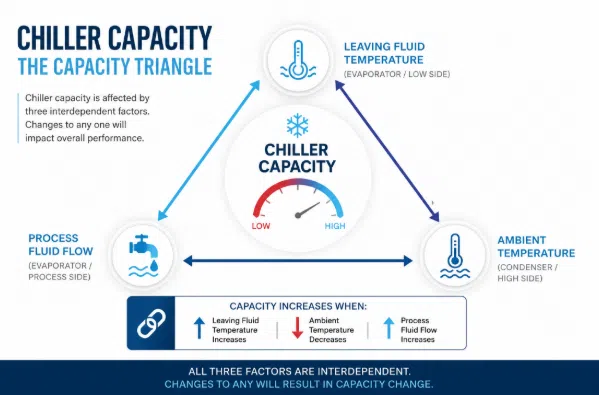
A simple way to understand this is through what we at Thermal Care call the “Chiller Capacity Triangle.” Much like the exposure triangle in photography, three main factors work together to determine how much cooling a chiller can actually provide. These three factors are Saturated Suction Temperature (SST), Saturated Discharge Temperature (SDT), and Process Fluid Flow. Changing one side of the triangle affects the other two, and ultimately changes the chiller’s capacity and efficiency.
Saturated Suction Temperature, or SST, is connected to the evaporator side of the refrigeration system. In simple terms, SST is closely related to the leaving fluid temperature coming out of the chiller. If a process requires very cold fluid, such as low-temperature glycol, the SST must also be lower. The lower the SST becomes, the harder the compressor has to work. As compressor workload increases, cooling capacity often decreases and electrical power consumption increases. On the other hand, a higher SST usually allows the compressor to operate more efficiently and deliver better capacity.
Saturated Discharge Temperature, or SDT, is connected to the condenser side of the system. On an air-cooled chiller, SDT is heavily influenced by the outdoor ambient air temperature. On a water-cooled chiller, it is related to the temperature of the condenser water entering the system. A chiller operating on a mild 75°F day will usually perform much better than the same machine operating on a 100°F day. Higher SDT increases the compressor’s workload, which reduces efficiency and lowers cooling capacity. Lower SDT generally improves system performance and reduces electrical usage.
The third side of the triangle is process fluid flow. Flow refers to how much water or glycol moves through the system, usually measured in gallons per minute (GPM). Proper flow is important because it allows heat to transfer effectively from the process into the refrigeration system. If flow is too low, heat transfer suffers and cooling performance drops. Properly optimized flow helps stabilize temperatures, improve heat transfer, and maximize available capacity.
Chiller capacity INCREASES:
When flow increases while leaving fluid temperature and ambient temperature remain constant.
When leaving fluid temperature increases while flow and ambient temperature remain constant.
When ambient temperature decreases while flow and leaving fluid temperature remain constant.
Chiller capacity DECREASES:
When flow decreases while leaving fluid temperature and ambient temperature remain constant.
When leaving fluid temperature decreases while flow and ambient temperature remain constant.
When ambient temperature increases while flow and leaving fluid temperature remain constant.
Always Compare Chillers at the Same Conditions
Because all three factors work together, it is very important to compare chillers under the same operating conditions. Two chillers may both be labeled as “10-ton” units, but if one rating is based on 50°F leaving water and the other is based on 65°F water with a lower ambient temperature, the comparison is not equal. The operating conditions completely change how much cooling the machine can provide.
Compressor horsepower is another area that often causes confusion. Many people assume that a 10 HP compressor should automatically produce 10 tons of cooling. In reality, compressor horsepower is only one piece of the puzzle. Two chillers with the same compressor horsepower can produce very different cooling capacities depending on how they are operating. A useful way to think about it is like a car engine. Horsepower matters, but fuel economy, terrain, and driving conditions also affect performance.

Optimizing a chiller for its actual operating conditions can result in major energy savings. Selecting the proper SST, designing around realistic ambient temperatures, and maintaining correct process flow can dramatically reduce electrical power consumption. Lower power usage not only reduces operating costs, but also improves long-term reliability and reduces wear on the refrigeration system.
With more than 50 years of experience, Thermal Care has extensive experience optimizing chiller systems for real-world applications. Properly matching a chiller to the operating conditions helps ensure the best combination of capacity, efficiency, and long-term performance.