 The recent acquisition of “Nitrex by Aichelin” caught the global heat treat industry by surprise; “Blockbuster Acquistion in the Global Heat Treat Furnace Industry“. While the official press release was reasonably detailed it certainly raised a host of questions about how this acquisition would look going forward.

Philippe Maetz, Geschäftsführer der SAFED GmbH und Philipp Krenn, Geschäftsführer der AICHELIN Ges.m.b.H. und AICHELIN Service Gmbh


“Hydrogen, Nitrogen, Argon, Acetylene, and Propane are among the most frequently used industrial gases in heat treating. Each have their own use properties, handling instructions, and safety protocols.
In this article, we are going to focus on three of the most common gases used by Industrial Vacuum Furnaces (Hydrogen, Argon and Nitrogen), discuss their properties, and offer some recommendations for their safe use during the heat-treating process. This will not be an exhaustive list of suggestions and recommendations, but it will offer some guidelines to prepare you as you develop your internal safety protocols around operating your Ipsen vacuum furnace.
Before we go into detail talking about industrial process gas safety, it’s important that you are currently following all safety measures recommended by your gas provider, regularly maintain and review rules around confined space entrance, and review how the piping and delivery systems for your process gases meet local and state codes with your local fire marshal.
Fire codes, safety regulations, and supplier guidelines are all designed to protect users from the adverse effects of leaking gas lines, flammable or explosive gases, or lack of atmospheric oxygen within confined spaces.
Outside of the US, if your jurisdiction does not have suitable safety guidelines for industrial furnace operations, we recommend referring to the National Fire Protection Association (NFPA) rules and guidelines, codes and standards as found in NFPA 86 as you develop your internal safety standards.
Process Gas: Hydrogen (and other lighter-than-air process gasses)
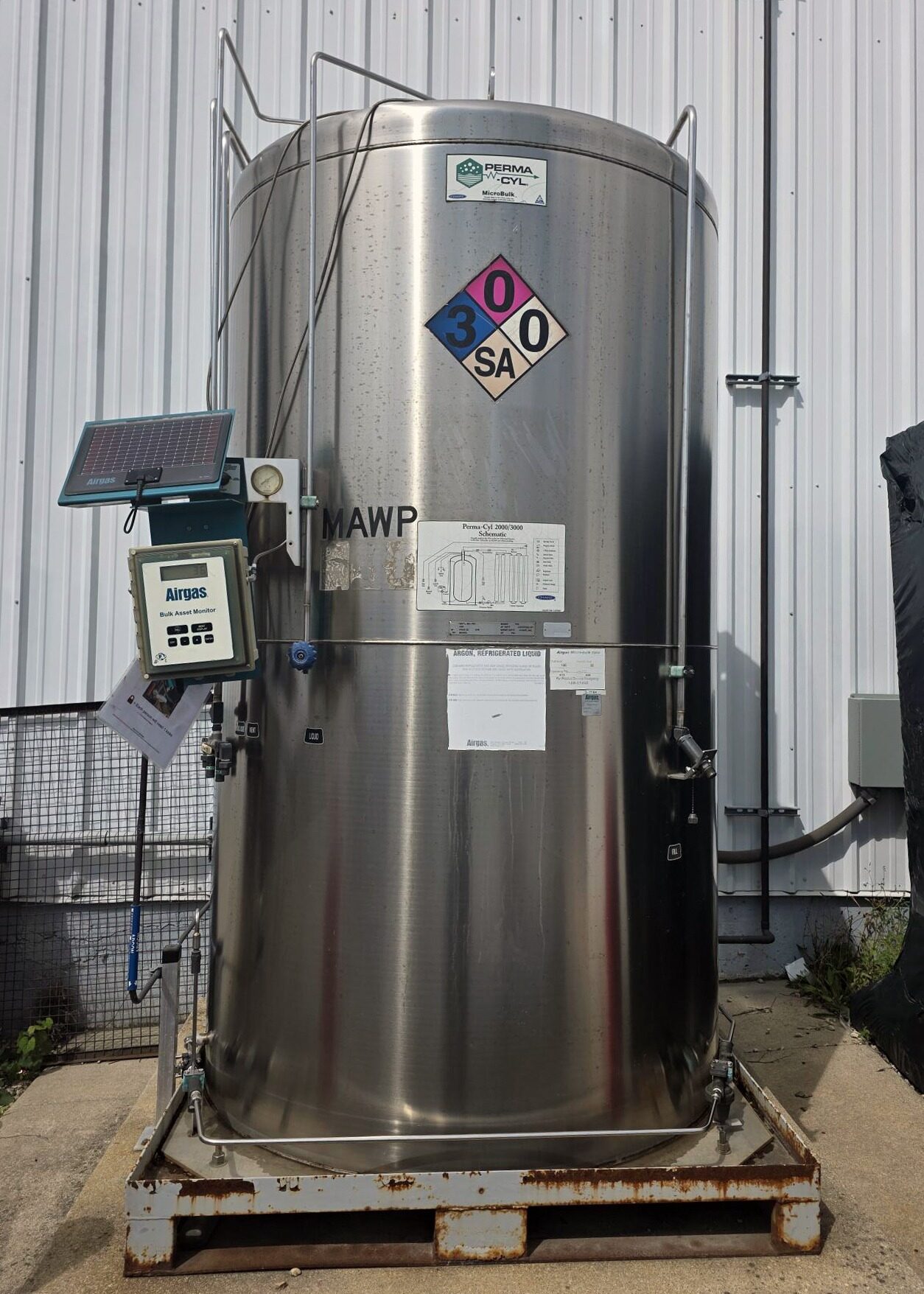
Argon Gas Tank
Hydrogen is commonly used both as a fuel and as an industrial process gas. Reactive to oxygen, hydrogen can be either flammable or explosive when exposed to an ignition source in an atmosphere with free oxygen, which means that it often comes with its own set of rules and regulations for use.
Within a vacuum furnace, hydrogen is often used to produce clean, bright parts. It’s also used as part of a cleanout process during a burnout, aids a brazing process by ensuring the braze bonds to a clean part without oxides, and can be a part of several processes involving rare earth magnets. On rare occasions, hydrogen can be used as a quenching gas.
Hydrogen is introduced into a furnace only after the furnace has been drawn into a deep vacuum. Ipsen furnaces have a programmed safety sequence that confirms a furnace leak rate below 50 microns before hydrogen can be safely introduced in the chamber. When hydrogen is introduced, it’s controlled by valves that allow only a sufficient amount of the gas to deliver the results necessary for the parts being processed per exact specifications. Hydrogen levels are measured by the system controls in microns, torr, mbar or pascal, maintaining content at or below one half of the lower flammability limit – less than 15 torr. This design protects operator safety throughout the process.
Even with these systemic safeties in place, the lines and valves that deliver hydrogen to your furnace must be regularly monitored and maintained. These lines are frequently kept under pressure, so regular leak testing and inspections of the joints and valves should be a part of your maintenance schedule.
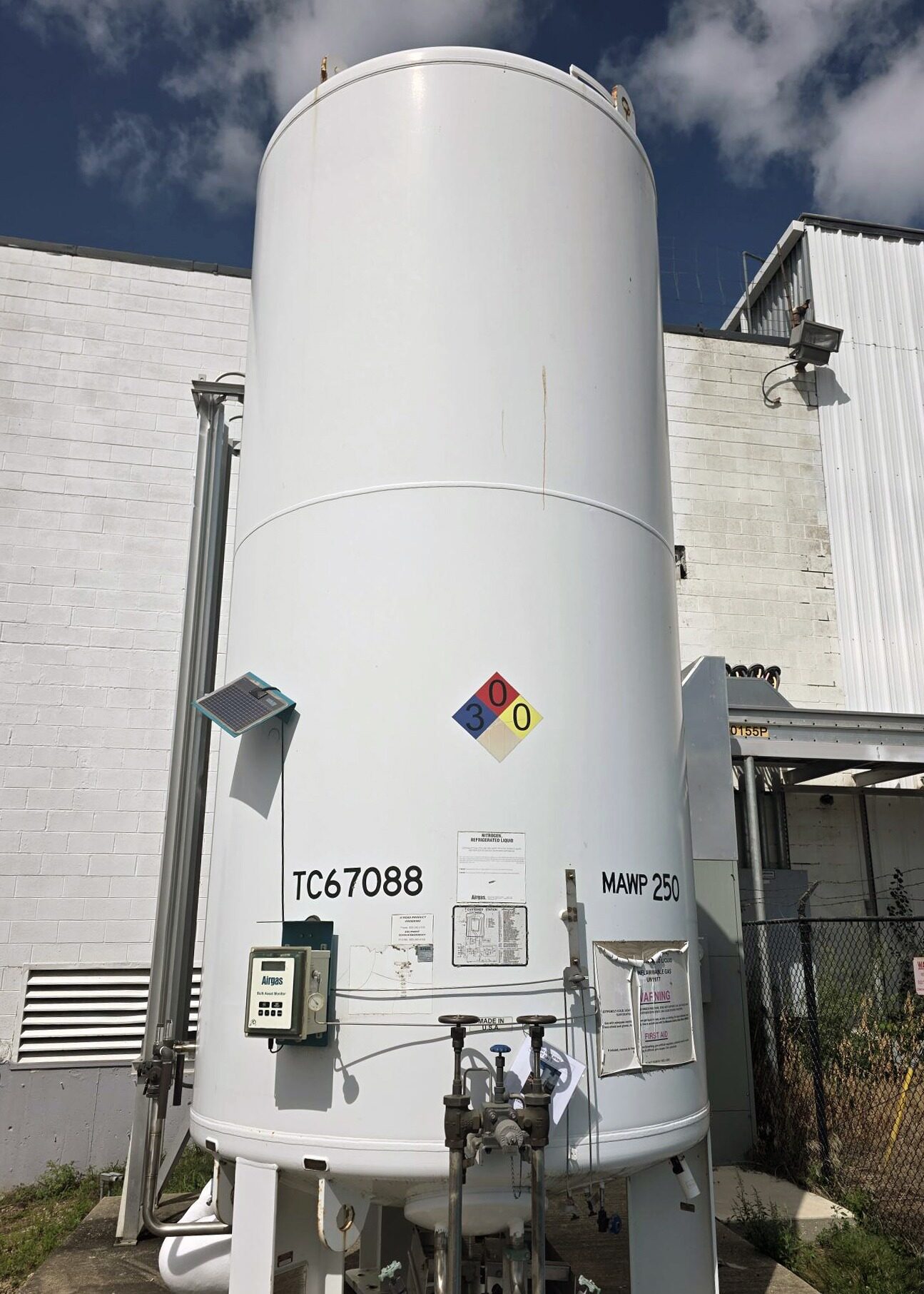
Nitrogen Gas Tank
Leaks not only waste process gases but also introduce atmospheric air into your vacuum furnace and can lead to discolored parts and an unsafe environment for your operators. Even the smallest leak from a pressure test warrants attention and response. Plumber’s putty can be a reasonable short-term solution to a very minor leak, but it should continue to be monitored and tested at a higher frequency when discovered, until the lines have been evacuated and a more permanent solution can be implemented.
Being the lightest of the gases (about 14 times lighter than air) hydrogen will rise quickly when released into the atmosphere. It disperses rapidly when not contained in a confined space. Ventilation systems in buildings where hydrogen process gas is being used should be designed to disperse any gas that may leak or be released at the top of any chamber or room where hydrogen might collect – which is also advised for any other lighter-than-air process gases, like acetylene. Gas sensors placed at or near the peaks of each room will indicate possible gas leaks as well as alert users to the need to vent any collected gas outside of the building.
Process Gas: Argon (and other heavier-than-air process gases)
Argon is an inert gas frequently used for quenching in the aviation industry. Aviation relies on argon to avoid even the slightest chance of nitrogen embrittlement during quenching. Argon can also be used for other processes, including partial pressure and convection heating.
Because Argon is a noble gas, the fact that it is non-reactive helps maintain the chemical integrity of parts processed in the chamber, preventing oxidation and contamination. Argon, however, is an expensive gas, which means its used less frequently across other industries than nitrogen gas, unless argon is explicitly specified.
Argon is heavier than air, which is fortunate when used for partial pressure heat treating in particular – there’s less sublimation into an atmosphere made of these heavier atoms. Argon can provide a protective blanket around parts in the chamber as they are quenched, preventing distortion and delivering clean parts free of unwanted nitriding effects.
Because argon is heavier than air, when it is released from a furnace without being pumped out, it sinks to the lowest areas it can find. Factories operating furnaces that use argon will want to monitor any proximate low-lying confined spaces nearby, like pits for machines, or sub-grade rooms like basements for the presence of argon.
Though argon itself is non-toxic, when argon is allowed to accumulate inside a pit or low-lying area, it displaces the typical oxygenated atmosphere that was there, making those spaces potentially dangerous for maintenance teams that need to descend.
It’s strongly recommended that any person that enters these areas follow their confined area protocols, including wearing personal gas sensors on their lapels, as close to their faces as possible. Additionally, there should always be a spotter nearby that can confirm the safety of the person entering the confined space.
If it is suspected that a low-lying area has accumulated argon, evacuate that area and assess the hazardous conditions. Should you also suspect the possibility of other heavier-than-air gases may have also accumulated there (like propane), remove any possible sources of ignition and use multi-gas detectors to discover what else may be in the atmosphere within that space.
Removing argon requires forced air ventilation, with the exhaust fans and ductwork placed as low as possible within the affected area, keeping any blower motors safely distant from the opening to eliminate the possibility of accidental combustion of any other accumulated gases. Maintenance technicians should always wear the appropriate types of PPE when working in these conditions.
Process Gas: Nitrogen (and other neutrally buoyant process gasses)
Nitrogen, an element that makes up more than three-quarters of our atmosphere, is most commonly found as a gas in its molecular version, N2. Because it’s mostly inert, non-toxic, inexpensive, and widely available, Nitrogen is a frequently used industrial process gas.
In vacuum heat treating, nitrogen is most often used for quenching and backfilling in a furnace to maintain a dry, controlled environment. It can also be used in partial pressure as a means to prevent oxidation and provide uniformity in the heating process when used in a convection furnace. There are certain applications where metallurgists avoid using nitrogen to avoid nitriding the surface of parts, but outside of those specific situations, nitrogen may be the most frequently used gas by volume in vacuum heat treating.
Pure nitrogen, weighing slightly less than the mostly-nitrogen atmosphere of air, tends to stay where its at until an effort is made to disperse it. Inside a chamber that’s being opened after a process, if the nitrogen hasn’t been pumped out of the vessel, it will linger. A simple shop fan may not be able to blow enough oxygenated air into a vertical or horizontal furnace that contains pure N2.
Even after a vessel using Nitrogen has been pumped out and atmospheric air (or dry air) has been backfilled, it remains important to follow all confined space protocols with a spotter in a safe location watching as the operator goes into the vessel for the first time. Once again, wearable oxygen monitors should be worn on the lapel, and alerts should be met with immediate, careful retreat.
Another neutral buoyant process gas is oxygen. While interacting with a high-oxygen environment doesn’t impede breathing in confined spaces, it’s always important when handling pure oxygen to follow all relevant fire safety procedures.
Conclusion
When properly maintained and using the proper process gases, vacuum furnaces deliver clean and bright parts that are accurately processed every time.
Because these gases are such an integral part of operating a vacuum furnace, proper safety protocols need to be observed during every maintenance operation and whenever interacting with confined places where those process gases can accumulate.
Ipsen always recommends that vacuum furnace maintenance and operations teams coordinate with building maintenance and facilities teams to set up safety protocols for all activities involving confined spaces, for inspecting process gas lines for leaks, and for responding to any observed leaks promptly and properly.
Review all safety procedures with local, state, and federal laws, and take advantage of any online resources, as well as local fire marshals or other industrial safety resources to make sure your team is working safely every day.”

“Advanced Heat Treat Corp. (AHT), a recognized leader in heat treat services and metallurgical solutions, announced that it has renewed its Nadcap® accreditation in heat treating – a recognition held since 2013. The renewed status is valid until November 30, 2027.
Under its Nadcap accreditation, AHT can accommodate the following AMS specifications: 2757 (Gas Nitrocarburizing), 2759/6 (Gas Nitriding), 2759/8 (Ion Nitriding), 2759/10 (Gas Nitriding), 2759/12 (Gas Nitrocarburizing) and 2759/13 (Gas Nitrocarburizing). The heat treater also complies with numerous customer specifications. More details can be found at https://www.ahtcorp.com/applications/aerospace-nadcap-nitriding/.
“Our Nadcap accreditation reaffirms AHT’s dedication to the highest standards of heat treating for the aerospace industry and beyond,” said Mikel Woods, President of Advanced Heat Treat Corp. “By maintaining this level of certification, we not only validate our processes but also give our customers confidence that their parts will meet the rigorous demands of their applications.”
The company is heavily involved in the aerospace industry, serving on the Nadcap Heat Treating Task Group, Aerospace Metals and Engineering Committee (AMEC) and AMS B Finishes, Processes and Fluids Committee. AHT also regularly attends industry events, such as the Aerospace & Defense Supplier Summit and various Nadcap meetings.
The Nadcap® Heat Treating accreditation (Merit Status) is held at AHT’s MidPort Blvd. location in Waterloo, Iowa. The heat treater also has locations in Cullman, Alabama; Monroe, Michigan; and another location on Burton Ave. in Waterloo, Iowa.
For more information about Advanced Heat Treat Corp. and its services, please visit www.ahtcorp.com or call 319-232-5221.
About Advanced Heat Treat Corp. Established in 1981, Advanced Heat Treat Corp. (AHT) is a recognized leader in providing heat treat services and superior metallurgical solutions to companies across the globe, with locations in Alabama, Iowa and Michigan. Their UltraGlow® family of processes includes plasma ion nitriding, ferritic nitrocarburizing (FNC), gas nitriding, UltraOx®, through hardening, carburizing, carbonitriding, induction hardening and many more.”
Did you like this article? Click here to subscribe to The Monty.
View our recent magazines and podcasts by clicking the following link. https://themonty.com/magazine/


 August 19th, 2025 “The Monty” had this news item about a new USA location for commercial heat-treating giant Bodycote; “Bodycote to Open New Facility in Fairfield, Ohio, USA”. At the time of posting details were in short supply but we did promise updates as they became available, that became today.