(Editors Note; The team at “The Monty” has seen first hand how replacing cast fixturing with lighter weight CFC fixturing in vacuum heat treating applications has resulted in increased throughput representing an ROI on CFC fixturing of less than 12 months-read on).
“Turbine demand is running past furnace supply, and a new vacuum furnace is still a year or two out. Some of the capacity you need is already sitting inside the furnaces you own — tied up in the fixture.
Last July, “The Monty Heat Treat News” reported that the AI data center buildout is pushing gas turbine demand into territory nobody planned for, and that vacuum furnace orders are following right behind it. Turbine lead times past five years. Siemens Energy nearly doubling unit sales in a single year. Mitsubishi planning to double manufacturing capacity by 2027.
Here is where that lands on the shop floor. A new vacuum furnace is itself 12 to 24 months out. So the heat treater who has been told to push 30 or 40 percent more through the department this year is not going to get there with a purchase order. He gets there, or doesn’t, with the furnaces already bolted to his floor.
Which makes one question worth asking out loud: how much of your existing furnace capacity is currently occupied by the fixture?

Inside that cycle the fixture is doing three jobs nobody wrote down. It is a heat sink, so it sets how long the load takes to equalize before the filler melts. It is an obstruction, so it shapes the gas flow during quench, and quench rate drives gamma prime size directly. And it is a mechanical boundary, holding thin-wall parts that will creep under their own weight at 1,200°C if the support points are wrong.
Here is the failure mode that frustrates process engineers most. The furnace passes its temperature uniformity survey. The recipe is unchanged and still approved. The operator did nothing differently. And braze quality drifts anyway, because the metal fixture has crept two or three millimeters over eighty cycles, the joint gap has shifted, and the support points are no longer where the qualification assumed they were. The evidence shows up in metallography weeks later, on parts that have already absorbed casting, coating and cooling hole drilling. You are not scrapping raw stock. You are scrapping finished airfoils.
What carbon fixtures actually do, and what they don’t; Carbon fiber reinforced carbon has an obvious appeal here, and an equally obvious sales pitch attached to it that deserves to be retired. Five times lighter does not mean five times less heat. The specific heat capacity of carbon runs around 1.8 to 2.0 kJ/(kg·K) against roughly 0.65 to 0.75 for nickel-base alloys. The honest net benefit is on the order of 1.5 to 2. That number is smaller than the brochure version and it survives being checked, which is the only kind of number worth putting in front of a process engineer.
The carburization question is the one that actually decides whether CFC gets through the door, and it has two separate answers because there are two separate paths. Direct contact above about 1,100°C will form chromium carbide in the surface zone of a nickel-base part. That path is closed by putting spacers of lanthanum oxide doped molybdenum between the carbon and the component. Molybdenum holds its shape at process temperature, it is not wetted by BNi filler metals so stray braze does not weld the part to its support point, and the lanthanum oxide dispersion keeps the material ductile even after recrystallization, where unalloyed molybdenum turns brittle. Worth saying plainly: those spacers sit in carbon contact themselves and form molybdenum carbide over cycle count. They are consumables with a service life, not fit-and-forget hardware.
The second path is the gas phase, CO forming from residual moisture and oxygen at the carbon. No contact barrier touches that one. It is handled by bake-out and preconditioning before the first production run, and any supplier who tells you a spacer eliminates carburization outright has skipped half the mechanism.
Two more things have changed on the fixture side that are worth knowing about. Load peaks can now be calculated at process temperature and designed out of the structure, instead of being buried under a safety allowance of extra mass — and since mass is heat sink, that feeds straight back into equalization time. The calculation is steady state, so it covers sag and support points at the hold, not the heat-up and quench transients. And fixtures can be individually marked, which sounds trivial until you connect it to the failure mode above. Mark the fixture and its position in the load, and cycle count, position and history become traceable. The variable that was invisible becomes a line in the record.
The part the purchasing side should read; Nobody in this market is being measured on fixture savings. On price you can win 20 percent. On schedule you can lose everything, because turbine contracts carry penalties and a failed load with the rotor shop waiting costs a multiple of the annual fixture budget. Meanwhile furnaces are sold out. Any fixture change that raises parts per load or shortens cycle time converts directly into capacity, at a fraction of furnace price and none of the furnace lead time. How much capacity is a question each shop has to answer with its own part family and its own numbers. The point is that this year it is the only capacity available. And modular systems beat discounts, because a separate drawing number for every part family costs more in administration than any rebate returns.
How to find out for yourself; Pick one part family with high volume and a known distortion problem. Record what you have now: furnace type, usable envelope, recipe, current fixture mass, parts per load, cycle time, fixture service life, documented scrap causes. Agree acceptance criteria in writing before anything goes in the furnace — part dimensional stability, metallography of the surface zone for carbide formation, joint gap, cycle time, parts per load. Then run a defined number of cycles and measure the fixture before and after. That measurement is the whole argument. Everything else is a claim. For more information contact; “Graphite Materials”
Your furnace is qualified. Your recipe is qualified. Your fixture changes every eighty cycles and appears in none of your records.”
Related Articles From “The Monty Heat Treat News”;
“CFC Fixturing-A Growing Trend?”
“Gear Supplier Invests in CFC Fixturing”
“CFC Fixtures Even For Extreme Conditions”


The new saw will provide the metallurgical laboratory with a dedicated, high-performance solution for cutting advanced alloys into samples for metallographic evaluation, tensile specimens, materials characterization, and quality assurance. Bringing this capability further in-house will help the company improve sample preparation efficiency while maintaining greater control over the testing process.
“Inconel and titanium are critical materials for many demanding applications, but their strength and other material characteristics can make sample preparation particularly challenging,” said Bob Hill President of Solar Atmospheres of Western PA. “The addition of the KASTO saw represents an important investment in our laboratory infrastructure and our ability to deliver timely, reliable metallurgical analysis.”
The investment reflects Solar’s continued commitment to technical excellence, quality, and the development of advanced in-house materials engineering capabilities.
“We’re continually looking for ways to strengthen our technical capabilities and provide better vertical support to our customers and engineering teams,” Bob added. “This equipment gives our metallurgical laboratory another important tool for working with some of the most demanding materials used in industry today.”
For additional information about Solar Atmospheres, contact Mike Johnson at 855-934-3284 x2223, email at [email protected], and visit us at solaratm.com.
ALD Thermal Treatment, Inc. Celebrates 20 Years of Operations in Port Huron
PORT HURON, Michigan, [Date]: ALD Thermal Treatment, Inc. is celebrating the 20th anniversary of its operations in Port Huron, marking two decades of advanced heat treatment services, manufacturing excellence, workplace safety, quality performance, and community partnership.
Since opening its Port Huron operation, ALD Thermal Treatment, Inc. has processed more than 500 million parts, with zero returned from the field, a milestone that reflects the company’s focus on precision, reliability, and customer confidence. The company also has achieved six consecutive years with zero lost-time accidents, demonstrating a sustained commitment to employee safety and operational discipline.
ALD Thermal Treatment, Inc. provides vacuum heat treatment services for precision manufactured components, including capabilities such as low-pressure carburizing, high-pressure gas quenching, hardening, annealing, tempering, and related processes. The broader ALD Heat Treatment Services service customers who benefit from ALD technologies without investing in their own facilities, with operations available through global centers in Germany, the United States, Mexico, and China. ALD Thermal Treatment, Inc., expertise is utilized by companies in the automotive, tooling, gear, and aerospace markets.
The Port Huron operation has earned the General Motors Supplier Quality Excellence Award in 11 of the past 12 years, including recognition as the first heat treatment services company to receive the award in 2014. The upcoming anniversary program will recognize colleagues who contributed to those GM Quality Awards, as well as employees who have been with the operation since its beginning 20 years ago.
“Reaching 20 years in Port Huron is a meaningful milestone for our company, our employees, our customers, and the manufacturing community we serve,” said Jim Muenzenberger, Senior Vice President, America’s of ALD Thermal Treatment, Inc. “This anniversary is an opportunity to recognize the people who built this operation, the customers who have trusted us, and the culture of quality and safety that continues to guide our work.”
Beyond its role in advanced manufacturing, ALD Thermal Treatment, Inc. has supported workforce development and community connection. The company hosts Manufacturing Day for high school students and offers internships for graduating students in material science or metallurgy. These efforts reflect the company’s commitment to introducing students and emerging professionals to career opportunities in technical manufacturing fields.
As ALD Thermal Treatment, Inc. celebrates this milestone, the company recognizes the employees, customers, corporate leaders, civic partners, and community stakeholders who have contributed to 20 years of operations in Port Huron.
About ALD Thermal Treatment, Inc.
ALD Thermal Treatment, Inc., located at 2656 24th Street in Port Huron, Michigan, provides advanced heat treatment services for precision manufactured components. Its capabilities include vacuum heat treatment, low-pressure carburizing, high-pressure gas quenching, hardening, annealing, tempering, and related processes. The company is part of the broader ALD Heat Treatment Services network, which provides commercial heat-treating services supported by ALD technologies and global service centers.


Our focus today is on the Port Huron, Michigan location.
This location was founded in 2005 with production starting in 2006 (hence the 20 year celebration) and features 4 ModulTherm® systems with 24 treatment chambers and 2 DualTherm® chamber furnaces which means this location has the equivalent of almost 30 carburizing systems. This capacity is boosted by 3 Gas Nitride / Ferritic Nitro-Carburizing furnaces provided by ALD and KGO.

Jim Muenzenberger, Senior Vice President-Americas, ALD TT, & Kelly Peters, Former Vice President Operations
Over the years the company has processed 474,313,474 parts (and counting) with zero parts returned which is why the plant has received the Supplier Quality Excellence Award (SQEA) from General Motors for nine consecutive years (it is certainly no secret that the focus of this plant is on General Motors transmission components).
When “LPC” was first introduced to the heat treat industry over 30 years ago, many predicted that it would take over the carburizing market around the world-this proved to be a very optimistic prediction. However, the benefits of “LPC” are beyond dispute and in some areas of heat treating it is the heat treatment process of choice especially amongst “in house” heat treaters. In the commercial field it is not as common, obviously in the case of “ALD” they have proven that the process makes sense and is very viable process for commercial heat treaters which has led to their tremendous success.
Tuesday, September 15, 2026 the company will be hosting a special anniversary celebration honoring the colleagues, customers, leaders, and achievements that shaped the facility. “The Monty” will be providing further details about the anniversary.
(Find out how popular LPC is in the “in house” heat treatment industry); “15 Largest Captive Heat Treats-North America”
(How does “ALD TT” compare in size to other commercial heat treaters)? “52 Largest North American Commercial Heat Treaters”

AHT senior metallurgist Jake McCann discusses effective case depth and total case depth when it comes to nitriding and carburizing surface treatments.
Thermochemical surface treatments such as nitriding (or carburizing) diffuse nitrogen (or carbon) into the surface of steel alloys. The diffusion layers increase the surface and near-surface hardness of the material, providing enhanced tribological properties (wear resistance, coefficient of friction, Hertzian contact stresses, etc.). Rightfully so, these heat treatments are often named “case hardening” type processes, since there is a hardened layer on the outside of the material leaving the internal material softer.
Two Methods to Evaluate the Diffusion Layer (Case Depth)
Effective Case Depth (ECD)
Effective Case Depth (ECD) is defined as the depth to a particular hardness value. On a metallographic mount, microhardness testing (Vickers- HV or Knoop- HK) is performed at standard intervals (this is called a “microhardness traverse”) on the cross-section. The resultant hardness values are plotted against the depth for each indentation. The depth to the desired hardness value is then interpolated.

Figure 1. Graph (microhardness vs depth) associated with Figure 2.
In Figure 1, the red horizontal line represents 50 HRC equivalent (513 HV). The intersection of the red line with the hardness curve (purple) determines the resultant ~0.016” effective case depth (at 50 HRC).
Total Case Depth (TCD)
Total Case Depth (TCD) is defined as the full or complete depth of atomic (nitrides/nitrogen or carbon) diffusion. For some steel alloys, TCD can be evaluated visually after etching with an appropriate acid to reveal the diffusion layer. For steel alloys that DO NOT reveal the diffusion layer, a microhardness traverse is performed. The resultant hardness values are plotted against the depth for each indentation. The full microhardness traverse is used to calculate the TCD, based on the extent of hardness drop from near-surface hardness to core hardness.
Note: TCD is typically defined as the depth to 50 HV or 50 HK above the core hardness average. Alternatively, TCD can be defined in other ways, such as the depth to 110% of the core hardness average.
In Figure 1, the green horizontal line represents the core hardness average of 334 HV. The blue horizontal line represents hardness value of 50 HV points above the core hardness average (50 HV + 334 HV= 384 HV). The intersection of the blue line with the hardness curve (purple) determines the resultant ~0.022” total case depth.

Figure 2. Nitrided medium alloy steel showing compound zone (white layer) at the surface and nitride diffusion zone. Hardness indentations shown are produced using Vickers indenter (HV).
Microhardness Traverse Profile
Figure 1. Graph (microhardness vs depth) associated with Figure 2.
Figure 2. Nitrided medium alloy steel showing compound zone (white layer) at the surface and nitride diffusion zone. Hardness indentations shown are produced using Vickers indenter (HV).
Case Depth Common Uses
Carburizing

Figure 3. Carburized and Quenched 8620 alloy showing higher hardness and carbon content martensite near the surface.
For carburizing treatments, case depths are usually defined as “ECD to 50 HRC” as this usually coincides with total carbon diffusion depth and the martensitic transformation (quenching) of the applied carbon diffusion. For common carburizing steel alloys (e.g. 8620, 9310, 5120, or 1018), “ECD” is most used because of the universal resultant case hardness for this process type.
Figure 3. Carburized and Quenched 8620 alloy showing higher hardness and carbon content martensite near the surface.
Nitriding
For nitriding treatments, case depths are usually defined as “TCD”. This is mainly because the resultant case hardness varies greatly from low alloy steels to high alloys steels.
- For nitrided LOW alloy steels (such as 1018), case hardness within the diffusion zone may peak at approximately 300 HV (~30 HRC eqv).
- For nitrided HIGH alloy steels (such as 17-4 PH), case hardness within the diffusion can easily exceed 1000 HV (above the HRC scale).
Because of this non-uniform resultant hardness of nitrided steels, it disallows the use of ECD to be used to compare case depths of different alloys.
For some highly alloyed steels, such as stainless steels, the total case depth (usually observed visually after etching) is approximately the same as effective case depth due to the abrupt change from case hardness to core hardness. Reference Figure 4.
Figure 4. Nitrided stainless steel (17-4 PH) showing sharp transition from case to core. Hardness indentations shown are produced using Knoop indenter (HK).

Figure 4. Nitrided stainless steel (17-4 PH) showing sharp transition from case to core. Hardness indentations shown are produced using Knoop indenter (HK).
What Affects Case Depth During Case Hardening?
For optimum diffusion to occur with either process type – nitriding or carburizing – the surface of the material should be clean and free of surface oxidation and heat treatment scale.
For carburizing applications, the combination of carbon diffusion and sufficient case depth are necessary to produce the effective case depth. If the parts are not quenched or insufficiently quenched (e.g. slack quench or slow cooling), carbon diffusion would remain, but the case properties would remain soft since the quenching operation has not yet produced the case hardening.
For nitriding applications, core hardness can play a crucial role in determining the ECD. Core hardness serves as the foundation upon which the case is built – nitriding improves the already-established core hardness. Considering two specimens of identical alloy (chemical composition), but varying core hardness, when nitrided under the same conditions, the specimen with the higher core hardness will exhibit a deeper effective case depth.
AHT Quality: Focusing on Your ECD Specification
Prior to nitriding, AHT often tests the incoming hardness of parts to identify any potential issues, ensuring that any concerns are addressed before processing.
When sending parts with an ECD requirement, it is helpful to also provide a sample piece of material that has undergone the same heat treatments as the parts in the order. While AHT includes sample materials in every load, discrepancies between the condition of our sample materials and the submitted parts can lead to skewed metallurgical results.
On a regular basis “The Monty Heat Treat News” updates our readers on well-known individuals in the global heat treatment industry who have made recent career changes-this is our September 11, 2026 update;
 Jay Jefsen, Furnacare; Vacuum furnace builder “Furnacare” (TAV) in Spartanburg, SC has just announced that Mr. Jay Jefsen, previously Sales Manager with the company has been promoted to General Manager, USA. Jay brings with him a very impressive resume which includes commercial heat treating and capital equipment sales. Jay Jefsen, [http://Vacuum furnace builder “Furnacare” (TAV) in Spartanburg, SC has just announced that Mr. Jay Jefsen, previously Sales Manager with the company has been promoted to General Manager, USA. Jay brings with him a very impressive resume which includes commercial heat treating and capital equipment sales.]“The Monty Talks Vacuum Furnaces with Mr. Jay Jefsen, Furnacare”.
 Rick Clift, IMT Elemental; With over 40 years’ experience in the North American heat treat industry, the announcement by “Mr. Rick Clift” that he is retiring at the end of September 2026 marks a real loss to the heat treatment industry. A metallurgical engineer by background Mr. Clift started his career with “Atlas Steel” (now Valbruna ASW Inc.) in Welland, Ontario, Canada over 40 years ago. His career has made several twists and turns over the years which led to some time as metallurgist and heat treat engineer at auto parts supplier “TRW Products” in St. Catherines, Ontario. After a brief return to Atlas Mr. Clift joined commercial heat treater “H & S” in Port Robinson, Ontario (now called IMT Elemental) in 2001 as corporate metallurgist. “Heat Treat Industry Losing a “Good One”-Rick Clift”.

The company, based in Hagen, Germany, had been a key supplier of components, spare parts, and furnace installations to the European industry since 1994. After the closure of “Avion” Roland quickly pivoted and is now a German corporate consultant and property management executive based in Hanover, Germany.


And that is your “Heat Treatment Names in the News” update for September 11, 2026.

“JUNE 26/2026 USA Commercial Heat Treater Closes Their Doors; Earlier this week, Phoenix Metal Treating, located at W190 N11350 Carnegie Drive in Germantown, Wisconsin, officially closed down. This 40 year old family owned company operated several medium sized Beavermatic and Ipsen batch IQ furnaces and catered largely to the local automotive parts suppliers. Unfortunately their largest customer closed down and the remaining work was not enough to justify keeping the business going.”

While it is hard to describe a vacuum hardening line as famous, in this case the adjective certainly fits. Built by “ALD” in 2008 for “Caterpillar” this line was originally designed as an “R & D” project as it was able to offer a number of different processes;
“ALD Holcroft ModulTherm Fully Automated High-Production Vacuum Heat Treat Line, New 2008, Upgraded in 2020 with (3) New Vacuum Furnaces & Washer, New Owner Purchased in 2014. Maximum Temp: 2,300°F, Consisting of (4) Heat Treat Furnaces, Air Temper Furnace, (2) Washers, 20 Bar Nitrogen or Helium Quench with Reversible Air Flow, Oil Quench, Rail Mounted Charge Car Equipped with Heated Vacuum Chamber”.
After a relatively short trial period of time “CAT” abandoned the project and put the system up for auction at which point auto parts supplier “McGard” in Upstate, NY, USA purchased the line in a rather surprising move. We say surprising as “McGard” had been successfully processing their parts in a very cost efficient manner in a basic quench and temper line-why the company decided to change to a far more expensive processing method remains a mystery to most.
The project did not produce the expected results and subsequently the line was shut down before processing any significant production volumes. Since that time, it has languished on the used furnace market will little interest shown. We now have word that the line will be auctioned this fall with bidding already open.
“ALD” is a premier furnace builder, well respected around the world, however this system having originally been built as an “R & D” project is not a good fit for virtually any firms doing high volume production. Perhaps the auction will attract some attention, however after so many years on the used market we do not expect significant interest in the system.

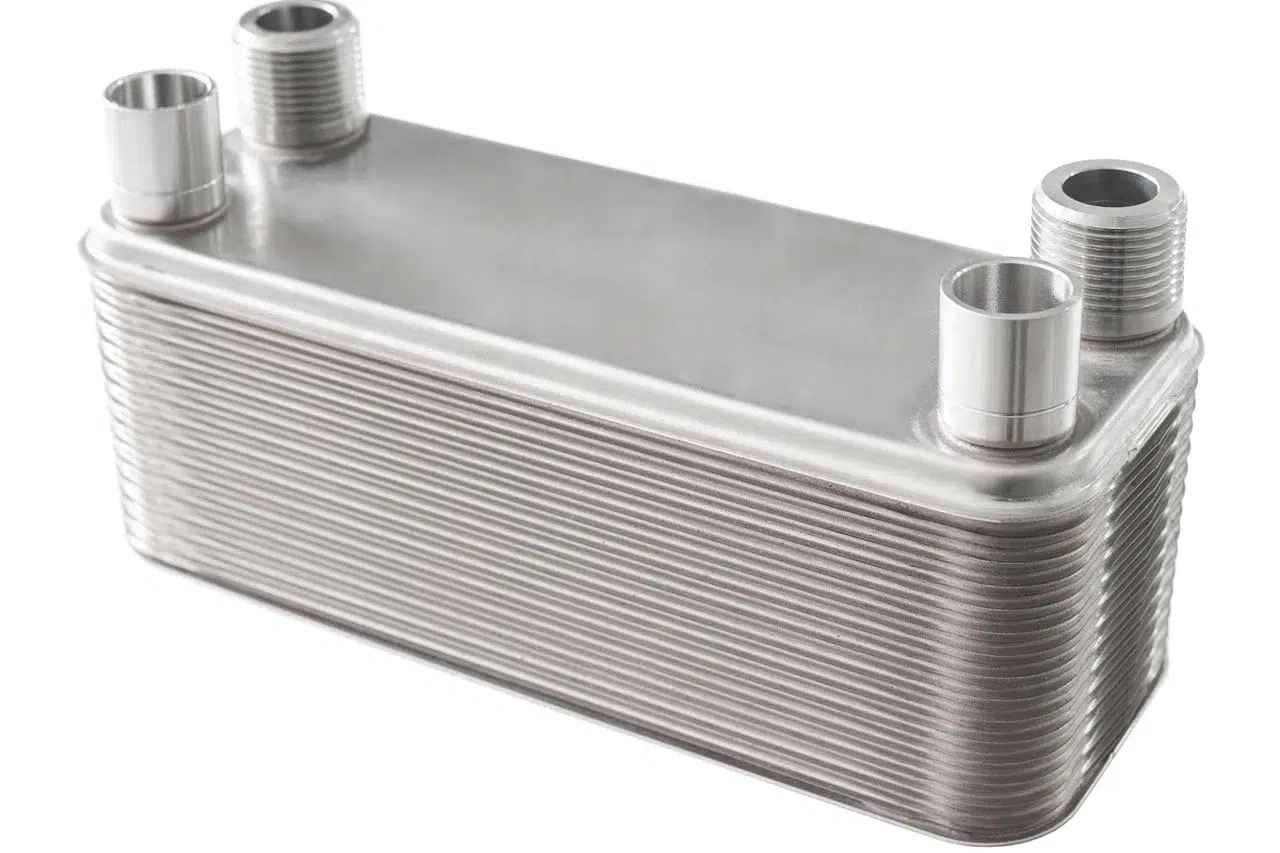 “A U.S.-based cooling systems manufacturer has selected the Universal CAB Batch Furnace from SECO/WARWICK for aluminum brazing, equipped with a thermal degreasing furnace, a dryer, a final cooling chamber, and an external transport system. The solution will enable the company to launch in-house production of brazed heat exchangers, shorten response times to market needs, and reduce dependence on external suppliers. The first collaboration with the SECO/WARWICK Group.
A U.S. manufacturer is adopting SECO/WARWICK’s Universal CAB Batch Furnace to gain in-house aluminum brazing capabilities, ensuring production independence and process flexibility.
- SECO/WARWICK provides a complete aluminum brazing line to a U.S. partner.
- The system includes a batch furnace, degreasing furnace, dryer, and cooling chamber.
- The solution enables in-house production of large plate-and-bar heat exchangers.
- The furnace design offers high flexibility and future scalability.
- Controlled nitrogen atmosphere ensures high quality and repeatable results.
The equipment will be delivered to the company’s plant in Pennsylvania, the same state where the American subsidiary of the SECO/WARWICK Group is also located. The solution will primarily be used for aluminum brazing of large plate-and-bar heat exchangers, used in the heavy-duty segment and the aftermarket. The new line will include the Universal CAB Batch Furnace for aluminum brazing, a dryer, a final cooling chamber, and an external transport system. In addition, a continuous thermal degreasing furnace will be supplied to properly prepare components before fluxing and brazing. This configuration will allow the process to be carried out in a controlled protective atmosphere, ensuring high brazing quality, repeatable parameters, and stable production of heat exchangers with various designs.
The purchase of SECO/WARWICK technology addresses one of the partner’s most important challenges: the need to become independent from its current suppliers of brazed heat exchangers.

Brazing large heat exchangers
The solution on order is designed primarily for brazing large plate-and-bar heat exchangers in the recommended vertical position. Thanks to its versatile design, the furnace will also enable the effective brazing of standard fin-and-tube heat exchangers as well as plate heat exchangers. The Universal CAB Batch Furnace enables manufacturers to respond flexibly to changing market needs without investing in multiple, specialized production lines.
“The deciding factors behind the selection of our technology are the advantages that matter in everyday heat exchanger production: convection heating and cooling, short setup and process times, high nitrogen atmosphere purity, temperature uniformity and a modern control system. This partner was looking for a solution that would allow them to start their own heat exchanger production without locking it into a single product geometry. The Universal CAB Batch Furnace offers that flexibility and can also be upgraded in the future from a batch system to a semi-continuous configuration,” emphasized Maciej Stempniewicz, Deputy Director of CAB Technology Sales.
One of the key advantages of SECO/WARWICK CAB batch furnaces is the ability to run the process in a clean nitrogen atmosphere while maintaining high temperature uniformity and steep heating profiles. In practice, this translates into high brazing quality, process stability and repeatable results. Convection heating and cooling shorten cycle times, which directly affects production efficiency and operating economics.
The Universal CAB Batch Furnace is a compact solution with a smaller footprint and lower investment, installation, and operating costs compared with more extensive continuous systems. At the same time, the furnace design allows for future expansion to a semi-continuous configuration, increasing production capacity. For the U.S. customer, this means a safe entry into in-house CAB production without the need for an immediate investment in a large continuous line. The company gains a technology that meets its current production needs while also supporting future business growth.
The system supplied will be complemented by equipment supporting the entire technological process. The continuous thermal degreasing furnace will prepare components before fluxing, the dryer will ensure proper load preparation before brazing, the final cooling chamber will stabilize the final stage of the process, and the external transport system will streamline product flow between successive stages of the line. This integrated configuration improves production repeatability and reduces the risk of process errors.
The contract was completed through the cooperation of SECO/WARWICK’s U.S. operation, Retech and SECO/WARWICK engineers in Poland. It is an example of the synergy within the Group and the joint use of sales, engineering and technological expertise on the North American market.”


A metallurgical engineer by background Mr. Clift started his career with “Atlas Steel” (now Valbruna ASW Inc.) in Welland, Ontario, Canada over 40 years ago. His career has made several twists and turns over the years which led to some time as metallurgist and heat treat engineer at auto parts supplier “TRW Products” in St. Catherines, Ontario. After a brief return to Atlas Mr. Clift joined commercial heat treater “H & S” in Port Robinson, Ontario (H & S is now IMT Elemental) in 2001 as corporate metallurgist.
Mr. Clift told us yesterday (and we paraphrase) that he is very proud of the fact that he has passed his lifetime experience along to his successor and that he is very pleased by the fact that the next generation is well prepared for the future.
Mr. Clift has been very involved in “MTI” (Metal Treating Institute) over his long career and is well known to many in the North American commercial heat treat industry. He will continue his part time career of teaching metallurgy at the local college.
“IMT Elemental” is one of the largest commercial/captive heat treaters in Canada.