Did you like this article? Click here to subscribe to The Monty.
View our recent magazines and podcasts by clicking the following link. https://themonty.com/magazine/

“New tempering and annealing furnace expands the possibilities of VTN Witten GmbH
VTN Witten GmbH is pleased to announce an important expansion of the machinery at the Herbede site. A state-of-the-art tempering and annealing furnace with an impressive usable space of 1750 x 1750 x 3000 mm is now available for the treatment of large components in the aerospace industry. The new system makes it possible to treat even large and complex components such as entire landing gear parts of aircraft efficiently and reliably.
The furnace meets the strict requirements of the aviation industry, such as the AMS 2750, and ensures the highest quality standards. The modern control technology ensures exact adherence to the process parameters and a temperature uniformity of ±6°C. With this investment, VTN Witten GmbH, as a NADCAP-certified company, is further expanding its capacities in this area. Numerous components from civil and military aviation are already being heat-treated at VTN. The main processes are vacuum hardening, vacuum annealing and low-pressure carburizing (LPC).
At the same time, with the commissioning of the plant, which is powered by 100% green electricity, an old, gas-heated plant was taken out of operation. Thus, this investment also serves the transformation from fossil fuels to renewable energy sources in heat treatment.”


-
FNC of Brake Rotors-A New Approach
-
Massive Fire at Captive Heat Treater
-
Fire Devastated Heat Treat Rebuilds
-
Heat Treatment Industry Losing a Giant
-
Largest Commercial Heat Treats-How Big is the Pie?
-
Another USA Commercial Heat Treater Closes it’s Doors
-
Item # T430 Surface Combustion 36 X 72 X 36 Tempers-Like New!
-
Item # VF462 Abar Ipsen “Turbotreater”, HR4848 2 Bar Quenching
-
Item # L151 Struers LaboPol-25 Dual Semi-Auto Polisher
-
Item # IQ518 Surface Combustion 36 X 72 X 36 Batch IQ Line
-
Item # M501 Atmosphere Engineering Nitrogen Methanol Furnace Control System
-
Item # G215 3000 CFH AFC Endothermic Gas Generators (2 Available)



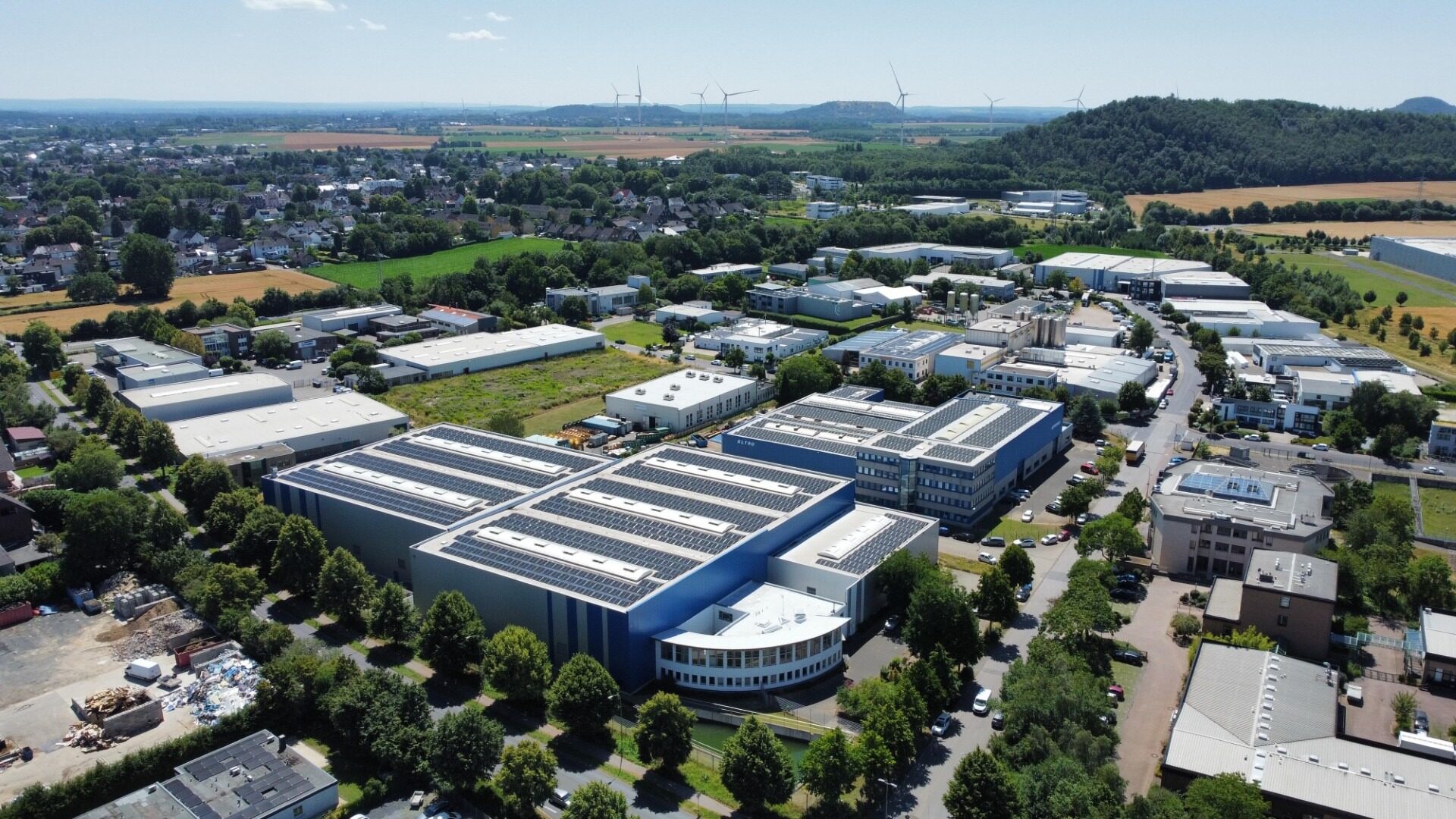
Kirsten, please give us some background on yourself, your brother and the company.
“Let’s start with our business. Eltropuls is a family-owned business which started to build plasma nitriding units almost 45 years ago! Since this time, we have continuously developed the technology. We ourselves are running 40 plasma nitriding units in our heat treatment shops. Therefore, we know how the furnaces work and how to treat components and we are happy to provide this know-how to our customers.
I personally have studied Material science and Metallurgy at Aachen University in Germany and joined the company in 2008.

What products do you offer?
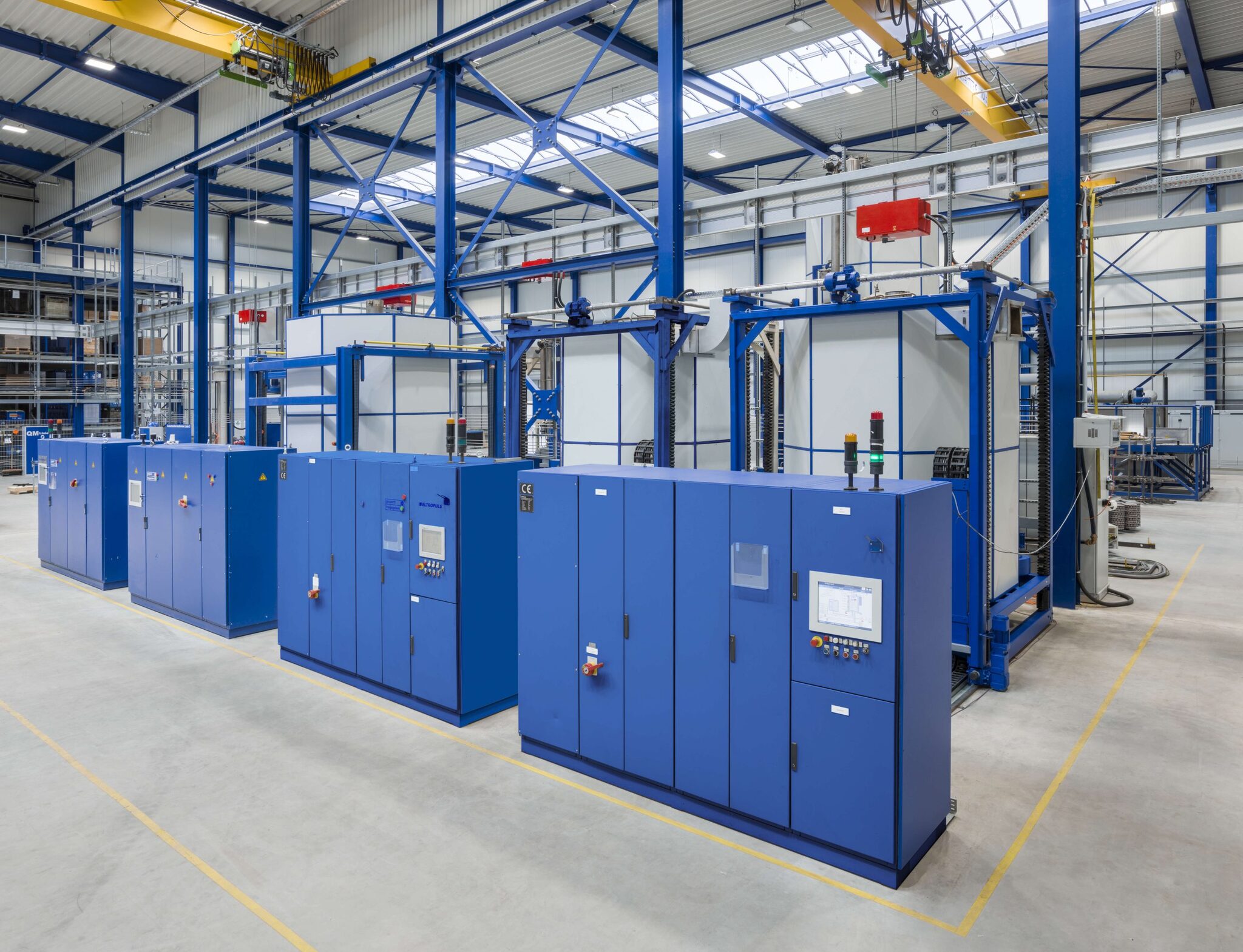
“We offer plasma nitriding and PVD-coating systems. If required from the customer we also manufacture cleaning equipment as well as fully automated loading systems for our nitriding units.
We also run a small heat treatment shop in Oxford, MI, USA. There we perform plasma nitriding, nitrocarburizing as well as post oxidizing.”
Right off the bat I have to ask, are the terms “Plasma Nitriding” and “Ion Nitriding” interchangeable?
“The answer to this is a bit tricky: Eltropuls was actually founded based on the discovery by a researcher from General Motors (Gary Tibbets) who discovered that ions in fact do not perform so called “ion nitriding” but the non ionic plasma does. So technically speaking ion nitriding is nonsense, in practice however the term is interchangeable with plasma nitriding.
When people still thought that ions were responsible for the nitriding, the process was much more difficult to control, and some practitioners even melted parts during the process. That is from our point of view the main reason a lot of people still hesitate to use “Ion-nitriding”. Before we started with our innovation of pulsed plasma a lot of power was put into the plasma to generate ions which resulted in a very hard to control process. Todays plasma-nitriding in contrast to yesterdays ion-nitriding is a process with much smaller power usage, less temperature differences and much easier control by the operator.”
I am rather embarrassed to say that after a lifetime in the heat treatment industry I have never completely understood how it works. Could you please enlighten myself and our readers?
“If you disregard the physics of the plasma, which is the part we handle as the furnace builder, the process is very similar to gas nitriding. Instead of Ammonia we use Nitrogen and Hydrogen. The plasma is created by applying a pulsed negative Voltage to the batch. The plasma then splits the nitrogen in two and creates nitrogen atoms which then diffuse into your parts in exactly the same way as the split ammonia in gas nitriding. Herein also lies one of the main advantages: Only where there is plasma is the nitrogen split, so if you mask off areas of your parts mechanically, they will not get nitrided.
Apart from that it looks like a typical heat treatment: First you heat up the batch by heating the furnace walls, this can be combined with a pre oxidation as in gas nitriding. Then you have an additional step of sputter-cleaning where the part is cleaned by a hydrogen plasma. This for example allows you to remove the surface oxide from stainless steels. Afterwards the parts get heated to nitriding temperature and held there for a pre calculated time, depending on the hardness depth required. After the time has elapsed the batch is cooled after optionally creating a black oxide layer.”
Why Ion nitriding rather than gas nitriding?
“Plasma nitriding offers some benefits that can’t be achieved with gas nitriding or that can’t be done easily, here are some examples;
Selective treatment of parts. Areas of the parts can be mechanically covered and be protected against nitriding. This allows welding, press-fitting or an improvement of the dimensional stability. This can be easily realized also in cases of mass production for instance automotive applications..
Treatment of stainless steel parts: Low and high temperature treatments are possible which lead to very high hardness (>1000HV)
Low distortion: The plasma allows for very low temperature treatments to realize best dimensional stability and to produce parts that can be assembled without hard machining.
Very high compressive stresses: Due to low temperature treatments very high compressive stresses can be generated at the surface. This is important for a lot of high-performance applications such as aircraft or motorsport applications.
Treatment of sintered parts: Dewaxing of sized sintered parts and nitriding can be done in the same treatment. The performance of the sintered parts is very good as the pores don’t get nitrided
Treatment of Titanium: Titanium can be nitrided to create a golden TiN-Layer which has an outstanding hardness of > 2000 HV. This is often used in the aerospace, motorsports and defense industries
Cost efficient due to low consumption: Ion nitriding is very cost efficient especially for big and heavy parts due to very low consumption of gas.
Safe process: Ion nitriding is a very safe process. No ammonia is needed, no explosive atmosphere can be created, no hazardous exhaust gas is produced. So, it can be easily integrated into every production facility.
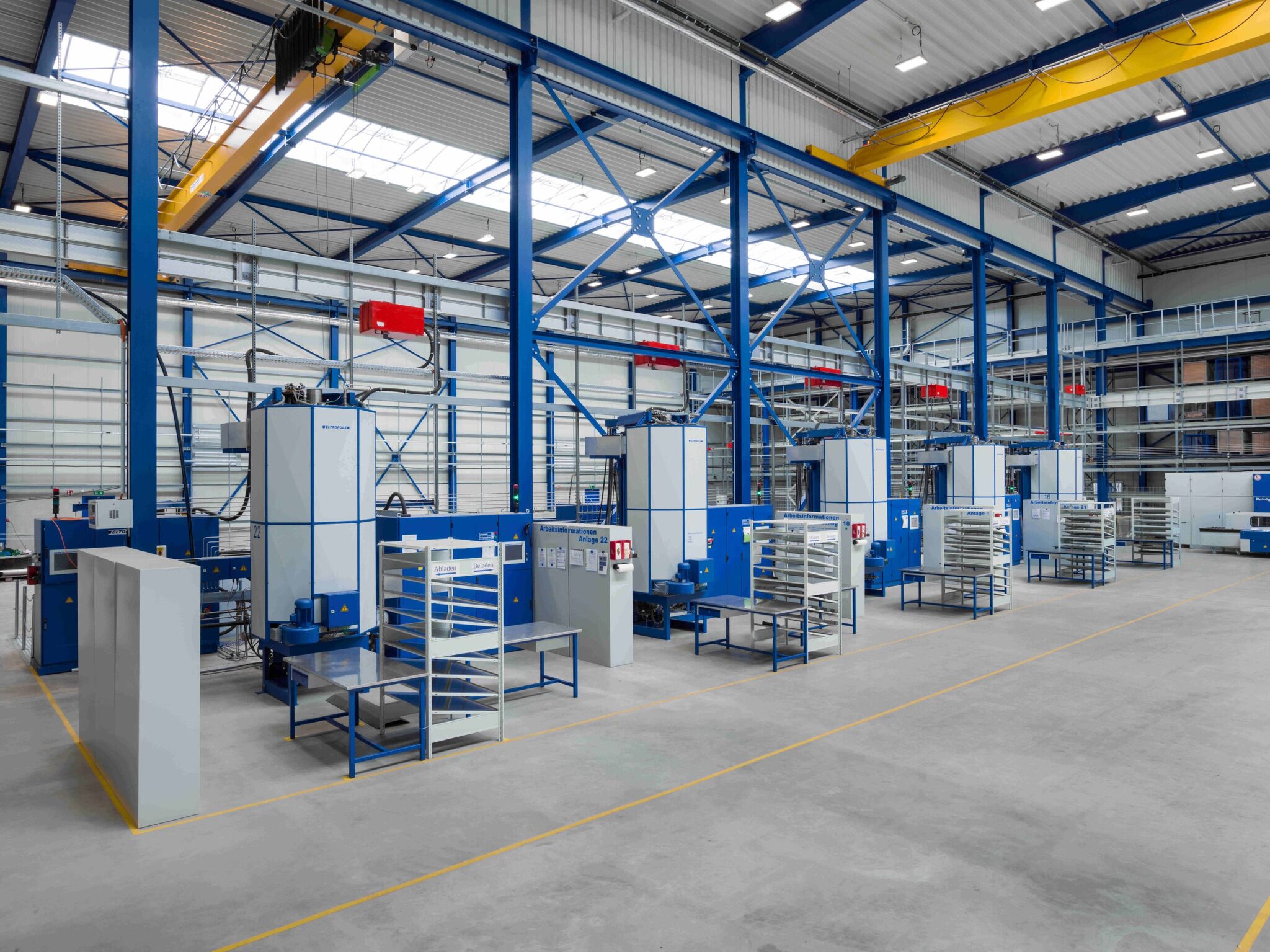
“Eltropuls built rotary hearth furnaces in the past but in most cases, this was not economically feasible due to the extra effort and cost you need for vacuum locks. If a continuous flow of parts is needed, for example in single piece flow machining, a small buffer space and an automated loading system is often more economic.”
What product is most suitable for Ion Nitriding?
“Hmmm, that is a very difficult question. I think the most obvious examples would be products that need selective nitriding (without painting) and stainless-steel products. I personally love the advantage the partial treatment brings to our customers, and I like to see the surprise in their faces in their faces when they see how easily this can be done.
Also, products where a manufacturer wants the heat treating to be “in line”. Plasma nitriding systems can very easily be integrated into a production line because the process is very clean.”
In Europe Ion Nitriding is very well known, but it is not well known in North America-why?
“The main reason might be that we are located in Europe. 😉
Seriously though, our first customers were actually mostly in the United States because Americans tend to be more innovative than Europeans. However, many heat treaters in the USA had bad experiences with the more primitive “Ion Nitriding” prior to the 1980s and this prejudice still seems to be around today. In Europe we had to spend a lot of time evangelizing to get rid of the bad image the process had.”
How has technology evolved over the years?
“The biggest leap in technology was when we introduced the pulsed process right at the start. Since then, we have continuously improved the process mainly in two areas. One focus is on efficiency and ease of use. Modern systems need much less energy, gas and maintenance than the original systems. The second area is on size and integration of other surface technologies. We have delivered plasma nitriding systems of up to 6,4 m diameter and above 5 m in height. Also, recently we also integrated PVD Coating into the same technology platform as the nitriding.”
“One of the short and mid term goals is to conquer the American market. Long term we want to further strengthen our technological lead especially in the area of combined processes like Nitriding and PVD Coating.”
Thank you Kirsten, we very much appreciate you sharing your knowledge.

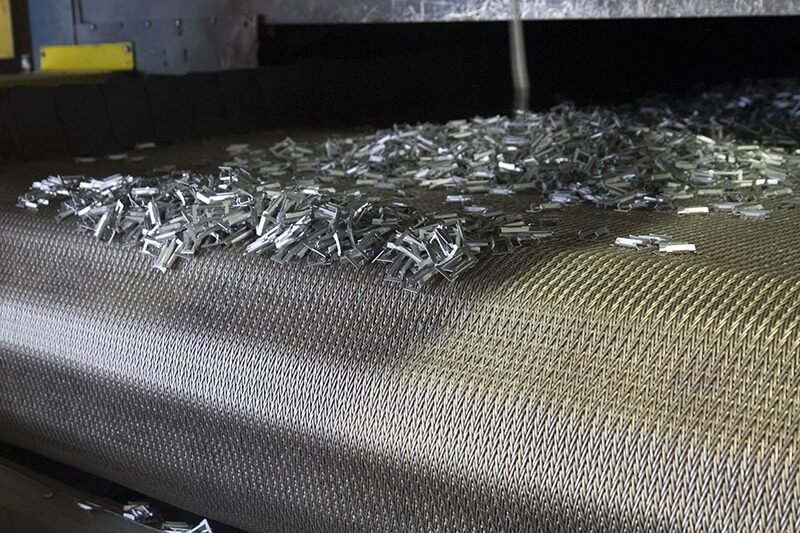 “Commercial Spring & Tool Company Ltd.” in Ontario, Canada has since 1973 been producing a wide variety of fasteners, stampings and clips, many of which are destined for the automotive market. During this time the firm has largely done their austempering in house, originally in a variety of mesh belt and shaker hearth furnaces. However over the years the company has done less and less in house until early in 2024 the company was down to a single older, mesh belt austemper line.