Commercial heat treater Metex Heat Treating in Mississauga, Ontario, Canada has consistently made the annual list of the 50 Largest Commercial Heat Treaters in North America as ranked by “The Monty Heat Treat News”-find out how they compare at https://themonty.com/project/t
Very recently Metex placed an order for what will be their 8th batch IQ furnace, this unit will be gas fired with working dimensions of 36″ X 72″ X 36″ and will be provided by AFC-Holcroft. Delivery and installation is expected for late 2023. To find our more about Metex we would suggest watching a “Heat Treat Podcast” provided by “The Monty Heat Treat News” in 2022. In this podcast our host Mr. Carlos Torres speaks with the President and CEO Mr. Raman Bawa about heat treating fasteners. https://www.youtube.com/watch?
Did you like this article? Click here to subscribe to The Monty.
View our recent magazines and podcasts by clicking the following link. https://themonty.com/magazine/

Mark has spent most of his life in the US heat treating industry, most recently as Techincal Manager with Thermal Process Holdings. Recently he made a substantial career change and entered the world of 3D printing-this is his story;
“Mark DeBruin, who was previously with Thermal Process Holdings and Delta H furnaces, has moved to a position. He is now working at Skuld LLC’s a startup company as their CTO. Skuld is developing a new manufacturing process that combines 3D printing with lost foam investment casting. Their CEO, Sarah Jordan, also has a heat treating background including working at Timken, CMC Impact Metals, and as a Nadcap Staff Engineer for heat treating.
Jordan reports, “We are developing a process to finally make 3D printing as cost effective as traditional manufacturing. Our process is 10 times more accurate than sand printing, 10 times faster than investment casting, and cheaper than either of those or direct metal 3D printing.” The company’s new technology which they call AMEC is a finalist in the 3D Pioneers Challenge to be held at Rapid Tech 3D in Germany in May.
The company is currently using AMEC to produce aluminum parts but has demonstrated the process in a wide range of alloys. DeBruin indicated that later this year they plan to expand casting to higher temperature alloys such as 304, 330, HU, and HT stainless steels. He says, “Once we get our 3 induction furnaces installed, we will be able to produce baskets and heat treat fixtures directly from casting without tooling.” The company also reports that they have 3 heat treat furnaces that they plan to install later in the year.”
Did you like this article? Click here to subscribe to The Monty.
View our recent magazines and podcasts by clicking the following link. https://themonty.com/magazine/


Gear failures have been a subject of many engineering articles, also addressing thermochemical methods used for improving performance and longevity [1-11]. Gear failure can be very complex. Many gears fail from bending fatigue as a result of cyclic bending stress at the tooth-root fillet and this location is often very critical for improving longevity of these components [1]. Pitting, scuffing and wear are the next failure modes and are the result of the rolling/sliding contact fatigue (RCF) of the tooth surface and subsurface layer.
Thermochemical treatments applied to steel gears, such as carburizing and nitriding, allow for inducing a compressive stress at the surface and increased hardness which are very effective in increasing durability of the gear components.
Heat Treating to Reduce Gear Failure
Carburizing
Carburizing has been a well-known conventional surface treatment used for hardening of many gears for a long time [3]. Benefits of this process are mostly related to its ability to form a very deep case in many carburizing steels. The achievable case depth reaches 5 mm (0.2”) and this is important when a danger of the core crashing exists. This technology however, requires a high temperature for the treatment, leading to unwanted dimensional changes of the teeth during quenching and the low tempering temperature. Typically, extra significant machining is needed to make the necessary dimensional corrections after each carburizing process. Also, the low carbon steels don’t harden in the core of the gear structure leaving it with a lower tensile strength than needed for the construction of many gears.
Nitriding
Nitriding is carried out with the mid-carbon, low alloy steels at low temperature, below any phase transformation in the steel so dimensional changes are very limited. Also, the nitrided layer has much better thermal resistance than the carburized layer because of a good stability of the alloying nitrides of chromium, molybdenum, titanium and other elements present in those steels. Because of low temperature, nitriding also assures a higher strength of the treated steel in the core of the gear structure. However, since nitriding is performed at much low temperature than carburizing, diffusion of nitrogen is much slower than diffusion of carbon resulting in much thinner layer, typically ≤ 1 mm (0.040”).
The Differences between Nitriding Heat Treatments of Gears
The Plasma/Ion Nitriding Process
This process is carried out in a vacuum chamber/furnace connected to the DC power supply in an atmosphere of nitrogen mixed with hydrogen. The load/gear has a negative-cathodic polarization and the chamber wall has the anodic polarization. Ions and neutrals-energetic particles generated near the cathode bombard its surface and produce active nitrogen atoms as well as the ammonia radicals. As a result, nitrogen atoms are subjected to chemisorption at the surface and diffuse into the steels. The entire treated surface is covered with the glow discharge, Fig. 1. Masking/protection of the selected surfaces from hardening is very simple; it is done with the steel bolts, plates, etc. which cover them and protect from a contact with the glow discharge.

The nitrided layer is very hard and its thickness reaches 0.040” (1 mm), if required. Such a layer increases bending fatigue resistance of the teeth, as well as the RCF and wear resistance.

It should be noted that the core hardness of the modified Ultra-Strength 4340 type steel after nitriding stayed very high, which is a result of the low temperature of the treatment. This is important in maintaining its high yield strength. Benefits of plasma nitriding of large gears include ability of the method for forming the nitrided layer with a very minimum compound zone thickness as well as the easiness of simple, mechanical masking of the not geared sections such as its center and other surfaces, see Fig. 3.


Fig. 4. The large-sized, low-noise second reduction marine gear after plasma/ion nitriding
Picture taken at Advanced Heat Treat Corp., in Monroe, Michigan.
The Gas Nitriding Process
Gas nitriding is a simple process with a long history of successful applications. Its modern/current version, uses ammonia, ammonia mixed with the disassociated ammonia or ammonia mixed with with nitrogen. The process is controlled by setting nitriding potential and/or nitriding potential with availability of nitrogen (disassociated) and those are set with a proper software and require advanced measuring devices. The latter are important for controlling very precise cycles, which require production of the layer with a minimum compound zone.
The gas nitriding method has also been successfully used for treating various gears. Although the produced nitrided layer has the required thickness and hardness, its compound zone has a tendency to be too thick and must be mechanically removed after processing after gas method. Also, masking/protecting from nitriding in gas nitriding is more complicated than in ion nitriding. It requires a galvanic plating with a copper, which has to be removed after the processing. Benefits of gas nitriding or nitrocarburizing (FNC) can be seen when gears that do not require masking need the treatment and especially those which are very small, Fig. 5.
Did you like this article? Click here to subscribe to The Monty.
View our recent magazines and podcasts by clicking the following link. https://themonty.com/magazine/


“The Solar Atmospheres of Michigan Chesterfield facility took delivery of their first vacuum furnace this week. The furnace has a working hot zone of 36” wide x 36” high x 48” deep and can handle workloads up to 5,000 lbs. To power this furnace along with nine other vacuum furnaces, a new 2600kVA transformer was installed. Things are moving along well! We anticipate to be fully operational in Chesterfield by the Fall of 2023!”
“MARCH 9th, 2023; The Monty Heat Treat News” Visits Solar Atmospheres of Michigan. January 9th of this year it was announced that commercial heat treater Vac-Met in Michigan had been acquired by Solar Atmospheres. That announcement also mentioned that the 9 existing vacuum furnaces at Vac-Met would be moved to a brand new location in Chesterfield, Michigan.
Armed with this information Gord Montgomery of “The Monty Heat Treat News” visited the existing Vac-Met locations and the new facility with tour guide Bob Hill, President of Solar Atmospheres of Michigan. Based on this tour “The Monty” has a couple of pictures to share with you showing the progress which has been made.
The second picture shows the next furnace which will arrive, this VFS 2 bar furnace has working dimensions of 10’ X 84” X 84” and is currently located at the Vac-Met location in Fraser, Michigan. In front we see Gord Montgomery, Bob Hill and Andrew Cronkright who will be the Production Manager in Chesterfield.

The final photo happens to be our favorite. In it we see Bob Hill in the new plant, a facility which is right on schedule to meet the planned start date of the end of 2023. As you can see Bob is positively beaming at the progress that has been made and rightfully so.

“Chesterfield, MI, January 9, 2023 – Solar Atmospheres of Michigan, formerly Vac-Met, has recently purchased 18,000 square feet of plant space on four plus acres in Chesterfield Michigan. The new building is 20 miles Northeast of the two existing Vac-Met facilities which are currently located in Warren and Fraser Michigan.
Bob Hill, President of Solar Atmospheres of Michigan Inc states, “We are working feverishly in 2023 to prepare and equip this new facility to make it our fifth state of the art vacuum heat treating and brazing facility in the United States. Once all of the electrical, water cooling and specialty gas utilities are installed, we will strategically relocate the nine existing vacuum furnaces to their new home. Additionally, two new vacuum furnaces were purchased from Solar Manufacturing.” Hill continues, “This investment of over $5 Million dollars gives Solar Atmospheres of Michigan the space to locate our valuable employees and equipment under one roof while continuing to grow the Michigan vacuum thermal processing needs.”
Did you like this article? Click here to subscribe to The Monty.
View our recent magazines and podcasts by clicking the following link. https://themonty.com/magazine/
Conveyor Hardening – Mesh Belt versus Cast Link Design: Reducing Carbon Footprint and Costs by: P. Kleinbrod, Aichelin GesmH
Conveyor belt furnaces are a proven technology for quenching and tempering fasteners (screws, bolts and nuts). The parts are fed as bulk material and transported on metal conveyor belts through the hardening and tempering furnace, as well as through the oil quenching unit and washers (Fig. 1).

Fig. 1: AICHELIN cast link belt furnace (750 kg/h / 1,700 lb/h)
Conveyor belt furnaces with mesh belts are ideal for small and medium capacities up to approximately 750 kg/h /1,700 lb/h. They are highly flexible and economical (M2x4 up to M14x180). However, the mesh belt furnace has higher energy costs due to the continuous cooling and reheating of the belt. For production, a line with an internal cast link belt is technically and economically the better alternative. These advantages are particularly significant for higher production capacities in the range of 750 to 2,500 kg/h / 1,700 to 5,500 lb/h (Fig. 2)

In addition to the technical advantages of the cast link furnace, such as twice the output per working area and 5 times the belt life, the reduced energy requirement for heating of the hardening and tempering furnace also results in a reduction in CO 2 emissions of 10-20 %(depending on working temperature and throughput).
The following table (Tab. 1) provides an overview of the energy consumption and the related energy costs and CO 2 emissions for the two different furnace types (mesh belt vs. cast link design) – based on an electric heating system and a production capacity of 1500 kg/h / 3,300 lb/h. The cast link belt hardening furnace shows a reduction in required heating power of 77 kW. This is primarily due to savings in belt reheating, to a lesser extent due to reduced process gas volume and minimized wall losses.
Did you like this article? Click here to subscribe to The Monty.
View our recent magazines and podcasts by clicking the following link. https://themonty.com/magazine/

In August of 2022 “The Monty Heat Treat News” had a news item about an Australian based company by the name of PWR Advanced Cooling obtaining their Nadcap accreditation and at the same time adding more heat treat capacity at their facility in Australia and also in the US. This press release from the successful vendor SECO/WARWICK provides more details. Read on for more details from “The Monty Heat Treat News” about PWR’s heat treating capabilities.
“The SECO/WARWICK Group will provide Australian PWR Advanced Cooling Technology with two Universal Batch CAB furnaces and a CAB continuous line. The furnaces will be used for brazing aluminum heat exchangers. The three solutions on order will go to two continents – Australia and North America both owned and operated by PWR Advanced Cooling Technology. PWR Advanced Cooling Technology has been specializing in the production of modern and efficient heat exchangers since 1988. SECO/WARWICK solutions were previously purchased by this Partner in 1996 and 2005. The current contract is the third purchase of technologies designed to meet the new production challenges related to the brazing process.
Two furnaces, the continuous CAB line and Universal Batch CAB Furnace, will be delivered to production plants in Australia. The second chamber furnace will be delivered at the same time to the American branch of PWR, C&R Racing Inc. SECO/WARWICK in Poland is responsible for the chamber furnace supply, while the continuous CAB line will be delivered by the Group’s Chinese branch.
“AUGUST 5, 2022. Captive Heat Treater PWR Receives NADCAP Accreditation-Plans on Adding More Heat Treatment; PWR Advanced Cooling Technology based in Ormeau, Australia is a high end supplier of heat exchangers. While based in Australia the firm also has facilities in the UK and the USA. PWR is rightfully very proud of the fact that they just received NADCAP Accreditation for both their chemical processing and heat treating operations which makes them the only company in Australia to have both. The centerpiece of the heat treat department is a very impressive, large TAV vacuum furnace designed for vacuum brazing. In addition PWR has two Controlled Atmosphere Brazing (CAB) furnaces, the first being a continuous belt with the second being a single batch type furnace.
The firm also has plans on adding heat treatment capabilities at their facility in the USA in the future. Congratulations are certainly in order for the entire team.
“Nadcap, administered by the not-for-profit Performance Review Institute, recognised the company following audits of their chemical processing and heat treating sites. The confirmation has enabled the company to undertake vacuum brazing, heat treating, hard anodising and conversion coatings, as well as supporting conformance processes, while being formally listed on the Quality Manufacturers List for chemical processing and heat treating. According to Kees Weel, managing director of PWR, the recent announcement reflects the company’s philosophy of quality. “Building on our existing AS9100D certification, Nadcap accreditation demonstrates PWR’s determination to ensure quality is at the centre of everything we do. This milestone allows PWR to be the only Australian company to offer both Nadcap-accredited heat treating and chemical processing within the same business,” he said.”
Did you like this article? Click here to subscribe to The Monty.
View our recent magazines and podcasts by clicking the following link. https://themonty.com/magazine/

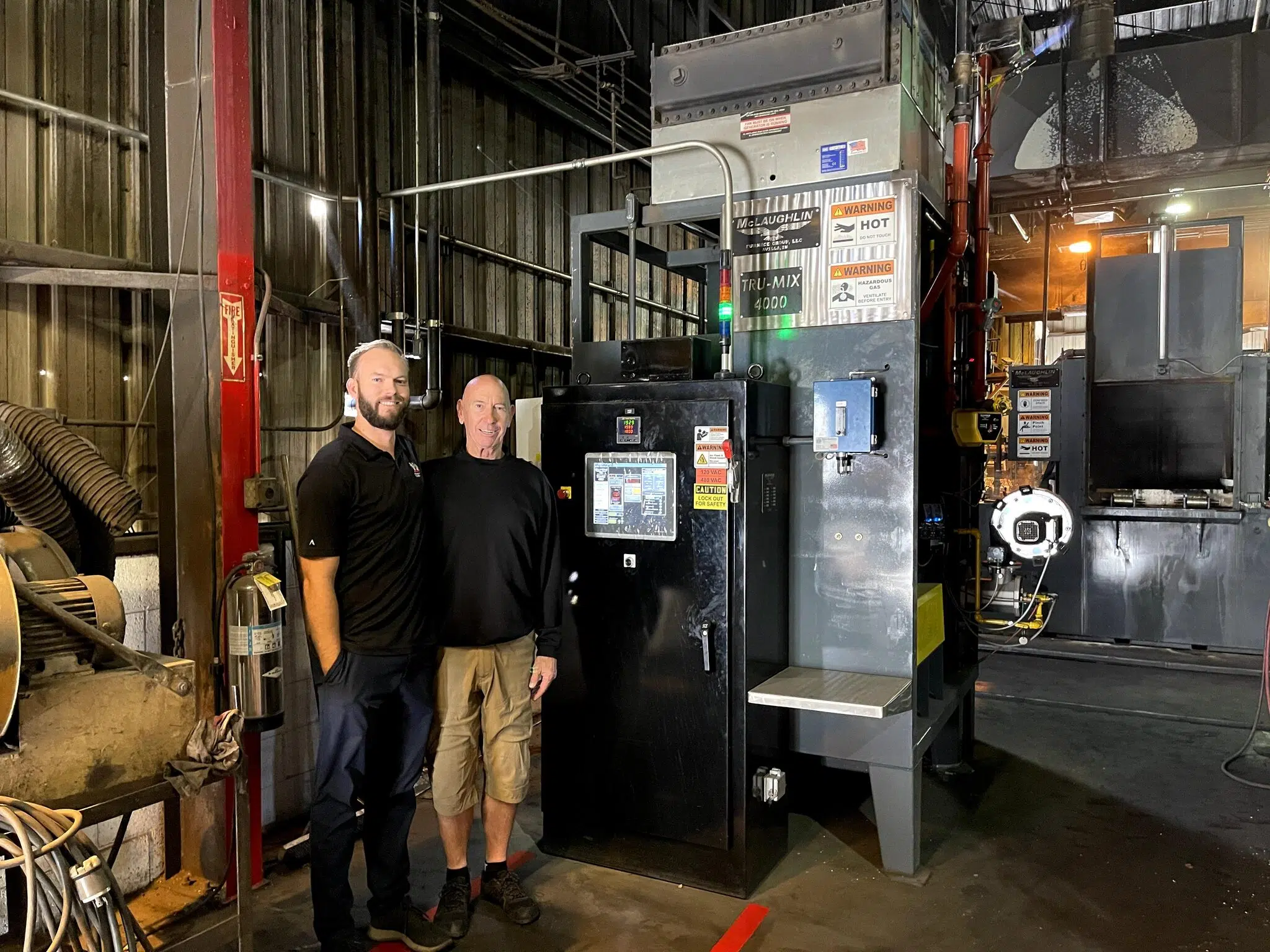
In November of 2022 Dale and Gord Montgomery had the priviledge of visiting commercial heat treater Phoenix Heat Treat in Phoenix, Arizona, USA-our summary can be found below. Today we are able to give you an update about the company adding more furnace capacity. As we speak the company is taking delivery of a completely rebuilt, like new “Super 30” batch IQ furnace originally built by Surface Combustion of Maumee, Ohio. The rebuild project, which was done by McLaughlin Furnace Group of Avilla, Indiana consisting of replacing all alloy, controls, flowmeters and burners with brand new components which were tested before delivery. The furnace will compliment existing Surface batch IQ furnaces already in place. This photo shows Charlie and Pete Hushek standing in front of a new endothermic generator again provided by McLaughlin.
“NOVEMBER 21, 2022. Phoenix Heat Treat Gives “The Monty Heat Treat News a Tour”; As previously mentioned commercial heat treater Phoenix Heat Treat gave “The Monty Heat Treat News” a 5 star tour of their facility this past Friday, a tour which we have been looking forward to. As the largest commercial heat treater between San Diego, CA and Dallas, Texas, USA we were anticipating a fairly large facility with a number of processes and we were not disappointed with what we saw.
Founded in 1963 by the grandfather of the current President, Mr. Pete Hushek the company now has 67 employees and a very substantial facility. Arizona is not known for a large manufacturing base which means Phoenix (NADCAP accredited by the way) by necessity offers a wide variety of thermal processing capabilities including aluminum heat treating, carburizing, gasnitriding, vacuum hardening, annealing, austempering and martempering-have we forgotten anything? If so the full list is available at Phoenix Heat Treating – Quick Quote – We provide tighter process control with higher quality at lower costs (phoenix-heat-treating.com)
What is striking about the company is the knowledge which has been passed along through several generations of Huskeks. In 3 hours of speaking with Pete we learned more heat treat industry tricks than we have learned in the past 5 years. A phrase which he used caught our attention as something we should remember it goes like this; “Metal is not very smart but it has a mind of its own in terms of its characteristics which means you have to trick the metal into doing what you want”-Pete went on to use some very interesting examples which could only come from years of experience. Pete’s son Charlie who is General Manager has quite obviously absorbed this knowledge from his father.
Phoenix is currently on a very strong growth curve which includes recent additions such as a larger drop bottom oven installation for processing aluminum, another very exciting addition which the firm is looking at includes-well we will have to leave that for a future date.
When we quizzed Pete and Charlie about what they see in the future for heat treating they were unanimous in saying that additive manufacturing is creating some very exciting opportunities, opportunities which are still being explored. Charlie added that he has always felt that the heat treatment industry is too secretive in terms of the processing and that more transparency in the industry would benefit both manufacturers and commercial heat treaters a sentiment which we would agree with.”
Did you like this article? Click here to subscribe to The Monty.
View our recent magazines and podcasts by clicking the following link. https://themonty.com/magazine/
The largest captive/commercial heat treater in Portugal is a steel supplier by the name of “Ramada Acos SA”. “The Monty Heat Treat News” visited their facility in Ovar, Portugal in 2021 and what we saw was a very substantial and impressive heat treat department with a mixture of atmosphere and vacuum furnaces (our profile of the company and updates can be found below.
The firm graces our pages today as they very recently installed 2 new “twin” furnaces supplied by French furnace builder BMI. The basic idea is that the 2 systems have an integrated energy management system, using only two vacuum pumps instead of four, thus reducing the electrical consumption of the equipment and installed power.

“MAY 2, 2022, OVAR PORTUGAL; How Are European Heat Treater Coping with Higher Energy Costs? High energy costs are a challenge to all heat treaters around the world, and particularly challenging to heat treaters in Europe. So what is the solution? We look to captive/commercial heat treat Ramada in Ovar, Portugal for a solution, a solution they outline in this note below. To cut a long story short the company is absorbing 80% of the cost increases themselves and passing on only 20%. “The Monty Heat Treat News” chose to look at Ramada as we are very familiar with the firm having visited just a few months ago. In addition Ramada is a reasonably large facility with a mix of atmosphere and vacuum furnaces which makes them fairly representative of heat treaters in Europe. Further down we have a summary of the company as we saw it just a few months ago.

Ramada Aços, at least in this initial period, will continue to bear the highest percentage of extra costs (80%) passing on to our customers at this time only 20% of all extra costs. However, given the current unpredictability of the costs of electricity, gases and fuels, we might have to review the percentage of cost distribution of the applied rate in the future. The evaluation of this “extra energy” fee will be carried out on the first business day of each month. The updated information will be available for consultation on our website https://www.ramada.pt/pt/extra
In order to facilitate the identification of the “extra energy” value, it will appear on the invoice, duly highlighted. We will as a company continue to work according to good practices, with the knowledge, experience and requirement of strict compliance with stages, temperatures, pressures, speeds and gas use, in order to continue to obtain the best performance of tools, molds and parts, subject to heat treatment. It is our intention that the application of this “extra energy” is temporary and we strongly hope that the current situation will fade away and that everything will quickly return to normal. This extra energy charge will be withdrawn when energy costs are less than €80/MWh.”
“NOVEMBER 26, 2021, OVAR, PORTUGAL; We have now concluded Part I & II of our series about heat treatment in Portugal, we now move on to Part III which features a company by the name of Ramada ACOS a captive/commercial heat treater located in the northern part of Portugal in the city of Ovar. The firm is another example of a company which offers some of the most “state of the art” heat treatment processes available anywhere in the world. Ramada has been in business for more than 75 years both as a heat treater and a distributor of steel for Uddeholm. The company has 13 vacuum hardening and vacuum nitriding furnaces all from French furnace builder BMI along with 8 sealed quench furnaces with oil quenching https://www.ramada.pt/pt/servi
The vacuum furnaces include a hardening furnace with dimensions of 1200 mm X 1200 mm X 1800 mm (48″ x 48″ x 72″) with 13 bar nitrogen quenching, a vacuum carburizing system, several tempering units and some nitriding systems. Every single one as mentioned previously was provided by BMI in Lyon, France and in many cases Ramada has been the testing ground for new processes being developed by BMI.
The firm reports business to be very good this year although with the usual trials and tribulations caused by current supply chain issues. In spite of these trials the entire company is posed to grow and expand in 2022.
Did you like this article? Click here to subscribe to The Monty
View our recent magazines and podcasts by clicking the following link. https://themonty.com/magazine/

“The Monty Heat Treat News” will be closed Friday, April 7, 2023 due to Easter Friday. Regular news items will resume Monday April 10.
Did you like this article? Click here to subscribe to The Monty.
View our recent magazines and podcasts by clicking the following link. https://themonty.com/magazine/

(Virginia Beach, VA, USA) — Busch USA is pleased to announce the acquisition of Vac-Tech Inc., a vacuum pump service and sales provider for precision high vacuum pumps in the semiconductor, electronics, and solar markets. Vac-Tech has two locations, one in Phoenix, AZ, and the other in Richardson, TX.
This initiative expands Busch USA’s nationwide presence by adding complementary high vacuum service closer to customers in the Western part of the country.
“We are very excited about this acquisition,” says Busch USA President, Turgay Ozan. “Vac-Tech has been a trusted service and sales provider for many years and bringing their team of vacuum experts under the Busch company provides even more value to our customers.”
The new Vac-Tech service locations offer vacuum pump repairs, component replacements, valve rebuilds, parts cleaning, and used vacuum equipment sales for many different brands and pump types.
- Mechanical pumps, rotary vane, rotary piston
- Dry pumps, scroll pumps
- Cryogenic pumps and compressors
- Turbo molecular pumps
- Diffusion pumps
According to Busch USA Vice President of Medium High Vacuum Sales, Mark Magill. “Vac-Tech joining Busch demonstrates our commitment to our customers through every step of the after-sales process from start to finish.” He added, “Busch is dedicated to helping customers get their pumps serviced quickly while ensuring exceptional quality workmanship.”
Vac-Tech will retain its brand and business operations as A Busch Group Company.
Did you like this article? Click here to subscribe to The Monty.
View our recent magazines and podcasts by clicking the following link. https://themonty.com/magazine/