
Gord Montgomery (GM). March 5, 2024 Gord Montgomery of “The Monty Heat Treat News” interviewed “Mr. Steven Christopher” of controls company SSi an interview which can be found at “Steven Christopher of Super Systems Inc.-The Interview”. Steven, in our last interview we spoke about a number of topics including flowmeters, automation and your personal background to name just a view. Today let’s talk about what is new in the heat treat industry in general and specifically what is new at SSi.
(GM). AI (Artificial Intelligence) fascinates me, both from what it can provide today but more importantly where it will take us in the future. I understand that you and your team are also exploring the possibilities it offers so my first question is-how seriously is SSi taking this new tool for lack of a better word?
(SC). Hi Gord, thanks for the opportunity to return. “Seriously” is a great descriptor and we are taking this seriously. AI is a huge opportunity and we are building, actually weaving, DataCenter AI (DCAI) into the fabric of our software. For years we have helped customers collect tremendous amounts of process data, now we are focused on helping them put that information to work, identifying opportunities to improve quality, reduce operating costs and overall make better decisions. We have regular meetings, bringing in views from different departments, to help navigate the effort. I think the beauty of AI is it makes it easier for non-software people to be part of the discussion. Our meetings avoid software-centric approach, seeking input from all the business units. Our sales and engineering teams are our front lines and active in these conversations. But in reality the best ideas start with our customers, what do they want that doesn’t exist? What challenges them day to day? In that light, software is just an opportunity to deliver what heat treaters are asking for, and AI the vehicle to speed that up.
(GM). In the near term how can we see AI applied in SSi products and applications?
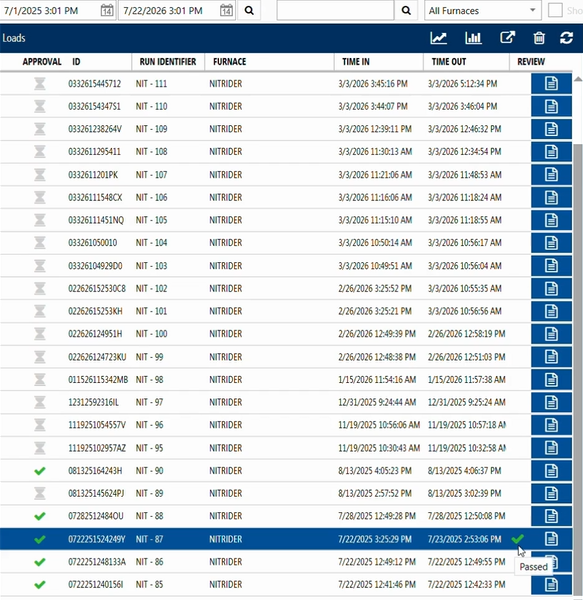
(SC). Before you used the word serious to describe our approach, now let me use the word “curiosity”. We approached AI with a certain curiosity because it inevitably feeds itself. We started off using AI as a tool within our software team to speed up development, debug code, and so on. That led to the realization that we sat on mounds of data that never left a spreadsheet and was filed away on the network—not too different than heat treaters process data in many ways. So we started using AI to make this data easier to access, from dashboards to reports to whatever. Our curiosity naturally shifted our inward thinking to outward. We realized the power in reviewing massive amounts of data and developed that in our latest product, Goal Posts (GP). GP in simple terms is an automated chart review, confirming jobs meet all the temperature, soak and any other requirements along the way. A lot of people saw this at FNA and the feedback was nothing short of amazing. Going back to what I said before, customers are our inspiration and they have been asking for this for a long time; though we had to lean on AI to deliver the final product.
(GM). Looking out to a distant horizon how do you see AI affecting SSi and the heat treatment industry in general?
(SC).This is why I love the topic, because I honestly can’t come up with an answer! This is sort of like repeating the dot-com boom, we all knew this was the future, but beyond creating our own website didn’t understand how prevalent it would become in daily life. Everyone I supposed besides Jeff Bezos who had a clear vision and went all in; now we can’t imagine life without. AI is today where the internet was in the late 90s, only the signs point to this moving even faster. So the distant horizon is not a decade from now, but a year from now. But I want to give a concrete answer and not skirt the question.
I see DCAI in particular making life easier on that distant horizon. On the front end users will be able to scan a spec or talk to a prompt, and it will construct an appropriate recipe. In cases where there is enough data it will be intelligent enough to tailor recipes based on unique furnace characteristics–consider two seemingly identical furnaces but one has a slightly faster quench rate, resulting in higher hardness. When I was cutting my teeth at a commercial heat treater, I remember punching parts’ as-quenched hardness, then asking opinions and consulting tables to find the perfect tempering temperature to achieve 40HRC.
AI eliminates all of this, these in the moment discussions will go the way of the card catalog. A new operator will interact with controllers in such a way that they’re guided to the optimal temperature to draw back hardness. On the shop floor it will remove ambiguity around furnace alarms and errors, pointing users to the exact problem, explain their options, along with how to do what. We want to shift from intelligent controllers to “self-aware” controllers; capable of making evaluations (and ultimately recommendations/adjustments) as to quench problems, production bottlenecks, and more. Of course this is just what I can predict, AI is going to take it even further.
(GM). Before we move away from this subject do you share some of the concerns which we see voiced about AI? Namely, is it going to cause mass unemployment?
(SC). Restructuring, of course. But unemployment, no way. We have had these Luddite concerns before and naturally there will be winners and losers, but mass unemployment is unlikely. There are a lot of jobs today built around market and data research, creating summaries for someone else to make informed decisions. AI is going to reduce jobs on the research side, after all it can consume thousands of pages of content very quickly. But in doing so it is going to produce even more information and entire teams of people will be required to act on it. AI agents are excellent at tasks that may be challenging, or less efficient, for humans. Leaning on AI as a tool doesn’t replace operators, rather allows them to shift their time and efforts to other priorities. But that’s the beauty of technology, it does not eliminate one job without creating new ones. To relate this to heat treat, imagine AI evaluating so much data that it cannot only predict maintenance, but recommend the optimal time to perform such a task to limit the impact on production—you may need a larger maintenance team to act, so it may create jobs in some ways.
(GM). Let’s move on from AI and look at a new product which SSi very recently introduced to the market, a software called “Goalposts”. The system is promoted as being designed to manage, monitor, and optimize thermal processing and heat-treating facility operations but what does that mean exactly?
(SC). We are really excited for Goal Posts. Monitoring has always been part of our SuperDATA suite, specifically with SDRecorder. The “manage and optimize” components existed before as part of our Load Entry software, GP is just one more tool in that toolbox. I would describe GP more as a quality tool and time saver. Ten years ago, we asked customers to describe their biggest challenges and they said operators running the wrong recipes; so we built a Parts database into Load Entry; problem solved.
Recently when we asked the same question, they all struggled with chart review. We repeatedly heard how difficult it was to find a talented quality person and often that talented person had options and moved on, they were difficult to pin down. At the end of the day even with the right people in place it was a hard job and human error inevitable. Then the problem was exacerbated with the labor crunch, so the time required to review charts became equally important. So we went back to the drawing board, came up with a plan, releasing what we now call Goal Posts.
GP allows Load Entry users to build specifications, defining time at heat, overshoot, starting and ending quench temperatures, dew point limits, really whatever is required by the process. To me we can call them widgets, because the user can literally enter any parameter they want, then audit the charts accordingly. Without even a single click, our jobs are evaluated as pass/fail and visually indicates as such on the history dashboard. For those jobs that failed, with a single click the user sees in red text the exact reason for non-compliance. Can you imagine the time saved? The paperwork avoided due to errors? I can’t remember the last product that I was this excited about—2027 is going to be a heck of a year as this rolls out!
(GM). How does this system fit in with your tried and proven “SuperData” system? Will it be an integral part of “SuperData” or an add-on option?
(SC). I almost finished the last response with “and the best part is it folds up nicely into the existing Load Entry system”, so glad that I didn’t say that! But that’s the answer here, it’s just an extension of Load Entry. Users have already built their Parts and Recipes, now they just build a Specification and it works without altering their daily routine. If you don’t mind me rambling a bit, Goal Posts is just one piece of the Load Entry puzzle. Users can lock out equipment due to maintenance issues or overdue pyrometry using our Maintenance module.
It kills a piece of me every time I hear a job being run beyond the qualified TUS dates, why? Why not build this into the system and prevent it from ever happening again? Another often overlooked component of Load Entry is Scheduling. Users can finally eliminate those production office white boards, and here again AI enters the picture. Today we predict door-to-door time by evaluating past runs, and in the future, we look to optimize scheduling by suggesting users combine this or wait for that. I really am proud how we have added all these features but managed to keep the product simple and intuitive. That is not always easy, but our team has done just that with Load Entry.
(SC). I don’t think we’re groundbreaking in 2026 terms, but we certainly are on the leading edge. Quite frankly the bar for what controls can and should) do is rising quickly. I was inspired at FNA this year seeing what companies are offering. I think GP is part of that rising tide, users just expect more and more from their suppliers and this is part of the ship.
What is unique about SSi is our ability to bring everything under one roof; and we do that in two ways. First, at our core we are system integrators, meaning we can’t specialize in just vacuum or nitriding, but both of them along with carburizing and everything else. Everything we do recognizes that every piece of equipment needs to fit nicely within our ecosystem—and that’s a real challenge. But it is also a real opportunity because it allows us to do all the cool things discussed up until now, no matter the model or type of equipment.
The second pillar to the under one roof philosophy is to be open. We’d love to be Apple and sell the phones and software and chargers and headphones, but we realize the importance of playing nice with others. Revisiting the maintenance example from before, we’d love for every SSi user to build their maintenance activities into our system. It’s certainly capable of it, why not? But we also appreciate that many users have maintenance systems in place which they are quite happy with. Who are we to tell them otherwise? We must be open to sharing information with secure 3rd party systems, which is quite easy via our API. So, if you’re happy with your ERP or pyrometry software, but want to lock out a furnace in your SSi system, why not! Just make the hooks. To wrap it up, we may not be groundbreaking with any single feature, but we sure are one of the few to do it so well and without limits.
(GM). As mentioned our last interview was two years ago and since then the industry has seen some changes, a major one being that one of your larger competitors was acquired by a furnace builder. This changes a lot of the dynamics between furnace builders and furnace controls companies-is this a subject which you could comment on either in specific or general terms?
(SC). Yeah a lot has changed in two years, including my role within SSi. I have taken on the challenge of business development and clearly this type of acquisition is on my radar. That being said this is not the first acquisition to create some, either real or perceived, conflicts of interest and I am thankful that we do not have to navigate such things at SSi.
Their challenge will be keeping an open mind and playing nice with an ever integrating world; perhaps easier said than done when you have hands in different ventures. But to be honest I am entirely focused on what we are going to do next, everything else is just noise.
We’ve talked a lot about software, now add to that our generator control platform [SuperGEN] and new mass flow controller, there is no time to worry about others. We just want to focus on doing what we do better than anyone else. One of SSI’s greatest advantages is that we are not focused solely on a single process. We work across vacuum, atmosphere, nitriding, carburizing and all thermal processes. That gives us a unique perspective on how different equipment operates—creating solutions for heat treat as a whole, not just one type. On the AI front related to that, as we develop AI capabilities, we are combining that experience with years of process information to create something much more valuable than a generic AI tool, it will be intelligence specifically designed for the heat treating industry.
(GM). On a final note, I understand that SSi is setting records these days for sales growth-why? What I mean by that question is that the heat treatment industry globally has seen a lot of ups and downs over the past year. Segments such as automotive and heavy industry are seeing lackluster growth while industries such as aerospace, defense and power generation are struggling to keep up with demand. So how is it that SSi has seen such tremendous growth during this turbulent time?
(SC). You said it, one sector is down but another is up—diversification is key. We host these monthly project meetings where we review everything on the books. Who is going where? What road blocks exist? Pretty typical project management. I remember a few years back these meetings were 75% endothermic work, nitriding and vacuum split what was left. Two years ago that shifted to 90% vacuum—a clear nod to the recent boom in the aerospace and defense sectors. And I don’t see that changing anytime soon, I anticipate that industry will remain strong well into 2028. But diversification highlights why we have seen such tremendous growth and expect to even as the industry makes its next shift.
But backing up a bit, we’re busy today because of choices we made long ago. Ten years ago we were known as an excellent controls company, but we weren’t viewed as the leaders in certain technologies. We invested heavily in expanding our field- and software teams and assembled a really talented team along the way. Heat treaters now look to us as the leaders in vacuum and nitriding even if we don’t make the equipment. We appreciate the recognition but also realize it neither happened by chance nor overnight. We have a lot of experience and clearly the industry sees it and is rewarding SSi with a lot of excellent opportunities. We are very thankful for the growth and excited to partner with so many great heat treaters.
(GM). Thank you for your time, Steven and I hope to be posing new questions to you two years from now.
(SC). Of course Gord, thank you for the opportunity. And thanks for everything that your team does for the industry. The Monty creates this amazing space for everyone to come together as one, and I applaud you for what you’ve created.
