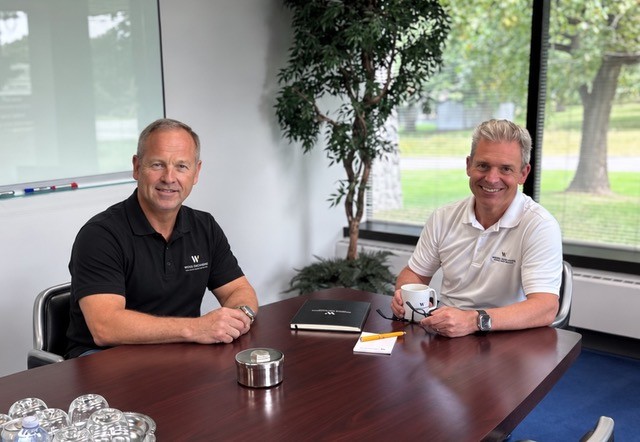
Today we have an interview with industry experts “Thomas Wingens” and “Mark Hemsath” of “Wingens Consultants“.
- Thomas, both you and Mark are pretty well known in the North American heat treat industry, as a matter of fact you both are pretty well known in the global heat treat industry so I don’t believe we need your full background, however a brief synopsis wouldn’t hurt.
Hi Gord, and thank you for the kind words. Mark and I have taken similar, yet different, paths through this industry, and both of our fathers were in this business. I am a third-generation heat treater and have worked for IHI, Bodycote, Ipsen, Seco-Warwick and Tenova, and I started Wingens Consultants 15 years ago. Mark also worked for Seco-Warwick, did consulting work with his father, and was President/CEO of Nitrex, GM Enterprises and UPC-Marathon until the Austrian firm bought them last year. We each have almost 40 years in the industry, including commercial heat treating and furnace companies. Together with our six additional consultants, we cover a fairly broad range of heat treat experience, and we still learn something new on almost every project.
- Mark, not that long ago you made a career change by moving to “Wingens Consultants” which represents a substantial change. I might be getting ahead of myself a little bit, but my first question is; has this been a good career move for you and are you having fun?
Yes, very much so. It has been exactly one year since the Nitrex equipment divisions were sold, with my last signatures on the deal. I was offered the chance to step away, and I took it. Now that my past agreements are behind me, two things have pleasantly surprised me: how much I enjoy consulting, and how interesting and innovative the projects at Wingens Consultants are. In this role I get to help many more companies and people than before, and that is the part I enjoy most. I am glad I can be of help.
- At this point let’s back up slightly, Thomas, can you give us the background on “Wingens Consultants”?
Wingens Consultants works in three connected areas: metallic materials, the furnaces that treat them, and the heat treaters, captive or commercial, who run those furnaces. We have been fortunate to support rare earth magnet material projects; titanium, tantalum and niobium metals production projects; and clients procuring plant equipment such as furnaces and cleaning systems. In short, we aim to be a full-service metals advisory group, and we rely on a wide network of colleagues and partners when a project calls for expertise beyond our own.
- What do you consult on? A basic question yes, but does Wingens get involved in any and every form of heat treating? Steel mills as an example? Foundries? In other words what are the fields that your team focuses on?
Over the years we have worked on projects ranging from powder metals and primary metals to forging, dies, aerospace parts and coatings, cleaning of metals, and recycling of high-value metals, so the work spans quite a few disciplines. Where there is heat and metal, there is a good chance we have seen something similar before, and where we haven’t, we are happy to say so and bring in the right people.
- And you personally Mark, can you give us some examples of projects you have been involved with to date? I fully understand that you probably can’t name, names, but in general terms what occupies your time day to day?
We generally don’t mention current customers, but in broad terms: I am starting to work with a graphite machining and CFC forming group (materials used in vacuum processing). I have also worked with some commercial heat treaters. I will be advising on nitriding of all kinds this month, and I am helping with project management of large furnace installations in an industry that is new to me, which keeps me learning. We would also welcome the chance to support aerospace and industrial gas turbine companies as they expand. Project management is something I picked up early, through my MBA studies, working with my father, building furnaces and the installations and start-ups that go with these projects. I still love seeing equipment installed, tested and commissioned until it runs productively and delivers high-quality output. In those days I did a bit of everything, including writing PLC code, running loads and testing materials.
- Thomas and Mark, I have all kinds of questions such as how long your projects last, are you international and so on and so on. With all due respect when I think of most consultants I think of old, retired guys picking up a few little jobs here and there-obviously this is not you and your team.
Thomas: Thank you, Gord, we will gladly take “experienced” over “old”! We have been fortunate to pick up a number of new clients in recent months, many of them European equipment companies looking at the US market. We help with market messaging and market fit, adapting product design for the US, and supporting messaging materials such as brochures, website content and technical papers. What we bring most is familiarity with these US markets and how to position oneself and sell. Aerospace, gas turbines and rare earth metals are very hot right now, no pun intended, and there are simply not enough experienced people to go around. That is a gap we can help fill now and for the short run, working alongside our clients’ own teams.
- Thomas, money is flowing into this industry. Business are being bought, sold, and merged. We just heard about Private Equity putting in large sums into software for heat treaters and Bodycote, as you know, is a huge deal. We ran an article recently on The Monty talking about PE failures. What are you seeing?
Gord, we are glad to see money coming into the US heat treat market. Between Mark and I, we have seen these transactions from several sides. After acquiring and/or integrating 24 heat treat shops in my Bodycote years, I came back to the US again to help buy companies for strategic and PE investors, and Mark participated in the sale of Nitrex, a PE-owned company, and has secured venture capital in the past. We both have MBAs and enjoy the equity side of the business. We have nothing negative to say about PE; the US heat treat industry needs to catch up with investments, and more of it is needed, not less. What investment in this field requres is people who understand the industry to help structure deals, perform proper due diligence, and, most of all, know how to run the daily business. In this field, getting qualified people is usually the most valuable asset. Deciding who to keep and how to fill the gaps and train and mentor are skills we have. This is precisely where many mistakes are made after the purchase. Having seen what is under the hood of quite a few of these companies, we can often help buyers see early on what is worth paying for, comprehending what they are buying, and what may become an issue a few months after closing. That is where we try to be useful.
- I have known you guys a long time. Mark, you love to boat. I never realized Wingens was this prevalent in the industry. Do you guys have time for all the work that should be coming your way?
Thomas: We are still growing Wingens Consultants. We have started building out a nitriding advisory team with Mark, we will be introducing Dr. “Glow” (Dr. Edward Rolinski) and several other metallurgists, and we are now, in October, advising equipment companies in these areas. The aim is to help users of this equipment (heat treaters) nitride better and choose the right equipment right here in the US. And yes, Gord, we are busy, but we both enjoy the work, and we try to keep a healthy balance, whether that is Mark on his boat in Florida or me running, biking the Pittsburgh hills, or at soccer tournaments with my family. We have also added services and people to support us: last year we implemented an ERP system and increased our back-office staff, so the consulting team can focus on what they know best — heat treating and metallurgy. In the end, our goal is simply to be useful to companies that value experience and careful thinking, and to help them grow with as little cost and risk as possible.
 1. Today we are very pleased to be speaking with a “heat treat industry expert” Mr. Jay Jefsen, now General Manager of vacuum furnace builder “Furnacare”. Jay lets start at the very beginning as they say-could you please provide our readers with a summary about your long career in the heat treat industry, a career which I believe stemmed from your father’s time in the industry.
“My career in the heat treat industry really did start with my father. I grew up around the industry and got my first opportunity at just 16 years old, working in a commercial heat treating plant. At that age, I certainly wasn’t thinking, “This is what I want to do for the next 30 years!” But apparently the heat treat industry had other plans for me.
I spent much of my career on the heat treating side of the business, which gave me firsthand experience with the challenges our customers deal with every day: keeping equipment running, meeting production schedules, maintaining quality, controlling costs, and dealing with all of the unexpected problems that seem to show up at the worst possible time.
Over the years, I eventually found myself on the other side of the business, working in the industrial capital equipment sector and specifically with vacuum furnace technology. And I have to admit, I like this side better! We still have plenty of problems to solve, but now I get to help our customers solve theirs instead of being the guy standing next to a furnace at 2:00 in the morning wondering why it isn’t running.
Most recently, I was promoted to General Manager of Furnacare, where I’m responsible for guiding our North American business. It’s been quite a journey from a 16-year-old kid working in a heat treat plant to helping lead a company that supplies and supports the equipment heat treaters depend on every day.
I think those years on the customer side have given me a perspective that is extremely valuable today. I understand the pressure our customers are under because I’ve been there. And after more than 30 years in this industry, I’ve also learned one other thing: there is always another problem to solve!”
2. I believe your title is “Director of Sales, Furnacare”, but the name “Furnacare” is not as well known as that of your parent company “TAV”. Could you please explain why the two names and provide us with some details about “TAV”; when was the company started, size of the firm, products offered etc.
“First, a small update since we started putting this interview together: I was recently promoted to General Manager of Furnacare, so I now have responsibility for guiding our North American business.
And you’re right, the TAV name is much better known in the industry than Furnacare. I actually have a funny story about that. When I originally interviewed for the job, I thought I was interviewing to work for TAV. Somewhere along the way I discovered I was actually going to work for a company called Furnacare. At that point, I just rolled with it! Fortunately, it all worked out pretty well.
The easiest way to explain it is that Furnacare is the North American business within the TAV family of companies. TAV has several companies focused on different areas of vacuum furnace technology, manufacturing, service, and support. Furnacare gives us the local presence here in North America to support our customers throughout the life of their equipment.
TAV itself was founded in Italy in 1984 and has grown into a globally recognized manufacturer of vacuum furnace systems. Today, TAV equipment is operating in more than 45 countries, with more than 900 furnaces built worldwide.
The product range is quite broad. We manufacture horizontal and vertical vacuum furnaces for applications including heat treatment, brazing, sintering, additive manufacturing, and low-pressure carburizing, serving industries such as aerospace, automotive, energy, medical, commercial heat treating, and general industrial markets.
One of the things that attracted me to TAV is that we aren’t limited to selling a standard furnace out of a catalog. There is a tremendous amount of engineering knowledge within the group, and we can develop equipment around the customer’s process and application.
On the Furnacare side, our job is to make sure the relationship doesn’t end when the furnace shows up. We provide the North American sales presence along with installation, commissioning, technical service, preventative maintenance, spare parts, upgrades, and long-term support.
So, if I’m explaining it simply: TAV builds some pretty impressive vacuum furnaces in Italy, and Furnacare makes sure our North American customers are taken care of before, during, and long after the sale. And thankfully, I eventually figured out which company I actually worked for!”
3. During a recent conversation you suggested that the “Furnacare” name would become less prominent over time-can you share with our readers what this means?
“Well, I guess it’s time to let the cat out of the bag! We are in the process of rebranding Furnacare as TAV USA. It’s something I’m extremely excited about and, quite frankly, I think it makes a lot of sense.
As we discussed earlier, Furnacare has always been part of the TAV family and serves as our North American operation. As TAV continues to grow its presence in North America, we believe having one clear and consistent identity in the marketplace is important. The TAV name is well established in the vacuum furnace industry globally, so transitioning to TAV USA allows us to build on that recognition while making it very clear who we are and what we represent.
It also means I can finally stop explaining that Furnacare does not, in fact, “care for furniture.” You would be surprised how often I get that question!
But joking aside, this is more than simply changing the name on the building or putting a new logo on our shirts. We are making a significant investment in the North American market. We are growing our team, expanding our service capabilities, increasing our spare parts and aftermarket support, and establishing a much stronger local presence for our customers.
The goal is for TAV USA to provide our North American customers with the best of both worlds: the engineering, technology, and manufacturing capabilities of TAV in Italy combined with a strong local organization here in the United States that can respond quickly and support our customers throughout the entire life of their equipment.
So yes, the Furnacare name will become less prominent, but for a very good reason. TAV USA is the next chapter for us in North America, and I’m incredibly excited about where we’re headed. And personally, I’m looking forward to introducing myself as the General Manager of TAV USA. It requires a lot less explaining!”
4. Jay you shared some very exciting news with me the other day concerning your presence in North America, can you now share it with the entire heat-treating community?
“Nice try, Gord! You almost got me. There is definitely some very exciting news coming regarding our continued investment and expansion in North America. Unfortunately, I’m going to have to keep a few of the details to myself just a little longer.
What I can say is that everything we’ve talked about with the transition to TAV USA is about much more than a name change. We have some ambitious plans for this market, and we are investing in the people, resources, and infrastructure needed to support the continued growth of TAV in North America.
A major focus for us is continuing to strengthen our service and aftermarket capabilities and putting our team in an even better position to support customers quickly and locally.
There is another significant piece of that strategy coming, but I think I’ll save that announcement for early 2027. Maybe that gives us a good excuse for another interview in February, Gord! For now, I’ll just say this: TAV USA is growing, we’re investing in North America, and we’re just getting started.”
5. Does this mean that “TAV” is now putting even more of an emphasis on the North American market?
“I wouldn’t necessarily say that North America is suddenly receiving more emphasis. The U.S. market has always been an important part of TAV’s growth strategy. Quite simply, it’s one of the largest and most attractive heat treatment markets in the world, so it’s a pretty good place to play!
What has changed is how we are approaching it. TAV has tremendous engineering and technical capabilities in Italy, and we have been successfully supplying equipment into North America for many years. But succeeding long term in the U.S. requires more than great equipment. You need a strong local presence, local service and support, an understanding of how American customers do business and, sometimes, you just need to speak a little better “Italish” — that unique combination of Italian and English we’ve all become very fluent in!
That’s really where TAV USA comes into the picture. We’re building the bridge between an extremely talented engineering and manufacturing organization in Italy and the expectations of customers here in North America. We are adding people, strengthening service and aftermarket support, and putting more resources closer to our customers. At the same time, we are working very closely with our colleagues in Italy so that we operate as one team rather than two organizations separated by an ocean.
So the desire to grow in North America isn’t new. What’s different today is that we’re putting the structure, people, and resources in place to really capitalize on the opportunity. And after several years with TAV, I’m happy to report that my Italish is getting pretty good!”
6. I gather this is not the only news you have for us today, rumor has it that “TAV” in Italy is also expanding and included in this expansion are acquisitions in your supply chain-you certainly have my attention.
“The rumors are true, Gord. Apparently, we’ve decided that being busy wasn’t enough!
There is a tremendous amount happening within TAV in Italy right now. We are currently completing a major expansion of our manufacturing operations with a new production building that will increase our overall production throughput by more than 50%. That is a significant investment and really speaks to both where the business is today and where we believe it is going.
I’ve joked that we should name it the Marco Baretti and Jay Jefsen Building, because Marco and I have promised ownership a whole lot of future business to help fill it. I’m just hoping that joke ages well! Sorry, Marco, if you’re reading this.
The growth we see isn’t limited to one market or one industry. Demand for vacuum furnace technology continues to be strong across aerospace, defense, energy, additive manufacturing, commercial heat treating, and other advanced manufacturing sectors. As that demand has grown, we recognized that our manufacturing capacity needed to grow with it.
But capacity is only part of the strategy. TAV has also been investing in ways to strengthen the overall organization and gain greater control over critical parts of our supply chain. That includes strategic acquisitions and investments within the broader TAV group.
For our customers, that is really the important part of the story. The goal isn’t simply to become bigger. It is to increase capacity, improve control over quality and lead times, strengthen our technical capabilities, and become an even more vertically integrated organization.
From my perspective here in the U.S., the timing couldn’t be better. We are building a stronger TAV USA organization at the same time our colleagues in Italy are significantly expanding the manufacturing capabilities behind us.
So yes, Gord, there is quite a bit going on. We have a new identity coming in the U.S., some additional North American news I’m apparently not allowed to tell you yet, a major manufacturing expansion in Italy, and continued investment throughout the TAV group. Now Marco and I just need to deliver on everything we promised!”
7. Obviously “TAV” is making some very substantial investments in the company, do these investments include technology investments such as updates to controls systems or R & D projects?
“Absolutely. Technology and R&D are a very important part of TAV’s continued investment and growth.
Now, Gord, I’ve been in sales long enough to recognize when someone is trying to get me to announce our future product-development plans in an interview. And I’ve recently been promoted to General Manager, so I’m going to give you my best career-politician answer here: we are always evaluating opportunities to improve our technology, controls, automation, and overall furnace performance. How was that?
In all seriousness, though, innovation is a major part of what TAV does. Vacuum furnace technology continues to evolve, and our customers are asking for more from their equipment than ever before. Better process control, more data, improved connectivity, increased automation, energy efficiency, predictive maintenance, and easier interaction between the operator and the furnace are all becoming increasingly important.
Controls are certainly part of that conversation, but our R&D efforts go well beyond the HMI or PLC. We are continually looking at the entire furnace system: process technology, mechanical design, thermal performance, vacuum systems, controls, software, efficiency, reliability, and maintainability.
One advantage TAV has is that we are an engineering-driven company. We have some incredibly talented people in Italy who genuinely enjoy solving difficult technical problems. Sometimes maybe a little too much. An American might look at something and say, “That works.” An Italian engineer will look at the same thing and say, “Yes, but we can make it better.” Then three meetings, seventeen drawings, and several cups of espresso later, we have a new solution!
So the short answer is yes, technology investment and R&D are absolutely part of the larger investment strategy at TAV.
As for exactly what we’re working on next… how about we save something for the next interview?”
8. It is apparent that you have been making very substantial investments which of course means lots of money. I am assuming this is backed up by a strong order book-how have sales been in 2026?
“What I will say is that 2026 has been a very strong year for TAV, and we are extremely pleased with where the business is today and, more importantly, where it is headed.
Personally, I’ve never been very comfortable bragging about success. I prefer to let the work, our customers, and ultimately the results speak for themselves. I think many of the things we’ve already discussed tell the story pretty well. We’re increasing our production capacity in Italy by more than 50%, investing in our supply chain, expanding our organization in North America, and transitioning to TAV USA.
Companies generally don’t make those kinds of investments unless they have confidence in both their current business and the opportunities ahead.
What excites me most about our order book isn’t simply the amount of business. It’s the diversity of the customers and markets we are working with and the number of long-term relationships we continue to develop. We are seeing opportunities across aerospace, defense, energy, commercial heat treating, and advanced manufacturing, and we continue to see a very healthy appetite for investment in vacuum heat treatment technology.
We are also seeing existing customers come back to us for additional equipment. To me, that is one of the best measures of success. Selling someone their first furnace is great. When they come back and buy another one, you know you did something right.
So yes, the order book is strong and 2026 has been very good to TAV. Beyond that, I think I’ll stick with my philosophy and let our growth speak for itself.
Besides, I’ve already given Marco enough to worry about in this interview!”
9. Looking back over orders in 2026 are there any major projects you would like to comment on either with or without the customers’ name? Perhaps a larger than average sized system? A project where you were literally pushing the envelope on what vacuum furnaces are capable of? Perhaps entering a market new to the “TAV” team?
“There are several projects from 2026 that I would love to talk about, Gord. Unfortunately, there are also several customers who would probably prefer that I don’t!
But there is one project I can tease a little. Internally, and very affectionately, we’ve started calling it “The Beast.”
I can’t share the customer or get into many of the technical details yet, but this is a very large vacuum furnace system and certainly one of the more impressive pieces of equipment we have produced. The size and scale have required our engineering and manufacturing teams to push well beyond what would be considered a typical furnace project.
To give you some perspective without giving too much away, we are currently working through the logistics of eventually getting The Beast from Italy to its final destination in the United States. Let’s just say there is a legitimate possibility we may have to shut down part of an interstate system when it makes the final leg of its journey. So if you find yourself sitting in traffic behind an enormous vacuum furnace someday, I apologize in advance!
Projects like this are also a great example of what I enjoy about TAV. We’re not afraid of applications that require us to think differently. When a customer comes to us with something outside the normal envelope, our engineering team tends to get excited rather than scared. Occasionally, those ideas turn into something so large that the sales guy starts wondering exactly how we’re going to get it down the highway!
I think “The Beast” will be a project we’ll be able to talk much more about in the future. For now, I probably need to stop there before someone in Italy takes away my interview privileges.
But yes, 2026 has given us some extremely interesting projects, and The Beast is certainly one of them.”
10. Jay, one final question and probably the hardest to answer- what does the future hold for TAV and the heat treat industry both short term and long term?
“This isn’t hard at all, Gord. We plan to take over the world! I’m kidding, of course… mostly.
In the short term, I think the future for both TAV and the heat treat industry is extremely exciting. We are seeing continued investment in aerospace, defense, energy, advanced manufacturing, and the reshoring of critical manufacturing capabilities. All of that creates opportunities for companies in our industry, but it also creates new expectations.
Customers want equipment that is more efficient, more connected, easier to operate, and more reliable. They want better data and process control, and they expect stronger service and support after the equipment is installed. In my opinion, the companies that can combine great technology with great customer support are going to be the ones that succeed.
For TAV, our direction is pretty clear. We intend to continue investing in our technology, our manufacturing capabilities, our people, and our presence in key markets around the world. In North America specifically, I believe you are going to see a much bigger TAV presence over the next several years. The transition to TAV USA is part of that. The investments we are making in service and aftermarket support are part of that. And, of course, there is still that little announcement I won’t let you make me reveal until 2027.
Longer term, I think the heat treat industry is going to continue becoming more technologically advanced. Automation, connectivity, data collection, energy efficiency, predictive maintenance, and process optimization will continue to change the way heat treatment equipment is designed, operated, and maintained.
But as much as the technology changes, I believe this will always remain a relationship-driven industry. I’ve been in heat treating since I was 16 years old, and one of the things I appreciate most is how small this industry can feel. Customers become friends, competitors become colleagues, and you tend to cross paths with the same good people throughout your career.
Technology will continue to change. Furnaces will get smarter. Processes will improve. Companies will grow. But ultimately, people still want to do business with people they know, trust, and believe will be there when something goes wrong.
That’s the kind of company we want TAV to be.
So yes, Gord, the official plan is still world domination. We’re just going to do it one vacuum furnace and one happy customer at a time.”
(Editors Note; This interview refers several times to the recent acquisitions of Visual Shop/Cornerstone and Bluestreak. Details of these acquisitions can be found at Major Acquisitions for Heat Treatment Software Supplier).
The reported acquisitions of Visual Shop/Cornerstone and BlueStreak have created uncertainty for heat treaters that rely on those systems. The Monty’s Gord Montgomery spoke with Sefi Grossman of Combustion OS about his thoughts in this changing market for heat treaters. His company and product, Combustion OS, offers a heat-treat-specific operating system can take an operation well beyond a traditional ERP.
GORD: Hello Sefi, it seems this interview is very timely with the buzz going on, but first, how did you get into this business of heat treating and software for heat treaters?

Our journey into heat treating started when we connected with a local commercial heat treater that was looking for something custom beyond Visual Shop. They needed a more modern, flexible solution that could adapt to their operation instead of forcing their operation to adapt to the software. As we immersed ourselves in the industry, we realized this wasn’t an isolated challenge. We saw a significant technology gap across heat treating, with many facilities relying on legacy systems that hadn’t evolved alongside today’s manufacturing, automation, and data capabilities.
That realization sparked something bigger than a single customer project. Together, we decided to invest in understanding the industry, working alongside heat treaters, and building technology specifically for their needs. That journey ultimately led to Combustion OS—a platform built to help move the heat treating industry forward with modern software, automation, and real-time operational visibility.
GORD: Sefi, I am hearing a lot of “buzz” about the two major heat treat operations software platforms being merged. There seems to be some concerns out there. What are you hearing from heat treaters?
SEFI: First, Visual Shop and BlueStreak have served this industry for many years, and many successful heat-treating companies depend on them every day. This is not about criticizing those products or the people who built them.
What I am hearing now is uncertainty. Shops are trying to understand what will happen to the systems they currently use, what their future deployment choices will be, and whether they will be required to move to a different platform or commercial model.
There are also broader efforts underway within the industry to evaluate alternatives. I think that is healthy. Changing a core operating system is a major decision, and companies should be able to compare platforms, deployment models, transition plans, and long-term relationships before committing.
I do not want to speculate about another company’s intentions or repeat every rumor circulating in the market. But concerns about migration pressure, pricing, cloud-only delivery, and year-end timelines are clearly causing shops to take a closer look at their options.
Our message is simple: customers deserve a choice. Combustion OS can preserve the functionality they rely on today while giving them a much broader path forward.
GORD: For someone hearing about Combustion OS for the first time, is it another ERP system?
SEFI: It can perform the core functions shops expect from an ERP, but that is only the starting point.
Combustion OS supports the complete lifecycle from quoting through invoicing. That includes customer and part history, receiving, recipes and process control, scheduling, lot tracking, quality documentation, certifications, shipping, invoicing, and accounting integration.
That parity is important because a company cannot improve its operation if the transition disrupts the work it already performs every day. We first have to make sure the essentials are handled correctly.
From there, Combustion OS reaches much deeper into the operation. It connects the job to the process, equipment, employees, documentation, quality requirements, maintenance, laboratory work, training, and management information surrounding it. That is why we call it an operating system rather than simply an ERP.
GORD: What makes it specific to heat treating?
SEFI: Heat treating has its own language, risks, equipment, documentation, and process requirements. A generic manufacturing ERP may be able to rename fields, but that does not necessarily mean it understands how a heat-treating operation works.
Combustion OS was built around heat treating. We understand that the same part can have different recipes, specifications, approvals, testing, and certification requirements. We understand furnaces, loads, lots, process parameters, pyrometry, traceability, and the importance of preserving exactly what happened to a job.
We can also connect directly with equipment, PLCs, scales, scanners, printers, and other shop-floor devices. Instead of treating production as a separate world, the system can connect what was planned, what the operator did, and what the equipment recorded.
Every heat-treat shop is also different. Our job is not to force all of them into one rigid workflow. We start with proven heat-treat building blocks and configure them around how each shop actually operates.
GORD: On August 20, you will be speaking at the Artificial Intelligence in Heat Treat Executive Seminar near Pittsburgh. Can you give us a sneak peek at what you will be talking about?
SEFI: The seminar is being presented by Wingens Consultants in partnership with HTT, and it brings together experts from heat treating, robotics, process control, cybersecurity, law, and artificial intelligence.
My part of the conversation will focus on practical AI in heat treating. There is a lot of excitement surrounding AI, but I want to show where it can create value in a real operation today, where human review remains essential, and why AI becomes much more useful when it is connected to the operating system instead of being treated as a separate novelty.
That is the same approach we are taking inside Combustion OS: using AI to remove repetitive work, improve consistency, and help people make better decisions.
At receiving, AI can read bills of lading and customer paperwork, identify relevant information, and use it to help create the work order. An employee validates the information before it becomes part of the permanent record.
For training, the system can use a company’s approved procedures and documents to generate quizzes and reinforce understanding. Managers remain responsible for reviewing and approving the material.
AI-assisted quoting is also available today. It can help interpret incoming quote requests, organize requirements, identify relevant historical information, and prepare the foundation of a quote for review. The goal is to reduce the time spent gathering and re-entering information while preserving human responsibility for pricing, process selection, and final approval.
We are also applying local and edge-based machine learning to equipment and process information where appropriate. That creates opportunities to identify patterns and unusual conditions without requiring every piece of operational data to leave the customer’s environment.
The important point is that AI does not replace accountability. It assists the person doing the work, while the employee or manager remains in control of the decision.
GORD: How far beyond traditional ERP does the system extend?
SEFI: Production is central, but a heat-treating company is an entire connected operation. Combustion OS can support employee readiness and training, preventive maintenance, laboratory activity, quality systems, document control, dashboards, and operational KPIs.
Each recipe has data points and the data coming from the machine can help make critical decisions in quoting and pricing and even scheduling. That connection allows the system to surface relationships that are easy to miss. Is a recurring delay (furnace not loaded or unloaded, for example) related to a particular process, equipment issue, documentation requirement, or training gap? Are people spending time coordinating something that could be automated? The more of the operation that is connected, the better the opportunity to understand and improve it.
GORD: Some shops want the cloud, while others want their system kept inside the facility. What choices do you offer?
SEFI: Combustion OS can be deployed in the cloud, on premises, or in a hybrid model. The correct choice depends on the customer’s operation, security requirements, infrastructure, and tolerance for an internet interruption.
Cloud hosting can be very effective. But a plant should not lose the ability to receive work, run equipment, or ship product because its internet connection is down. An on-premises or hybrid design can keep critical functions operating locally while still supporting secure remote access and cloud services where they add value.
Local or carefully designed hybrid deployment can also make CMMC compliance easier for customers performing government or Department of Defense work. Keeping sensitive data and critical operations inside a defined, controlled environment can simplify the system boundary, reduce unnecessary exposure, and make access controls and audit evidence easier to manage.
It does not make a company CMMC compliant by itself, but it can provide a cleaner foundation for meeting those requirements.
The customer also owns its data. We are not interested in trapping a customer by making its information inaccessible. The system uses an open SQL foundation, and the deployment should support the customer’s operational and security needs.
GORD: Can a Visual Shop or BlueStreak customer realistically transition before the end of 2026?
SEFI: For a qualified shop, yes. But it has to be approached carefully, and we would never promise a date without understanding the scope and condition of the data.
We begin with a confidential transition review. We map what the shop uses today and divide it into three groups: what must be there for day one, what should be improved during the transition, and what can follow later.
For many shops, the initial core is receiving, inventory, shipping, invoicing, and light scheduling. We map and validate the data, preserve necessary history, test the business rules, train operators, and run the new system in parallel before cutover. Depending on scope and customer participation, that initial phase may be achievable in roughly 60 to 90 days.
Our objective is to create an “easy button” for the transition—not by pretending migration is effortless, but by doing the difficult mapping and validation work up front. Qualified shops can go live before December 31, 2026, provided we have timely data access, a controlled scope, and active customer participation.
GORD: We have talked extensively about the system, but tell us about the company and the people behind Combustion OS.
SEFI: Combustion OS is built on our Alpha platform, which, simply explained, is an enterprise systems builder that we have developed and continuously enhanced over the past 11 years. Alpha gives us a mature, stable foundation for building connected business and operational systems without having to start from scratch each time.
We used that foundation to create Combustion OS specifically for heat treaters. That distinction is important: the underlying platform has been developed and proven over many years, but Combustion OS has a deliberately narrow focus. We are not trying to build generic software for every industry. We work directly with heat treaters, listen to the problems they are trying to solve, and build practical tools around how their people and processes actually work.
I am a problem solver by nature. I enjoy walking into an operation, talking with the people doing the work, and finding the places where better information, software, or automation can make their jobs easier. Our team shares that mindset. We have people who build software, connect equipment, map workflows, and work directly with operators and management. The technology matters, but understanding the operation comes first.
We are privately owned and are not controlled by venture capital or private equity. That allows us to make decisions based on what creates lasting value for our customers instead of following an investment timetable or forcing every shop into the same commercial model.
We believe this is a marathon, not a sprint. If a customer needs us to sprint during an implementation, we will sprint with them. But the relationship is intended to last for years. We expect to keep learning from the customer, improving the system, and finding opportunities together long after the initial go-live.
We also do not want customers afraid to give another employee access because every login creates another fee. Software should help knowledge move through the company. Our goal is to become a trusted, long-term partner—one that understands the shop and continues helping it improve, not simply a vendor that installs software and disappears.
GORD: You have said that some of your best ideas came from mistakes. Can you give us an example?
SEFI: Absolutely. One of our biggest breakthroughs began as one of our biggest misses.
We were developing the first version of what became our Process Control and Recipe Sheet. The customer gave us five example parts, and we built a slick web interface around them. We went away for about a month, came back, and demonstrated it. The customer loved it.
Before we left, though, they asked one simple question: “How do we adapt this to the other 500 variations?”
My heart sank. We had built five very nice solutions, but we had not built a scalable system. I left that meeting feeling defeated.
Once I got past that feeling, the failure forced us to look at the problem differently. Instead of programming a separate screen for every variation, we developed what became our Alpha form system: a flexible, key/value-driven visual system that can reproduce a customer’s existing forms and workflows almost exactly.
That solved more than the original problem. Because the digital forms look familiar, training became nearly seamless. The system could also maintain value history, revisions, validations, approvals, and audit trails—things paper forms could never do reliably.
What looked like a huge miss became one of the crown-jewel modules of Combustion OS.
It also changed how we work. Five examples may show you what a process looks like, but they do not necessarily reveal the system behind it. Today we spend much more time looking for the variations, exceptions, and edge cases before deciding how something should be built.
You cannot improve a process you have only seen in a conference room. You have to understand how the people doing the work actually use it, where it changes, and why those differences exist.
GORD: Can you share an example of finding an improvement the customer had not necessarily recognized?
SEFI: At one operation, experienced people were manually coordinating furnace activities that the system could coordinate automatically. As we studied the workflow, we uncovered a significant labor-savings opportunity by connecting the equipment, schedule, process rules, and operator actions.
We are implementing that automation now, so I would not present the savings as a completed result yet. What the analysis revealed was how much time the shop was spending simply keeping information moving and coordinating routine decisions manually.
The opportunity is not just about reducing labor. It is about reducing the shop’s dependence on a few individuals carrying the operation in their heads. As the new workflow is implemented, those experienced people will be able to spend more time handling exceptions, improving quality, and optimizing the process instead of constantly keeping the basic workflow moving.
That is the difference between digitizing paperwork and improving an operation.
We are not trying to reproduce every old step on a screen. We want to understand why the step exists and whether software, automation, or AI can make the work simpler, safer, and more useful.
GORD: What should a Visual Shop or BlueStreak customer do if they are evaluating their options?
SEFI: Do not panic, but do not wait until the last minute either. Start by documenting the workflows, data, integrations, and historical information your operation depends on. Then take the time to understand what your real options are.
We will be at Furnaces North America in Indianapolis in mid October. If you would like to see whether Combustion OS could support your operation and provide a realistic transition path, go to CombustionOS.com and click “Book a Demo.”
We will take the time to understand your shop, show you what the system can do today, and discuss what a safe transition could look like. It is a working conversation—not a high-pressure
GORD: With today’s AI tools, what are your thoughts about “vibe coding” – or having someone’s nephew build a custom system as an alternative?
SEFI: The AI development tools available today are incredible. We use them ourselves to accelerate onboarding, integrations, testing, and development. In experienced hands, they can make a strong team much faster.
The risk is confusing speed with simplicity. A vibe-coded application may look great and work well during the initial demonstration. Problems appear when it encounters a situation nobody prompted for – a process exception, conflicting data, a security requirement, an equipment failure, or one of the hundreds of variations that exist in a real heat-treat operation.
If the person who created it does not understand what is happening inside the black box, troubleshooting and maintaining it can become difficult very quickly. In our industry, software also has to preserve traceability, validation, access controls, revisions, and audit evidence. Those responsibilities do not disappear because AI helped write the code.
AI is a powerful development accelerator, but it is not a replacement for experience, architecture, testing, and accountability. Personally, I would not want a vibe coder sitting on the other side of the table from an auditor – but that is just me.
Ryan McLaughlin
McLaughlin Furnace Group

Ben Gasbarre

Mr. Max Stormo
Ipsen in Rockford, Illinois, USA

“Mr. Francesco Pieropan”
CEO of Italian furnace builder “Meapforni“

Jay Jefsen
Director of Sales , Furnacare Inc.
Gord: We at “The Monty Heat Treat News” have been looking forward to a discussion with Mr. Jay Jefsen, Director of Sales for furnace builder “Furnacare” of Spartanburg, SC, USA. Jay with your permission I would like to start off with some questions about your personal background and then move on to “Furnacare” and “TAV”. So starting off could you please provide us with some background-specifically how you ended up in the heat treat industry and your previous experience?
Jay: First off, I want to thank you for this opportunity, Gord. I kind of feel like “I’ve made it” now☺. You have been a major voice in the heat-treating world, and I am honored to talk with you.
I got started in the heat treat industry because of my dad (Steve Jefsen). He was the Plant Manager at Woodworth Heat Treating through the 1980s until 1992, and I used to tag along with him on Saturdays. Being in the plant at a young age gave me an early appreciation for the work.
When we later moved to Murfreesboro, TN, he joined Bill Stevens at Mid-South Metallurgical, and that’s when I really became involved myself. I spent my summers and after-school hours working there, and once I graduated high school, I went full-time into a tool steel straightening apprenticeship.
My dad is still the smartest heat treater I know. Every day he found a way to teach me something practical about heat treatment—no matter how busy things were, he always made time to share his knowledge. That experience and mentorship set the foundation for my career and really sparked my passion for the industry.
Gord: By the way congratulations on becoming the Director of Sales for “Furnacare”. How and why did you choose to work with the company?Jay: Funny story, Gord — I must “come clean” on how I ended up here. Back in 2017, I was part of the MTI YES program, and during that time I became good friends with Tom Hart from SECO/Vacuum. He told me that with my background in heat treat, I’d be a great fit for selling capital equipment. I laughed and told him I’d never be on that side of the table.
Fast forward a few years, and I had to call Tom to admit I was eating a little crow. The truth is, I wasn’t actively looking to make a change when Furnacare found me. But the opportunity to help build Furnacare’s business was exciting — it gave me a chance to take the hands-on knowledge I’d gained in heat treat and use it to help other companies grow through the right equipment solutions.
Now, funny enough, Tom and I are technically “competitors,” but our friendship is one I truly value and cherish. And looking back, joining Furnacare has been the right decision — the company’s reputation, innovative technology, and commitment to its customers made the move an easy one.
Gord: I’m curious as I am sure many of our readers are-what differences have you seen between working in the commercial heat treat industry vs; selling capital equipment” I know there are obvious differences but what about the culture of each? Is there a big difference between selling heat treating services and selling equipment to heat treaters?
Jay: To me, both sides of the business ultimately come down to relationships and people. I’ve always said, “people don’t buy from companies, they buy from other people.” Whether you’re selling heat treating services or capital equipment, the customer needs to know they can trust you — that you’ll deliver on time and with the quality they expect.
The biggest difference I’ve noticed is in the rhythm of the work. On the commercial heat treat side, the business is more transactional — there are frequent jobs coming in and out, and the pace can feel very day-to-day. On the capital equipment side, the transactions are less frequent, but they carry a different weight. These are long-term investments for customers, so the sales cycle is longer, the conversations are deeper, and you really become a partner in helping them grow their capabilities.
So, while the culture of both industries is built on trust and relationships, the equipment side allows me to take that foundation and build it into something more strategic and forward-looking for the customer.
Gord: I am sure we have puzzled a few of our readers by referencing both “Furnacare” and “TAV”. Could you please clear up the difference between the two company names?
Jay: That’s a fair question — the names “TAV” and “Furnacare” do get used together often, so here’s how I like to explain it:TAV is the Italian company based in Caravaggio, Italy. They design and manufacture high-end vacuum furnaces and are recognized globally for their advanced vacuum heat treatment technologies.
Furnacare, on the other hand, is TAV’s North American presence. Importantly, we are not a rep or reseller — we are owned by TAV. Our role is to be the local arm in North America, providing sales, service, support, spare parts, retrofits, and installation. This allows U.S. customers to get direct access to TAV technology with a team on the ground that can respond quickly and understand the local market.
Gord: In the 15 or 20 years that I have been familiar with “TAV” I have noticed an enormous change in brand recognition-specifically “TAV” has become a very well-known name in the North American vacuum furnace market. How and why did this happen?
Jay: I think TAV’s recognition in North America really grew for a few reasons. When Furnacare was established as TAV’s North American subsidiary, it gave customers a local team for support, service, and guidance — which made the technology much more accessible. Beyond that, TAV’s commitment to quality, innovation, and reliability has spoken for itself over the years. And finally, their focus on building strong, long-term customer relationships has helped turn new clients into loyal partners, which really cemented TAV as a trusted name in the vacuum furnace market
Gord: Lets take this question one step further, how many installations do you currently have in North America? Care to give us an estimate on where you will be in lets say 5 years?
Jay: Right now, TAV has well over 50 vacuum furnace installations in North America across aerospace, automotive, and commercial heat treating. Looking forward, I believe we’ll grow substantially, and I’m excited to play a key role in driving that expansion for TAV and Furnacare. The combination of increasing demand for advanced heat treatment and our local support makes me confident that North America will see a significant rise in installations over the next several years.
Gord: What part of the heat treat industry are you targeting, let me narrow this question down a little. There is a substantial market in North America for relatively standard furnaces with quick delivery and very competitive pricing. There is also a market for “high end” more custom furnaces-what is your target market? Or do you have product offerings for both?
Jay: Over the past couple of years, we’ve seen a growing need for smaller vacuum furnaces that can be delivered quickly. While our primary focus remains on full-size systems, we’ve adapted by offering “standard-size” furnaces with reduced lead times — providing an effective solution for customers who need faster turnaround without compromising performance.Where TAV and Furnacare really excel is in the high-end, custom technology and process-driven side of the market. That’s where engineering expertise and deep process knowledge are critical, and it’s exactly where we bring the most value. We focus on helping customers tackle complex heat treatment challenges, optimize processes, and implement advanced solutions that go beyond standard offerings.
Gord: Lets switch gears a little and look at the financial side of the business, specifically tariffs. US tariffs are a big topic these days-with your principal manufacturing facility in Italy are you facing large tariffs and if so how are you handling this? Along the same lines will this make you look more closely at expanding your facility in South Carolina?
Jay: Ah, the dreaded tariff question! Our focus is on providing cutting-edge technology and a true partnership. Customers understand the long-term value, so tariffs don’t diminish the competitiveness or appeal of our solutions.Tariffs have had more impact on companies sourcing heavily from places like China or Mexico, but we have strong, long-term suppliers in Europe, so the only tariff is on the final product. In fact, one positive outcome has been that some business is coming back to the US, which is creating new opportunities for domestic growth and closer collaboration with our customers.
As for expanding our facility in South Carolina, it’s something we continuously evaluate strategically. For now, our priority is delivering top-tier technology and supporting our customers locally through Furnacare.
Gord: Speaking of expanding your USA facility do you see a time when you will be assembling complete systems in the USA?
Jay: Right now, our focus is on providing our customers — and future customers — with exceptional service and after-sales support. We want to make sure we don’t lose the Italian engineering excellence that TAV is known for. While assembling complete systems in the USA is something we’ll always evaluate strategically, maintaining the high level of quality and expertise from Italy remains our top priority.
Gord: Technically do you feel that TAV and your competitors are “pushing the boundaries” on vacuum heat treating? For example is there much point in going beyond 10, 15, 20 bar quenching? Is there much point at looking at different quenching gases? In other words where do we go from here?
Jay: There’s a lot to cover on this topic, but at a high level, the future of vacuum heat treating is about integrating advanced controls, AI, and cutting-edge technology. Many people focus on gas pressure — trying to hit big numbers like 20 bar — but pressure alone doesn’t guarantee results. Without the proper ancillary equipment to support it, those numbers are essentially meaningless.What really drives consistent, high-quality outcomes is the full system: smart controls, precise monitoring, the right gas, and supporting equipment working together. That’s where TAV stands out. We’re committed to providing not just high-pressure furnaces, but complete, technologically advanced solutions that help customers optimize processes, improve repeatability, and push the boundaries of what’s possible in vacuum heat treating.
Gord: Jay care to give us a prediction about where “TAV” and the heat treat industry in general will be a year or two from now?
Jay: Looking ahead, I see TAV continuing to be a leading source for vacuum technology and a primary provider in the U.S. That said, the heat treat industry is undergoing significant changes. Over the past year, roughly eight commercial heat treaters in North America have closed their doors, driven by rising operational costs, labor shortages, and the increasing complexity of heat treatment processes.It’s important to note that even the bigger players — names like Bodycote, Alberts, and others — are not immune to these pressures.
I believe we haven’t seen the last of these shifts — more shops will likely close or consolidate as these pressures continue. It’s personal for me, because my early career was in commercial shops, so seeing these closures and changes firsthand is always difficult.
As a result, many manufacturing facilities are opting to bring heat treatment in-house. This shift allows them to have greater control over quality, reduce lead times, and enhance flexibility in production. For instance, some companies have transitioned from primarily outsourced heat treatment to in-house vacuum technology, enabling them to perform processes like low-pressure carburizing and through-hardening 24/7.
At TAV, we’re committed to supporting this evolution by providing advanced, reliable technology and local expertise through Furnacare. Our goal is to help our customers navigate these changes and continue to thrive in an increasingly complex manufacturing landscape.
Gord: We appreciate your time today.
Jay: I’d like to sincerely thank you, Gord, and your team for taking the time to speak with me and for the opportunity to share insights about TAV, Furnacare, and the evolving heat treat industry. I also really appreciate you letting me tell my story. It’s been a pleasure discussing our technology, our customers, and the future of the business.

Mr. Piotr Zawistowski
President of SECO/WARWICK USA-The Interview
My professional career has always been associated with advanced industrial technologies – you could say that I grew up surrounded by them. In the 1980s, my father, Andrzej Zawistowski, along with his partners, founded a small company, TransVac, which became the foundation of today’s SECO/WARWICK – one of the world’s largest suppliers of industrial furnaces. As you know, SECO/WARWICK is now a global technology company with branches and production sites in Poland, China, India, and the United States, offering solutions in over 70 countries. We have delivered nearly 5,000 heat treatment and metallurgy systems supporting hundreds of companies worldwide, including leaders in the aerospace, automotive, and energy industries.
I have been working at SECO/WARWICK Group for exactly 20 years, developing in both technical and managerial roles. In 2013, I was appointed Global Manager for vacuum carburizing and oil quenching. In 2017, I co-founded SECO/VACUUM – a company fully dedicated to vacuum furnace technology in North America, which I had the pleasure of managing. In 2025, I assumed the position of Managing Director of SECO/WARWICK USA. When the decision was made to merge our two companies in the USA, I naturally took on the leadership of the integrated organization, with great enthusiasm and a strong sense of responsibility.
SECO/WARWICK has a long and distinguished history in the USA, always in Meadville, PA, I believe. I am sure that our readers, like myself, would be interested in how long SECO/WARWICK has had a presence in the USA.
That is correct. SECO/WARWICK has been operating under this name continuously in Meadville, Pennsylvania, since 1984. For over four decades, we have been developing our activities from here, serving North American customers and building a strong market position. Meadville has always been our operational and strategic center in the USA.
SECO/WARWICK has operated under its current name in Meadville, Pennsylvania since 1984, serving North American customers and acting as the company’s strategic and operational center in the U.S. The company’s American roots date back to 1900, when the Chicago Flexible Shaft Company began developing heat treatment furnaces to support its shearing tool business. Over time, the furnace division evolved and became part of Sunbeam Corporation.
In 1958, Sunbeam acquired the furnace division of Westinghouse and moved operations to Meadville under the name Sunbeam Equipment Corporation. This entity operated as a wholly owned subsidiary of Sunbeam until 1982, when Allegheny International acquired the parent company. In 1984, a group of Sunbeam executives purchased both Sunbeam Equipment Corporation and the Warwick Furnace Company, forming SECO/WARWICK — a name combining “SECO” (Sunbeam Equipment Corporation) and “Warwick.
Earlier this year, it was announced that the two US companies under the SECO/WARWICK banner were merging, SECO/VACUUM Technologies (SVT) and SECO/WARWICK (SWC). The obvious question is why. What was gained by this merger, and has it been a success?
This was a strategic decision, preceded by a thorough analysis of the market, finances, and organizational structure. The integration of SECO/VACUUM and SECO/WARWICK Corp. allowed us to eliminate duplicate administrative, managerial, and IT structures, which increased efficiency and reduced operational costs. We now operate under one strong brand, with one team, harmonized processes, and a more flexible business model. As a result, we can respond more quickly to customer needs, increase production flexibility, and expand our order portfolio. Yes, we consider this merger a success.
Thanks to this change, we gain brand clarity, a simplified structure, and higher operational efficiency. We combine engineering potential, team experience, service and sales capabilities to better meet our customers’ needs. SECO/VACUUM was established in 2017 with the goal of rebuilding the best position related to vacuum furnaces in the North American market, which I believe we have achieved, and we are now one of the main and most recognizable suppliers in this market. Operating under one brand (SECO/WARWICK) is an important step in implementing the product strategy in the North American market.
The merger of companies is the result of an analysis of the market, financial and organizational situation. The new structure will also allow us to respond more effectively to customer needs and react more quickly to dynamic changes in the business environment.
Amongst my “briefing notes” from Katarzyna Sawka, SECO/WARWICK’s VP of Marketing, is a mention that you have made a substantial investment in the Meadville facilities. What was the nature of this investment and what has it provided? In particular I am curious about whether you have the ability to build and service furnaces from the Meadville plant?
We have invested 4 million dollars in the development, expansion, and modernization of our production facility in Meadville. Supporting this expansion, the Commonwealth of Pennsylvania awarded a grant package worth 2 million dollars last year from the Department of Community and Economic Development (DCED) through the Redevelopment Assistance Capital Program (RACP). Thanks to this investment, we can fully design, manufacture, and service furnaces directly in and from the USA. This is a key element of our “Made in the USA” strategy, which the Group has been implementing since last year, allowing us to shorten delivery times, strengthen local capabilities, and respond more quickly to the needs of the North American market. The investment also included infrastructure modernization and optimization of production processes, significantly improving our operational capabilities. This year, we plan to produce the first devices in our new hall in Meadville, PA.
You have another branch of the group in the USA-RETECH in Buffalo, NY-where does this fit into the overall group?
RETECH operates independently under its own brand within the SECO/WARWICK Group. It specializes in vacuum metallurgy technologies, primarily for the titanium and aerospace industries. RETECH was not included in the merger and continues to develop in its niche, supporting the diversification and innovation of the entire Group.
RETECH’s clients include the largest players in the USA. Due to the strategic importance of these contracts, we often cannot publicly boast about them. The company is managed by Earl Good and achieves very good sales and financial results. I would add that the American company again increased its sales, this time by another 12%.
RETECH is a brand known for years in the world of vacuum metallurgy, valued for its innovative technologies, reliable products, and excellent reputation. I am pleased that it is part of the SECO/WARWICK family.
In a recent statement from the Group’s CEO, Mr. Slawomir Wozniak, he threw out a fascinating statistic, namely that SECO/WARWICK recently shipped your 5,000th unit-very impressive! Can you provide a very rough break down of this, for example what % are vacuum furnaces?
Thank you! This is an important milestone and a testament to the trust our customers place in us. Approximately 35-40% of these 5000 units are vacuum furnaces. Another 30% are atmospheric furnaces, and the rest are Aluminum Process and CAB brazing systems, vacuum metallurgy systems, and special solutions tailored to individual customer needs. I can proudly say that the American market accounted for nearly 40% of the Group’s total revenue last year, and this 5000th unit will soon roll off the American production line, which we will certainly celebrate in a big way.
Last year was a wonderful year for the company in terms of sales and profits, this appears to apply to every geographic area you operate in including the USA. To what do you accredit this? I am looking for specifics as opposed to an umbrella explanation such as “customer service”. As an example, do you win orders on faster deliveries? Is your technology more advanced that your competition? Is your pricing more attractive than others in the industry?
Several specific factors influenced our success. First, we significantly shortened delivery times. Second, we offer advanced technologies and competitive, highly sophisticated automation solutions. Moreover, our two R&D centers, one in the USA and one in Poland, allows us to conduct various research and continuous development projects for our partners, as well as creating customized solutions and highly standardized technologies or implementations which greatly distinguishes us in the industry. Third, local production and service in the USA ensures speed, flexibility, and savings. Finally, we have tapped into the growing demand in the aviation, defense, energy, and electromobility sectors, where our solutions are particularly competitive. In 2024, we achieved nearly 200 million USD in revenue, of which almost half came from the American market. In my opinion, such a result places us among the largest, if not the leader, in the industry.
Let’s talk tariffs. SECO/WARWICK has the ability to build furnaces pretty much anywhere in the world. With the current US administration applying tariffs on many imports, will this lead your company to do more manufacturing in the USA?
Our strategy was developed long before the tariffs were introduced, but the truth is that we anticipated such scenarios earlier. Tariffs and trade restrictions are one of the reasons why we are strengthening production in the USA – but it was not the only reason. Expanding the Meadville plant allows us to produce locally and avoid the complications associated with imports, which improves our competitiveness in terms of both costs and delivery times. It is also a response to the expectations of many customers who value local suppliers and short supply chains. We strive to be competitive in all markets, and the current geopolitical situation requires anticipating potential disruptions. It’s also worth remembering that for many large American companies, the fact that the equipment was made in the USA is very important. Manufacturing in the USA also means jobs and tax revenue. Although SECO/WARWICK is a global brand, we remain committed to a local development vision. These actions are part of the Group’s global strategy, which aims to strengthen the competencies and independence of all companies in their local markets. Today, we already produce equipment in China for the Chinese market and in India for the Indian market.
SECO/WARWICK has been very vocal about the fact that you are a “green” company with solutions to reducing CO2 emissions. This is an important issue in Europe but generally not in the USA. What has your experience been in promoting this to potential customers? A yawn? Thoughtful listening? Great interest?
We are definitely seeing a change in approach in the USA. A few years ago, this topic was treated with polite interest; today, we see real engagement, especially among large companies and industries subject to regulations. Our solutions not only reduce emissions but also lower operating costs, which appeals to conscientious manufacturers. This is no longer just a “European issue”—it’s part of a sustainable development strategy in North America as well. In North America, we work with companies that are subcontractors to major European corporations such as Airbus or German car manufacturers. This year, to be able to act as a supplier to such companies, it is necessary to report the carbon footprint. As a result, many American companies must implement solutions that reduce CO₂ emissions—and our technologies enable just that.
Of course, we are closely monitoring the political changes that have occurred in the USA, especially the fact that the current administration does not actively promote green initiatives. Nevertheless, we do not deviate from the chosen course. For us, ecological solutions are also economic solutions. Lower media and gas consumption translates into real savings—and that has tangible significance in business. It can be said that the reduced environmental impact of our equipment is a positive side effect.
Piotr, please take out your crystal ball and give us your predictions for the rest of 2025 and 2026.
I am cautiously optimistic. We begin 2025 with a strong order portfolio, growing momentum in the American market and new technologies ready for implementation. I expect continued growth in the area of vacuum systems, solutions for aviation and the military. We see the segment of aluminum processing and melting furnaces as an area with great development potential. We are seeing an increasing number of investments in this sector, especially in aluminum recycling. I expect record production volumes in 2025, and in 2026 we want to enter strategic sectors even more strongly and invest in innovation and proximity to the customer.
I very much appreciate the time and your honest and candid answers. Thank you, Gord
Mr. Jim Fairbairn
CEO, Bodycote
 In an industry exclusive “The Monty Heat Treat News” had the very distinct privilege of interviewing “Mr. Jim Fairbairn”, CEO of the world’s largest commercial heat treater-“Bodycote”.