“TS USA”, a commercial heat treater in Chattanooga, TN, US has just reopened their upgraded facility after some very substantial investments-their official press release can be found below. This facility closed in 2024 after a tragic accident which occurred May 30th, of that year-the details of the accident and subsequent investigation can be found below and also at “https://www.csb.gov/csb-releases-investigative-update-into-chemical-eruption/“.
This accident was remarkably similar to one which happened a number of years back at a “SKF” facility in PA where again water ended up in a salt quench tank, precipitating an explosion.
“TS USA, a proud member of the HEF Group, is excited to announce the reopening of our fully upgraded facility in Chattanooga, Tennessee! We’ve invested heavily in new technologies and advanced safety measures — all to better serve our customers and protect our team. We’re proud to offer enhanced capabilities in advanced surface treatments, including:
🛠 Liquid Nitriding (Also known as QPQ, Melonite, ARCOR, or Salt Bath Nitriding) ✔️ Exceptional corrosion resistance ✔️ Improved wear and friction performance ✔️ Extended lifespan for critical components
At TS USA, we’re committed to delivering the highest quality surface engineering solutions while maintaining a safe and efficient environment for our team and partners. We invite you to visit our facility or reach out to learn how we can support your next project.”
Accident Summary; “September 26, 2024 – Today the U.S. Chemical Safety and Hazard Investigation Board (CSB) released an update into its ongoing investigation of a May 30, 2024, accidental release of a molten mixture of sodium hydroxide and sodium nitrate which fatally injured one employee and resulted in injuries to a second employee at the Techniques Surfaces USA (“TS USA”) Liquid Nitriding facility in Chattanooga, Tennessee. TS USA is a wholly owned subsidiary of HEF USA, headquartered in Springfield, Ohio, which in turn is a wholly owned subsidiary of the HEF Group, headquartered in Andrézieux-Bouthéon, France.
Chairperson Steve Owens said, “The CSB is issuing this update to keep the public informed on the agency’s ongoing investigation into the tragic incident at TS USA. Moving forward, the CSB will continue its analysis and of the cause of this incident in order to prevent similar events from occurring.”
The TS USA facility located in Chattanooga, Tennessee began operations in September 2017 and was designed for processing large and heavy parts requiring nitriding. Liquid nitrating is a surface hardening process that enhances the wear resistance of iron and steel by diffusing nitrogen into the material. Liquid nitriding involves submerging components in molten nitrogen-containing sodium and potassium salts to increase the hardness and durability of the treated materials. The liquid nitriding process is particularly beneficial for industries requiring durable components, such as automotive, aerospace, and manufacturing, where parts are subject to high stress and wear.
On the day before the incident, TS USA had completed a liquid nitriding process for five 316 stainless steel rollers. The rollers were left in a hot water rinse bath overnight, a common practice at the facility. The next morning, the plant manager found one roller still leaking water and suspected that it was clogged with solidified oxidizer salt. After consulting with a process engineer who was working remotely, the manager decided to reintroduce the rollers directly into the oxidizing bath without preheating. At 8:58 a.m., an eruption of molten salt from the oxidizing bath occurred, fatally injuring one employee and igniting combustible materials in the area, leading to multiple fires.
The CSB is continuing to gather facts and analyze several key areas, including:
The cause of the molten salt eruption
Hazard Analyses of Liquid Nitriding Processes
TS USA’s Hazard Identification Program
TS USA’s Safety Management Systems
HEF and TS USA’s Corporate Governance of Safety Programs
Regulatory and Industry Guidance for Liquid Nitriding Facilities
The CSB’s board members are appointed by the President subject to Senate confirmation. The Board does not issue citations or fines but makes safety recommendations to companies, industry organizations, labor groups, and regulatory agencies such as OSHA and EPA.
Please visit our website, www.csb.gov. For more information, contact Communications Manager Hillary Cohen at [email protected].
“2024 financial review: AICHELIN Group sets strategic course for further expansion
Stable development in a challenging environment
Expansion of global partnerships and service expertise
The AICHELIN Group, a member of Berndorf AG and global provider of industrial heat treatment solutions, looks back on an eventful year 2024. Despite global uncertainties, the group achieved a stable business development: At EUR 183 million, sales remained at the level of the previous year (2023: EUR 185 million ). In addition to driving the operational business forward, the Group has set its strategic course for the future: the focus was on entering the vacuum heat treatment segment, investing in growth markets and further developing its overall strategy and positioning.
Market entry into new technologies: Joint venture for vacuum heat treatment; A milestone in 2024 was the operational implementation of the joint venture with Sistem Teknik in the field of vacuum heat treatment. With the successful establishment of the new organization, the AICHELIN Group is entering a future-oriented technology field and strategically expanding its product portfolio. The first vacuum furnaces have already been delivered to the market.
“With our entry into vacuum technology, we have taken an important step in our long-term growth strategy. The intensive cooperation with our partners has shown the potential of our combined expertise,” says Christian Grosspointner, CEO of AICHELIN Group.
Adjustments in Europe – strength through lean structures
Against the backdrop of restrained investment activities, high energy prices and structural uncertainties, the AICHELIN Group has systematically developed its organization in Europe. With the successful sale of its German subsidiary EMA Indutec, the Group has taken a step towards focusing on its core competencies in 2024. At the same time, European production was successfully bundled at the Assembly Center Europe (ACE) in Celje, Slovenia, as part of a streamlined and flexible setup that responds to the ongoing consolidation of the European market.
“Europe is stabilizing at a lower level. This makes it even more important to adapt our own organization and make it more efficient, without giving up our strong industry roots and valuable expertise.,” explains Grosspointner. “Our commitment to Europe as a business location remains unchanged.”
Global focus: investments in Asia and North America; International positioning continued to be a key success factor for the Group in 2024. AICHELIN Group made targeted investments in regions with high growth potential: in India, a strategic property was purchased on which a new production plant will be built from 2025. In China, the local subsidiary will relocate to a state-of-the-art building in Beijing in 2025 to further expand capacity. At the same time, the North American business will benefit from structural modernization and targeted investments.
Service as the key to success; The growing demand for expertise remains a clear industry trend: many customers are reducing their internal technical staff and are increasingly relying on external support. The AICHELIN Group has therefore strengthened its global service network in 2024 with new teams of experts and local support in strategic markets. AICHELIN also offers service for third-party plants, i.e. systems not manufactured by AICHELIN, an area that is increasingly in demand and now accounts for around a fifth of the company’s business in Europe.
“For us, service is much more than maintenance – it’s a strategic product. Our customers are looking for a long-term, reliable partner who provides advice and solutions. We fill this role with expertise and proximity,” states Grosspointner.
Sustainability as an important factor: proven solutions for the industry; AICHELIN is committed to innovation in the field of sustainability. The Group has proven technologies for increasing efficiency and switching to alternative heating systems, including electric systems or hydrogen solutions. Applications such as hydrogen-compatible burners and urea injection for NOx reduction are already in successful use. “Climate-friendly solutions are no longer a vision – we have the technology in-house and are implementing it together with our customers,” says Grosspointner
In 2024, ESG structures were strengthened across the Group, internal processes were adapted to the CSRD, and transparency and the database were further expanded with initiatives such as the ISO 14001 certification for the German service facility.
Prospects for 2025: Strategy 2030 – global proximity, new markets, digital services; Geopolitical developments, such as rising tariffs and tighter market regulations are creating increasing uncertainty in many industries. Thanks to its consistently regional production structure based on the motto “Think global, act local” in Europe, Asia and North America, the AICHELIN Group is well equipped to deal with external shocks, even if the environment remains volatile. In recent months, the AICHELIN Group has developed its Strategy 2030, a clear roadmap for sustainable growth and technological progress. The focus is on diversification into new sectors and fields of applications, both through internal development initiatives and targeted acquisitions. By entering additional markets and customer segments, the Group aims to strengthen its resilience and drive long-term sales growth.
Another strategic focus is consistent localization: products, services and structures are specifically adapted to regional market requirements in order to increase customer proximity and speed of response. In addition, the Group is investing in digital solutions – such as process control systems and automation technologies – that increase efficiency and transparency in heat treatment. With its “Service-as-a-Product”-approach, AICHELIN is developing scalable, standardized service packages that can be sold independently of the plant business. The aim is to become a trusted lifecycle partner, supporting customers throughout the lifecycle of their furnace lines – from planning and commissioning to modernization and retrofitting. The aim is to position the company as a reliable lifecycle partner that supports customers throughout the entire lifespan of their furnace lines – from planning and commissioning to modernization and retrofitting.
“We want to grow smartly – with a strong foundation, regional proximity and technological excellence,” summarizes CEO Christian Grosspointner the strategic direction. The focus is on acquisitions or partnerships for forward-looking solutions that add value to the existing portfolio. We are pursuing a clear vision: stable and good business development through diversification and entry into new fields of technology. At the same time, we are working on strengthening our positioning both internally and externally. We are therefore optimistic about the further development 2025“, concludes Grosspointner.
About the AICHELIN Group; The AICHELIN Group is one of the world’s leading providers of heat treatment solutions and is part of Berndorf AG, headquartered in Mödling near Vienna (Austria). Products include industrial furnaces, industrial heating systems, control and automation systems, Industry 4.0 solutions and services. The company’s roots date back to 1868. In addition to the renowned AICHELIN brand, the group includes AFC-Holcroft, SAFED, BOSIO and NOXMAT. With more than 1,000 employees, the group ranks among the top 3 heat treatment companies worldwide. AICHELIN has subsidiaries in Austria, Germany, Slovenia, France, Turkey, China, India and the USA. A sales network in another 22 countries completes the Group’s global presence. www.aichelin.com”
Monday, May 26th marks “Memorial Day” in the USA. WG Montgomery Ltd., “The Monty” will resume regular news items Tuesday May 27th.
Did you like this article? Click here to subscribe to The Monty.
“Missouri Heat Treat Inc.”, inWentzville, Missouri, USA was founded in 1980 and up until recently offered a number of different processes such as press quenching, carburizing, carbonitriding, stress relieving and normalizing. Going through our records we find that the only mention “The Monty Heat Treat News” has ever made about the company was when they invested in a new vacuum furnace a number of years ago (the vacuum furnace was later sold to another local company).
Unfortunately, it would appear that the company has closed it’s doors for good.
Super Systems Mexico Achieves ISO 9001:2015 Certification: Committed to Quality and Customer Service
At Super Systems Mexico, we are proud to announce that we have achieved ISO 9001:2015 Certification, an international standard that validates the implementation of a robust quality management system focused on continuous improvement and customer satisfaction.
This certification marks a key milestone in our commitment to delivering automation and control solutions for industrial heat treatment furnaces with the highest quality standards. Our focus goes beyond technology—we strive to provide reliable, responsive, and customer-focused service in Mexico and around the world.
This achievement would not have been possible without the dedication and professionalism of our entire team. We also reaffirm our commitment to our customers and partners: we will continue working with integrity, precision, and passion to deliver products and services that make a difference in every thermal process.
With ISO 9001 as our foundation, we strengthen our philosophy of continuous improvement, innovation, and customer focus—solidifying Super Systems Mexico as a global reference in control and automation for the heat treatment industry.
Thank you for your trust. We remain committed to delivering quality, optimizing processes, and creating value for our clients—today and always.
Super Systems México obtiene la certificación ISO 9001:2015 Comprometidos con la calidad y el servicio al cliente
En Super Systems México nos enorgullece anunciar que hemos obtenido la certificación ISO 9001:2015 , un estándar internacional que avala la implementación de un sistema de gestión de calidad robusto, orientado a la mejora continua y la satisfacción del cliente.
Esta certificación representa un paso clave en nuestro compromiso por ofrecer soluciones de automatización y control para hornos industriales de tratamiento térmico con los más altos estándares de calidad. Nuestro enfoque no solo está en la tecnología, sino en brindar un servicio cercano, confiable y adaptado a las necesidades de nuestros clientes, en México y en todo el mundo.
La obtención de esta certificación no sería posible sin la participación activa de todo nuestro equipo, cuyo profesionalismo y dedicación han sido fundamentales para alcanzar este logro. Asimismo, reafirmamos nuestro compromiso con nuestros clientes y socios: seguiremos trabajando con integridad, precisión y pasión para ofrecer productos y servicios que marquen la diferencia en cada proceso térmico.
Con ISO 9001:2015 como base, fortalecemos nuestra filosofía de mejora continua, innovación y enfoque al cliente, consolidando a Super Systems México como un referente global en control y automatización para la industria del tratamiento térmico.
Gracias por confiar en nosotros. Seguimos trabajando para elevar la calidad, optimizar los procesos y generar valor para nuestros clientes, hoy y siempre.
Each year for the past decade “The Monty Heat Treat News” has put together a list of the “15 Largest Single Location Captive Heat Treats in North America”. As of early this year two of the companies on this list merged when “American Axle & Manfacturing (AAM)” acquired “Dowlais Group plc” parent company of “GKN Automotive”. Read the press release below and then refer to our rankings to see some of the details about heat treating at “AAM” and “GKN”.
“American Axle & Manufacturing (AAM) has reached an agreement to acquire Dowlais Group plc, the parent company of GKN Automotive, in a transaction valued at approximately $1.4 billion. The move is expected to significantly alter the landscape of global driveline and metal-forming technologies, strengthening AAM’s position in both internal combustion engine (ICE) and electrified vehicle markets.
GKN Automotive is a long-established leader in driveline systems, supplying key components to major automotive manufacturers. The acquisition positions AAM as one of the world’s largest suppliers of driveline and metal-forming technologies, expanding its customer base and global footprint. Other footprints that are likely to see an impact, concern sustainable manufacturing. On top of this, both GKN Powder Metallurgy and GKN Automotive are to be absorbed by AAM under the deal.
David C. Dauch, Chairman and Chief Executive of AAM, stated: “The combination of AAM and Dowlais is a powerful strategic fit, bringing together two highly complementary businesses with strong capabilities in driveline and metal-forming technologies. This transaction enhances our ability to serve our customers across internal combustion, hybrid, and electric vehicle applications.”
The merger comes at a critical moment as the automotive sector undergoes a rapid shift towards electrification. GKN Automotive’s expertise in eDrive systems will complement AAM’s existing electric axle and hybrid solutions, reinforcing the company’s position in the transition to EVs. The deal also strengthens AAM’s ability to provide integrated electric drive solutions, positioning it as a more central player in the global EV supply chain. By integrating GKN’s established electric propulsion technologies with AAM’s own investments in electrification, the combined entity aims to accelerate development and production efficiencies.
The move also enhances AAM’s footprint in European and Asian markets, aligning with OEM strategies that prioritise regionalised supply chains for electric vehicle production. With automakers facing tightening emissions regulations and shifts in consumer demand, a more vertically integrated supplier with a broad range of electrified solutions becomes increasingly attractive.
With an expected combined annual revenue of approximately $12 billion based on 2023 figures, the acquisition offers AAM increased scale and manufacturing efficiencies. The integration of GKN Automotive’s operations will allow AAM to leverage expertise across multiple vehicle architectures, from traditional drivetrains to next-generation electric propulsion systems.
The deal is expected to generate approximately $300 million in annual run-rate cost synergies, which will be reinvested into product innovation and manufacturing enhancements. For OEMs, this consolidation brings a more streamlined and resilient supply chain, offering greater stability amid fluctuating demand for EV and hybrid technologies.
Upon completion of the transaction, AAM shareholders will own approximately 51% of the merged entity, with Dowlais shareholders holding around 49%. The combined company will be headquartered in Detroit, Michigan, under the continued leadership of David C. Dauch.
The acquisition is expected to be finalised by the end of 2025, subject to regulatory approvals and shareholder consent. AAM’s expanded portfolio will enable it to compete more effectively in a consolidating market, where scale and technology leadership are critical to long-term success.
As automotive production processes and supply chains continue to be impacted by the transition to electrification, the deal highlights the growing importance of advanced driveline technologies in shaping the future of automotive manufacturing. For automakers, the consolidation of AAM and GKN Automotive signals a shift towards a more integrated and innovation-driven production environment and supply base. Source; Automotive Manufacturing Solutions”
When “The Monty Heat Treat News” published our industry exclusive list of the “52 Largest North American Commercial Heat Treaters” for 2025 we included a brand new entry “Ohio Metallurgical” of Elyria, Ohio. While we have known the firm for many years our understanding of the company is reasonably limited so we appreciated the commernets from the owner and President of the company Mr. John Gaydosh about the history of Ohiomet. Here is what John added to our knowledge;
“I thought I’d also give you a little history on Ohio Metallurgical. The company was founded in 1947 by William Latiano and was purchased by my father and another employee/partner in 1977. I joined the company in 1990 and eventually bought out my father’s partner, then the remaining shares of the company. My son has been at Ohio Metallurgical t for over 5 years, so we now have three generations of Gaydosh’s with the company.”
This history is remarkably similar to many other commercial heat treaters in North America and also Europe, Mexico and Scandinavia in that these family firms have grown and prospered for 3 and even 4 generations now.
Did you like this article? Click here to subscribe to The Monty.
Specialty insulation plays a key role in helping vacuum furnaces operate efficiently and produce consistent results. It’s one hidden component of your furnace that can make a big difference in pump down time, helps make sure your furnace can hit and hold temperature reliably every time, and protects the rest of your furnace from the intense heat inside the hot zone.
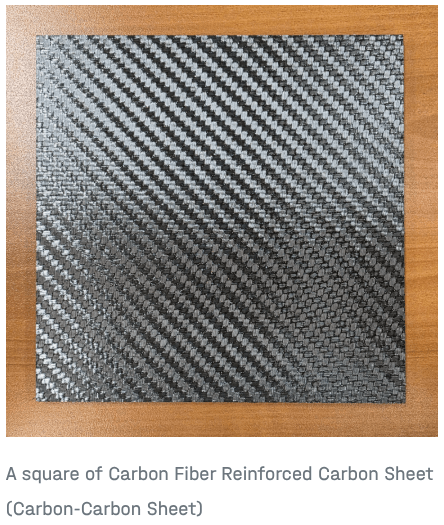
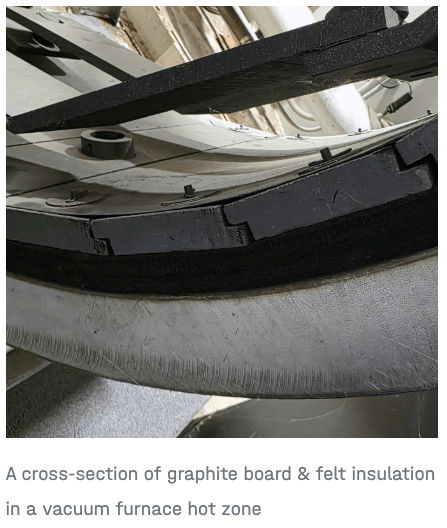
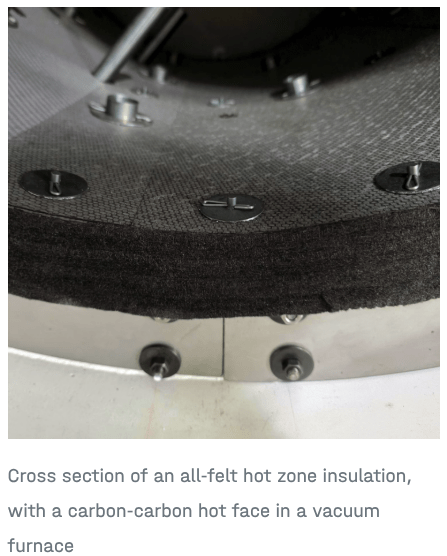
When you look at a cross-section of a graphite insulated hot zone, you might find one of two material varieties: graphite board or graphite felt. These materials are often protected with a hot face that’s made up of a graphite foil or a carbon fiber reinforced carbon sheet (also known as “carbon-carbon sheet”).
For many years, Ipsen furnace insulation cross-sections frequently contained both 1” graphite board and two ½” sections of graphite felt between the hot face and the plenum. A thin layer of graphite foil protected the hot face. The graphite foil and board worked together to serve as a rigid layer designed to resist damage from small parts that fall into the hot zone during loading and unloading.
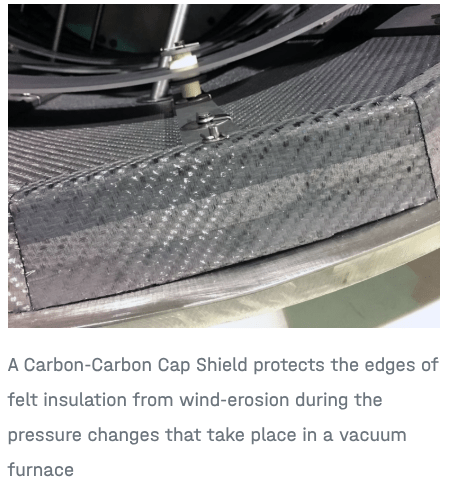
If you look at a new Ipsen vacuum furnace, you’ll notice that our standards have changed. Today’s Ipsen furnaces are offered with four ½” graphite felt layers behind a thin layer of carbon-carbon sheet hot face. A carbon-carbon cap shield can be installed at the front edge of the hot zone to prevent damage from wind erosion within certain Ipsen furnaces where needed.
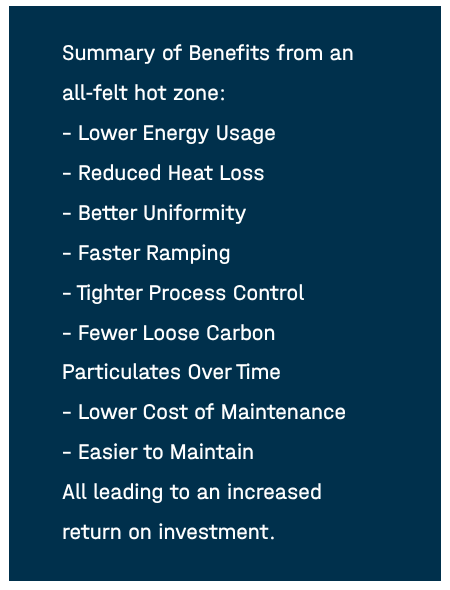
Furnace operators who are looking for a replacement hot zone are frequently encouraged to move to an all-felt hot zone insulation package, though a board and felt hot zone can be provided at a customer’s request. Many users have asked – why make the change?
The Case for All-Felt Insulation
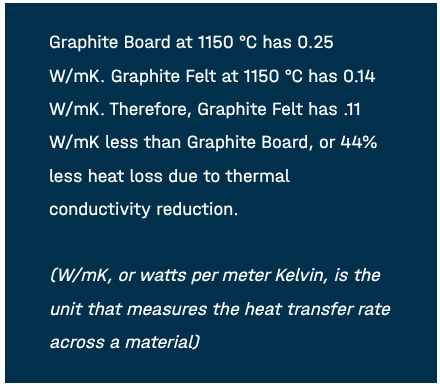
Thermal insulation works best when there is less density – lower density insulation is more effective at limiting thermal energy transfer than higher density materials. Though graphite board is designed to be porous, the larger gaps in the cloth-like material of the graphite felt significantly lowers the transfer of thermal energy by conduction. This way, the felt allows less heat flux to reach the plenum and the chamber cold wall, protecting both more effectively.
And the difference is significant. When comparing the use of a combination of board and felt to an all-felt solution, our engineers have observed that there’s roughly a 10% overall increase in heat loss for a 1” felt plus 1” board insulation design when compared to a similar setup using exclusively 2” of graphite felt.
Graphite felt also has sufficient elasticity to withstand thermal expansion and has proven to be easier to maintain. Replacing felt can be as simple as removing the carbon fiber hot face, cutting out the damaged felt with a pair of scissors or shop knife, and replacing the section with a new piece of felt cut to size. Also, it’s easier to maneuver felt around mounting points and nozzles. A handheld cutting tool allows for precise cuts around ingress points during installation. A roll of graphite felt kept on hand can be used for emergency repairs.
Thermal expansion and contraction may occasionally cause graphite board to show cracks in certain sections. In time, those cracks may grow to a point where the board needs to be replaced. Since graphite board is a stiffer, more dense material, it needs to be carefully machined to match the piece that it’s replacing.
The woven fibers in the carbon-carbon sheet make it much more resistant to tearing and brittleness than foil, while the compressibility of the felt is better at absorbing the shock of falling parts and springing back. Boards are also more susceptible to wind erosion in the cracks and holes, having an adverse effect on the board’s longevity.
Are You Ready for a New Hot Zone?
You’ll know it’s time to consider replacing your old felt and board hot zone with a new all-felt hot zone if:
Your furnace doesn’t pump down effectively any longer
You’re finding it difficult to hit set points that you used to hit regularly at higher temperatures
Your steady power level has increased as compared to when the hot zone was new
You’re seeing hot spots on the outside of your furnace
Your furnace is failing Temperature Uniformity Surveys
You’re seeing graphite contamination on part surfaces
Or you’re noticing cracking and erosion of your graphite insulation boards
“Berlin, CT, May 19, 2025 – Solar Atmospheres, the largest family-owned heat treating company in the United States, is proud to announce the opening of its seventh U.S. heat treat operation — an existing industrial facility located in Berlin, Connecticut, slated for completion in 2026.
The 28,000-square-foot facility is located in the Spruce Brook Industrial Park and will further expand Solar
Atmospheres’ footprint and capabilities in the Northeast region.
“We are excited to establish a new presence in Connecticut,” said Jamie Jones, President of Solar Atmospheres of Eastern PA and Connecticut. “This strategic location allows us to better serve our growing customer base and continue supporting the aerospace, medical, and commercial manufacturing markets throughout New England.”
This expansion reinforces Solar Atmospheres’ commitment to providing innovative, high-quality vacuum heat treating solutions across the country while maintaining the personalized service and reliability that has made the company a trusted partner for decades.
Stay tuned for updates as we build our newest state-of-the-art facility!
For additional information about Solar Atmospheres of Connecticut, contact Tim Steber at 1-855-934-3284 x1216 or email at [email protected], and visit us at solaratm.com.”
Did you like this article? Click here to subscribe to The Monty.
“The Industrial Heating Equipment Association (IHEA) recently announced its 2025-26 Board of Directors and Executive Officers. Taking over as President is Gary Berwick of Dry Coolers, Inc.; Vice-President is Jason Safarz of Karl Dungs, Inc. and Treasurer is Bob Fincken of Super Systems, Inc. Jeff Rafter of Selas Heat Technology Co. LLC assumes the Past President position.
IHEA also welcomes a new face to the Board of Directors, Chad Spore, John Deere. Chad has been an active member of IHEA for the past several years, especially supporting IHEA’s sustainability and decarbonization efforts. Chad is the enterprise materials engineering supervisor for John Deere where he has been employed for more than 25 years. “Chad has been a wealth of knowledge supporting IHEA’s Industrial Heating Decarbonization SUMMIT,” notes IHEA Executive Vice-President Anne Goyer. “His insight into our program development is helping us produce an even better SUMMIT for 2025. We are grateful for his time and expertise.”
Finalizing the lineup of IHEA’s Board of Directors for 2024-2025, the following members continue their tenure: Scott Bishop, Electric Power Research Institute (EPRI); Ben Gasbarre, Gasbarre Thermal Processing Systems; Doug Glenn, Heat Treat Today; Brian Kelly, Honeywell Thermal Solutions; John Podach, Fostoria Infrared; John Stanley, Karl Dungs, Inc.; Helen Tuttle, WS Thermal Process Technology Inc.; and Jeff Valuck, Surface Combustion, Inc.
In addition, IHEA is equally pleased to note the dedication and service of all members who serve on IHEA Committees and Divisions. Special appreciation goes to our current committee chairpersons: Sustainability Committee led by Jeff Rafter, Selas Heat Technology Co. LLC; Safety Standards and Codes Committee led by Jason Safarz, Karl Dungs, Inc.; Education Committee led by Brian Kelly, Honeywell Thermal Solutions; Marketing Communication & Membership Committee led by Doug Glenn, Heat Treat Today. The Infrared Division is chaired by Marty Sawyer, Trimac Industrial Systems.
Established in 1929 to meet the need for effective group action in promoting the interests of industrial furnace manufacturers, IHEA has expanded and currently includes designers and manufacturers of all types of industrial heat processing equipment used for the melting, refining and heat processing of ferrous and nonferrous metals and certain nonmetallic materials and heat-treatment of products made from them. Visit IHEA online at www.ihea.org and on Facebook and LinkedIn.” Source: www.ihea.org