“Peters’ Heat Treating, Inc. of Meadville, PA and McKean, PA is pleased to announce that Mr. Andrew S. Wilkosz has been named President of the company. Andy Wilkosz has been with Peters’ Heat Treating, Inc. for nearly four years. Wilkosz was previously acting as the Vice President of Operations, overseeing the day to day operations of the company across all three facilities. Wilkosz is also a principal in Laser Hard, Inc., specializing in robotic laser heat treating and cladding. Wilkosz has a Bachelor of Chemical Engineering from Pennsylvania State University and a Master of Business Administration from Katz School of Business at the University of Pittsburgh. His work experience includes Process Coordinator at U.S. Steel’s Clairton Coke Works Chemicals Division outside of Pittsburgh, PA, Process Safety Management consulting at Sage Environmental in Austin, TX and Special Projects Engineer at Texas Heat Treating in Round Rock, TX. His vast knowledge in business, engineering and project management serve as a solid foundation for his new role as President of the 60-employee company.
After 40 years, the company founder, J. Douglas Peters, is moving to a CEO role and will continue to be active in the company. Doug Peters with his wife, Jackie (Kuhn) Peters, founded the company in 1979 and over his career Peters has served on numerous community service and industry trade association boards. Most notably, he is Past President of the NW Chapter National Tooling and Machining Association and the Millennial President of the Metal Treating Institute, the international trade association of commercial heat treating. Doug is excited to hand the baton to his son-in-law, Andy, as the family-owned company passes into the second-generation hands of his children, Diana (Peters) Wilkosz, Vice President of Administration, Andy Wilkosz, now President, and Christopher Peters, IT Manager.
Peters’ Heat Treating, Inc. is a diverse heat treating company that specializes in a variety of high tech heat treating processes making it a leader in the precision parts heat treating industry. Located in Meadville and McKean, Peters’ Heat Treating has three locations serving the tristate region and all serviceable industries including aerospace, automotive, defense, nuclear, molding, tool & die and more. Processing capabilities include: vacuum processing, neutral hardening, carburizing, gas nitriding, cryogenics, annealing, stress relieving, black oxide coating, induction processing, sandblasting, integrated straightening and metallurgical testing, as well as laser heat treating in partnership with Laser Hard, Inc. Peters’ is compliant to ISO 9001:2015, Federal Firearms guidelines and International Traffic & Arms Regulations. Learn more at www.petersheattreat.com.”


Over the years we have created lists for the 10 Largest Furnace Manufacturers In The World, 10 Largest Commercial Heat Treaters in North America, 10 Largest Captive Heat Treaters In The World and plenty more-you get the picture, basically “The Monty” loves putting together lists about the worldwide heat treating industry (examples can be found on our articles page, this is one https://themonty.com/largest-commercial-heat-treaters-in-north-america-october-2018/ )This preamble brings us to our next “Top 10” list-the largest commercial heat treaters in Europe. From a very knowledgeable friend with some very modest help from ourselves we will be providing this list Friday of this week. This photo shows a commercial heat treat in Germany we visited just a few months ago-we will boldly suggest that this company might be on our list of the largest.

“Plymouth, MI – Gasbarre is pleased to announce the promotion of Jake Verdoux to Manufacturing Manager for Gasbarre Industrial Furnace Systems (IFS). IFS, formerly known as J.L. Becker, is located in Plymouth, MI and falls under Gasbarre’s Thermal Processing Systems division. Verdoux started with the IFS division of Gasbarre as a welder/fabricator in 2014. He quickly progressed and transitioned into the assembly department before being promoted to Materials Manager in 2016. His success in that role led to his recent promotion to Manufacturing Manager. Says Ben Gasbarre, President of IFS, “We are excited to have Jake in this role as his experience, leadership skills, and passion for the organization will lead to improved operational performance that will benefit both our organization and our customers.”
About Gasbarre Thermal Processing Systems; Gasbarre, through its Thermal Processing Systems division, provides top quality industrial heat treating equipment, engineering, and service. With products ranging from batch furnaces to continuous belt furnaces, pusher furnaces, vacuum furnaces, humpback furnaces, and much more, Gasbarre can solve any application challenge with expertise and passion. Gasbarre product lines: Sinterite, C.I. Hayes, and Gasbarre Industrial Furnace Systems (formerly J.L. Becker), deliver the equipment to make any process consistently productive and profitable.”

While pusher lines are not a popular as they once were they certainly still have their place as we can see here. Transmission components manufacturer SISTEMAS AUTOMOTRICES has just completed the installation of a brand new 3 row pusher at their facility in Northern Mexico. The line was provided by AFC-Holcroft and MATTSA (their licensee in Mexico) in record time which emphasizes the great partnership of both companies in the furnace business in the USMCA region. The first photo from SISTEMA shows the holding chamber and quench tank arriving, and the other two photos show the furnace being unloaded and subsequently installed.


Just last week we had an interview with Mr. Laurent Pelissier, CEO of furnace manufacturer ECM with headquarters in Grenoble, France. During our interview with Laurent we took the opportunity to tour the plant and the results are these photos.


When Gary Sharp, founded Advanced Heat Treat Corp., all those years ago he probably didn’t realize that he more than anybody else in North America would be responsible for bringing Plasma Nitriding into mainstream heat treating-quite a feat. Since that time he has marketed the purple glow of Plasma Nitriding into a very recognizable brand as you can see in these photos. As a matter of fact dinner at Gary’s house would not be complete without donning the corporate colors. In the ribbon cutting photo below Gary is front and center on the left, Mike Woods is on his left.
“WATERLOO, IA – February 11, 2019 – Advanced Heat Treat Corp. (AHT), a recognized leader in heat treat services and metallurgical solutions, announced today the completion of the 15,000-square foot building expansion at their corporate headquarters located in Waterloo, Iowa. The milestone was celebrated on February 7 with a ceremonial ribbon-cutting, donning the AHT brand color of purple. AHT employees, government officials, local economic leaders, and the contractors and construction crew were in attendance. AHT President Mike Woods commented, “The expansion is a knockout! A great group of people – both internally and externally – put their minds together on a mission and created a great extension of our facility. We’re excited about the additional space that’s going to allow us to grow, bring on new services and enable us to better serve our customer base.”
Last month, AHT announced their three new gas nitriding units with plans for a fourth before the end of the year; these units are housed in the new addition in order to separate the gas nitriding equipment from the ion (plasma) nitriding units at the corporate headquarters. AHT has four locations: two in Waterloo, Iowa; one in Monroe, Michigan; and a fourth in Cullman, Alabama. AHT also plans to expand its Burton Ave location in Waterloo where traditional heat treating services such as induction hardening and carburizing are offered. Woods added, “This past year has been exciting. We attribute this to our amazing employees, great relationships with our customers, and our continual investment in the future. We thank everyone involved and look forward to another great year.”


Big management changes at the world’s largest manufacturer of vacuum furnaces. Ipsen in Kleve, Germany is seeing a number of top people either parting ways with the company or planning to. These include Marc Angenendt who was the CEO, Dirk Otto who was head of Sales and Markus Reinhold who was Ipsen Group Technical Lead. Below we have a photo of Marc which we took at the HK show in Cologne, Germany last year. Marc is on the right and Pat McKenna, CEO of Ipsen North America is on the left.

Jim Hagene who was Vice President at US Bosch in Kentwood, Michigan retired as of January 31st. US Bosch has a large captive heat treating department and we at “The Monty” have had some dealings with the company over the years. Commercial heat treater Paulo in North America recently summed up all of their recent investments. While none of this is new and has all been mentioned on “The Monty” recently it does make for an interesting summary; “We try to see what the industry sees on the horizon and react accordingly. It’s produced tangible results we know will deepen our ties to aerospace customers. The most notable is a multi-phase expansion at our Cleveland Division, a location specializing in aerospace thermal processing. Phase one of an ambitious expansion at the site is underway: A 30,000-square-foot addition to the existing plant is under construction as we speak. A new vacuum furnace—the first of an order of five—was installed there in July. When the expansion is complete, we’ll have added 50,000 square feet to the site. This increase in our capacity to execute advanced thermal processes is mutually beneficial: For us, it’s good for business. But it also alleviates some of the pressure on the upper-tier aerospace suppliers who outsource heat treating. Adding service offerings can be just as crucial as expanding current ones. As aerospace components become more and more complex, the thermal processes required for them to perform as designed must also evolve. We added hot isostatic pressing (HIP) capabilities to our menu of aerospace heat treating services to meet that need. As a result, we’re in position to work directly with OEMs to develop the industry’s next generation of advanced thermal processes. But it doesn’t stop there. Investing in increased capacity and new equipment is accompanied by our continuous efforts to secure key industry certifications and approvals. For instance, two of our plants (Cleveland and Kansas City) meet aerospace-specific Nadcap and AS9100 requirements.”

Last week we had an interview with Mr. Laurent Pelissier, CEO of furnace builder ECM in Grenoble, France, an interview which can be found at https://themonty.com/interviews/laurent-pelissier-ecm/ To show the more relaxed “human” side of Laurent we have this photo taken last week in Megeve, France in which we can see from the left; Gord Montgomery, Arthur Pelissier, Project Manager, ECM, Laurent Pelissier, Marlène Pelissier, Yves, Yvan Trouillot, General Manager, ECM, Dale Montgomery and all the way on the right Emma Gaumet, fiance of Arthur.

Lino Masnaghi. When it comes to longevity few in this industry can match Lino Masnaghi. For as long as we can remember Lino (who is based in Burlington, Canada) has been servicing Surface Combustion equipment both in Canada and the US. Lino is on the right in this recent photo taken at Cambridge Heat Treat in Cambridge, Canada.

From Expanite in Denmark we have this press release about how the company is partnering with Kern Liebers and installing their surface hardening technology at Kern’s facility in China. As it happens we are quite familiar with captive/commercial heat treater Kern Liebers and had a summary about the company after we visited their German location back in October of 2018-par of our summary is included below and entitled “Do Manufacurers Make Good Commercial Heat Treaters?”
“Only one year after successfully launching Expanite’s surface hardening technology for stainless steel in the Chinese market, KERN-LIEBERS and Expanite has signed a joint agreement, which will expand the product offerings available from KERN-LIEBERS´ facility in Taicang, China. The new agreement ensures that all Expanite processes for surface hardening of stainless steel will be available in China from the fall of 2019. In November 2017, KERN-LIEBERS and Expanite signed the first license agreement which included KERN-LIEBERS installing equipment to executing Expanite’s hardening processes for martensitic stainless steels, also referred to as the ExpaniteHigh-T processes, at their Taicang facility near Shanghai, China. Now, approximately one year later, the Parties have agreed to expand the license agreement to also cover Expanite’s processes for austenitic, ferritic and duplex stainless steels, referred to as the ExpaniteLow-T and SuperExpanite processes, and thereby making it possible to offer the complete range of Expanite processes for stainless steel to Chinese and other Asian companies. “Our China business has had a fantastic start in 2018 and we continue to see tremendous growth potential towards many local and international companies with operations in China. The combination of KERN-LIEBERS reputation of supplying parts and heat treatment to the highest quality standards and Expanite’s best-in-class hardening technologies for stainless steel, represents an ideal partnership, which essentially benefits our customers,” Thomas Abel Sandholdt CEO at Expanite explains. Richard Zhang, CEO of KERN-LIEBERS, Taicang continues, “with extension of our current installation, we will have the capabilities of reaching a much broader range of customers, applications and industries – and we can offer cutting-edge technologies to our customers. We are very proud of being the first in China to have true low-temperature surface hardening solution for stainless steel”. The new installation is expected to be fully operational during Q4, 2019.”

Kern-Liebers/October 30/2018; “Do Manufacturers Make Good Commercial Heat Treaters? Kern Liebers. Generally our opinion is that manufacturers who have in house heat treating capacity make poor commercial heat treaters for a wide variety of reasons. However having said that we very recently visited a manufacturer who for years now has been offering commercial heat treating from their in house heat treating departments and has been very successful at it. KERN-LIEBERS is a medium-sized family owned company based in southwest Germany who specializes in the production of highly complex strip and wire parts and assemblies. The KERN-LIEBERS group of companies develops and manufactures precision products at over 50 locations around the world and currently 6 of these locations have in house heat treating capacity which offer commercial heat treating.”
Introduction
The nitriding process is perhaps one of the most misunderstood thermo-chemical surface treatment processes that are practiced today. The process of nitriding is just one hundred and sixteen years old in 2019. The patent for nitriding was first granted to Machlet of Elizabeth New Jersey in the year 1908, followed by Adolph Fry of Germany in the early 1920’s. So the process is not as old as, for example carburizing. However, it is perhaps (as far as chemistry is concerned) one of the most simple of all of the thermo-chemical surface treatments are concerned. We will describe in this article some of the problems that can occur as a result of and during the nitriding process.
There are many problems that can occur with the nitride procedure, and it will be necessary to evaluate the process technique. The process techniques can be described in the following illustration:

The next illustration shows the process techniques of nitriding with the process mediums and the operating temperature range


From this , it can be said that the trouble shooting can be categorized into three very distinct categories which are shown as follows: (Fig 3)
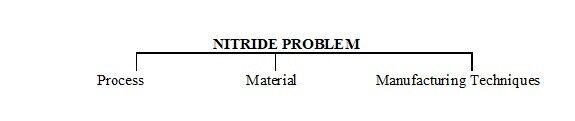
Referring back to Fig 1, we will deal with the problems usually associated with process problems
Gas Nitriding
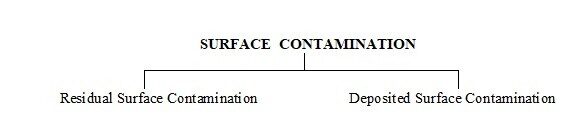
One of the major problems with gas nitriding is the understanding of surface preparation in terms of surface cleaning. It cannot be over emphasized, how important the pre-cleaning of the surface of the steel is. Surface cleanliness in mandatory and a primary requirement to the success of the procedure. Surface contamination can be seen in many forms Fig 4. Once the surface contamination has been dealt with prior to the nitriding process, then we can deal with the problem occurring at the nitride procedure.
Case Flaking
This can occur as a direct result of the presence of a surface contaminant on the component. Investigate the pre- cleaning method prior to nitriding and after pre-machining.
Case Crushing
This problem is usually due to a low core hardness that is failing to support the nitrided case. Another possibility is that the formed case is too shallow and this can be remedied by increasing the case depth. However the increase of case depth should be cautioned. Check what the application of the work piece is and what sort of load will be applied to the component
Salt Bath Nitriding.
Salt bath nitriding can be an economical method of nitriding providing that both the salt bath chemistry and the salt bath cleanliness are maintained. It is mandatory that the salt bath chemistry is checked at the commencement of each shift and the appropriate additions of salt are added to return the bath to its operational strength.
Regular desludging of the bath is necessary, to remove precipitated oxide in suspension in the salt, from work baskets and suspension wire.
Pre cleaning is as mandatory as it is with the gas nitride procedure, and most importantly after the nitride treatment, to remove any trace of the heat treatment salt in holes or cavities.
Dilution Nitriding
Dilution nitriding is a process that has been known since the initial development of gas nitriding by Adolph Machlet. The process has been refined and developed in North America to a very precise science and it is a process that still uses ammonia as the nitrogen source but controls the surface metallurgy of the procedure by dilution of the process gas using nitrogen or hydrogen. The next area of process control and process repeatability is to deliver the process gas in a very precise gas metering system.
The problems that can occur are mainly due to the metallurgical aspect of the procedure such as are described in the gas nitriding section. The problems are not usually hardware or program related, although there is no doubt that problems can ultimately occur.
Ion Nitriding
Ion nitriding is also known as glow discharge nitriding or plasma nitriding. The process is gaining a great deal of popularity in North America due to legislation on process effluents, European engineering specifications and a growing awareness of the repeatability and metallurgical consistency of the process is accomplished by computer control. It is necessary to understand that there are two power system types:
- Continuous DC Power
- Pulsed DC Power
From this there are two types of hardware system which are:
- Cold Wall
- Hot Wall
Part Overheating
This is usually as a result of the parts being too close together and is known as Hollow Cathode Effect. The hollow cathode effect can usually be seen during the process if one looks through the process sight glass. The particular area being subjected to the hollow cathode effect can sometimes be seen to be glowing at a visible temperature. It can also be seen after the process is completed and the part unloaded from the process chamber, as a dark area on the part where the hollow cathode has occurred. It can also be measured in terms of hardness. That area of the part will be lower in surface hardness than the rest of the component.
The part can also be over heated by process voltage and amperage variations during the process. This can be caused simply by an incorrect program process value being used in either the process controller or the PC (if the process control is by PC). The overheating could also be caused simply by an incorrect temperature value being used.
So what is the correct process temperature to use? This will depend on:
- The steel composition that is being used for the part manufacture
- The pre-heat treatment tempering temperature
- The surface metallurgy that is required
Avery important aspect of non-uniform process temperatures during the nitride procedure and in the process chamber is that it will cause case depth variations on the component. Therefore the loading of the process chamber is extremely important to ensure that hollow cathode does not occur. Further to this, it is important that the process thermocouples are placed in the load area that will present an accurate picture of the process temperature on the part surface. It is equally important that the process control; values are values that are known to be ‘good values’ from previous runs.
Loss of Nitriding
If, during the observation of the process conditions through the furnace sight glass, there are area’s on the part being treated, that there is no plasma glow sitting uniformly around the component, it simply means that the selected process pressure is incorrect and that the value is too high. If this condition occurs, it is most important to rectify the condition, because where no glow is seen on the component, no nitriding effect will be taking place, which further means, no case formed or at least a very shallow case will be formed. The manner in which this condition is corrected, is simply to check that there are no leaks on the vessel (remember, the process is operating at partial pressure conditions), or if no leaks, reduce the operating pressure setting. Until the glow seam reappears on the part, the parts are not previously covered by the plasma glow seam and will not be nitrided.
Arc Discharge
This is usually seen on continuous DC current systems, but can also occur in the pulsed DC systems (although not too frequently on the pulsed power system). The cause is from too high a process voltage, so the remedy would be simply to reduce the process voltage until the discharge no longer continues to occur. The arc discharge is simply seen as a miniature ‘lightning strike’ in the process chamber and will usually be attracted to sharp corners on the component, which will result in localized overheating and probable surface burin/localized melting. The remedy is simply to reduce the process voltage, or change the process pressure.
Part Chipping
This is usually seen, once again at sharp corners. The most probable cause is ‘nitride networking’. This means that the corner that has chipped has been over saturated with nitrogen. This condition can apply also to gas nitride and salt bath nitride. The cause is, that too much nitrogen is present in the corner due to the ‘corner effect’. Nitrogen is soluble in iron up to a value of approximately 7% by volume (maximum). When over saturation occurs, the nitrogen has precipitated out of solution during the cooling stage of the process and has settled at the grain boundary locations in the corner if the component. The remedy is simply to reduce the nitrogen in the process, or round off the corners of the component.
Low surface hardness
This can be caused by a low nitrogen availability with insufficient nitrogen in solution with the steel to form sufficient stable nitrides in the surface of the steel. Another condition that can cause this is that the steel itself is too low in nitride forming alloying elements. The remedy is simply to change either the steel that the component is manufactured from, or increase the nitrogen and thus the nitride potential of the process gas.
Surface Flaking
The cause of this condition is usually due to a surface contaminant being carried into the process on the part surface. Simply check the manufacturing method for the type of coolant or cutting fluid used during the pre-machining operation, and then check the method of pre-cleaning prior to the nitride procedure. Some surface contaminants can be removed by sputter cleaning at the commencement of the ion nitride process using hydrogen as the sputter clean gas. If hydrogen is not aggressive enough, then a blended mixture of hydrogen/ argon can be used. However be cautious with the use of argon as this gas has a high atomic weight and can cause surface etching. The maximum suggested volume of argon would be 10% argon with 90% hydrogen. Generally the mixture ratio is 5%argon and 95% hydrogen
Sincerely David
Gruppo T.T.N./Italy. Last week we had the chance to visit commercial heat treater Gruppo T.T.N., at their headquarters in Nerviano, Italy which proved to be a rather interesting experience. The family owned group consists of 9 locations, all in northern Italy with a total of 500 employees-now 9 plants and 500 employees would rank the company as one of the largest commercial heat treaters in Europe and even the world for that matter. As far as we can tell there are no processes the company does not have-Induction, Vacuum, Salt, Gas & Plasma Nitriding, annealing, Quench & Temper, Vacuum Carburizing-there is literally not a process we can think of that the company does not have. The only common denominator would appear to be that the company focuses mainly on large parts, however since they also have belt furnaces even this statement is not entirely true. In the lobby there is a rather interesting photo and certificate dating back about 15 years. The certificate of achievement is from Boeing and emphasizes the company’s contributions to the Nasa Space missions when they heat treated components for fuel tanks for rockets, a contribution which required a Boeing team to be on site for 6 months. Mr. Pirovano who founded the company back in 1978 and who is still very active turned out to be a very friendly and open fellow who allowed us to take photos of the entire plant-some of the results of which you can see below and are far more interesting than our scribblings.

Pit Gas Nitriders

Pit Carburizing Furnace-the largest in Europe outside of Reese in Bochum, Germany

New Meapforni Vacuum Furnace Installation

Salt Quenching From a Vacuum Furnace-a New One on Us.
After extreme cold weather and gas delivery issues caused heat treating to stop at GM and Ford in Michigan, USA last week the companies are back heat treating; “GM, Ford and FCA have been re-establishing normal production operations in Michigan after an energy supply shortage brought on in part by the extremely low temperatures that have swept across parts of the US recently. Temperatures as low as -25°C (-13°F) in Detroit – caused by a weather phenomenon known as a Polar Vortex – compounded energy supply problems following a fire at a compressor station operated by natural gas supplier Consumers Energy. Though the blaze was soon brought under control, the station had to be taken off line so the fire damage could be repaired. In order to cope with extra domestic demand during the sub-zero temperatures, Consumers Energy asked carmakers to reduce their production. General Motors suspended operations at 13 of its factories on January 31, as well as three other locations. But most manufacturing plants and some critical labs, testing and other specific sites were scheduled to resume activities on February 1, the company said. The exception was the Lansing Grand River stamping plant, which restated February 4. Office workers at GM’s Technical Center in Warren, Pontiac Engineering Center and Grand Blanc aftersales headquarters were asked to continue working from home on February 1, but normal operations were expected to resume over the weekend. A Ford spokesperson told Automotive Logistics it had lowered the temperature at its Livonia and Van Dyke transmission plants to minimum levels, stopped heat treatment processes at the Sterling axle plant, and halted the paint process and parts of the stamping operation at its Michigan assembly plant – all at Consumers Energy’s request.”
