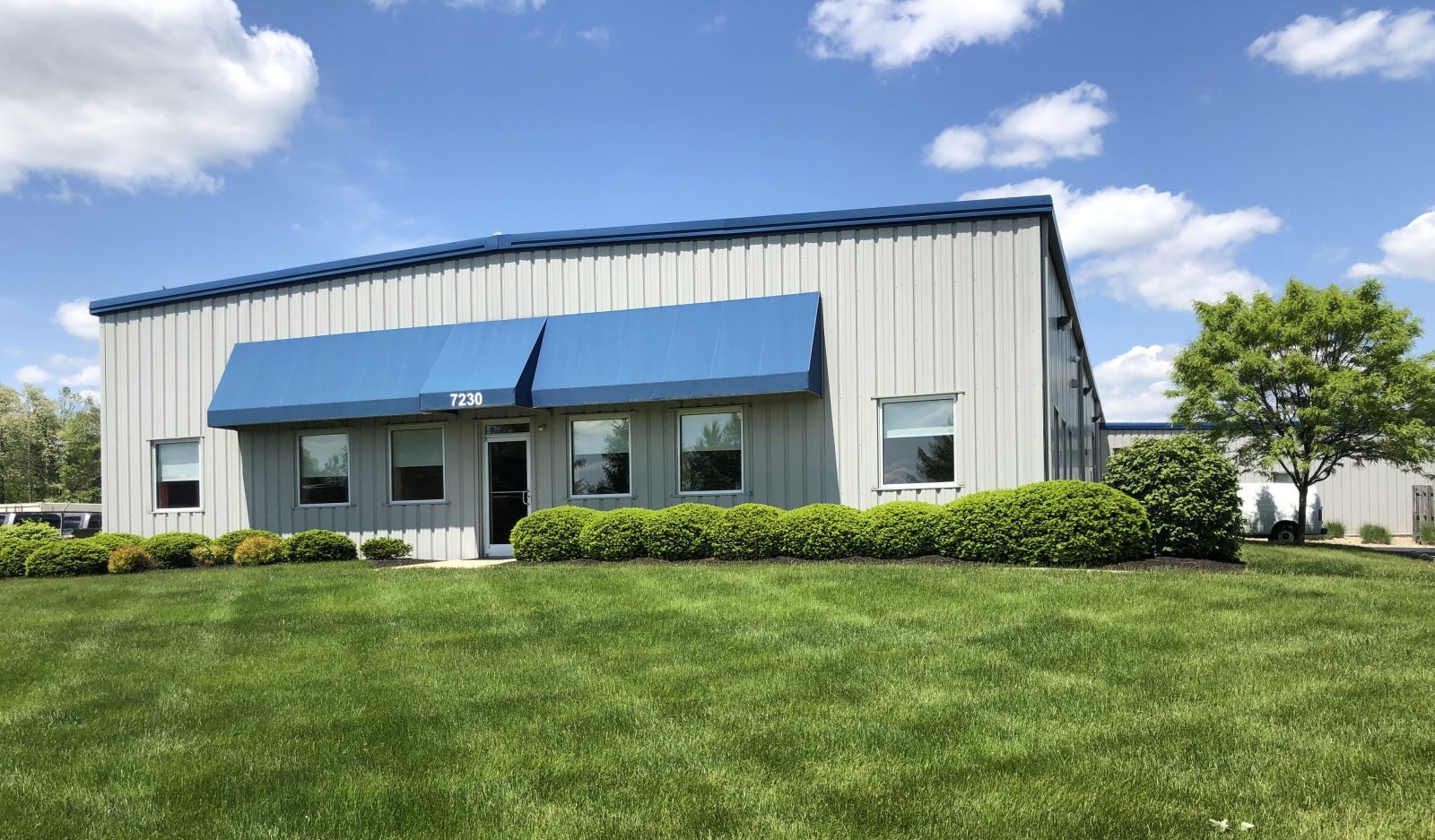
In Springfield, Ohio Parker Trutec just completed an expansion of their heat treatment facility. Parker Trutec is a subsidiary of Japan based Nihon Parkerizing one of the largest commercial heat treaters in Japan and like many Japanese companies largely services the Japanese automotive manufacturers located in North America. We searched through our archives and came up with this 2106 press release from the company which tells us how they were adding a fourth AFC-Holcroft batch IQ furnace. “MARCH 2016 PRESS RELEASE; Parker Trutec, Inc. in Springfield, Ohio has added a 4th UBQ 36-48-36 universal batch integral quench furnace to an existing line. This latest furnace will be equipped for carburizing, and will be made CQI-9 Compliant. The equipment is scheduled for installation in March of 2016. About Parker Trutec: Parker Trutec is a North American subsidiary of Nihon Parkerizing, a world leader in metal improvement technology. The Parker Trutec Group operates 6 facilities in the United States and Mexico which specialize in metal treatments and products that improve the resistance to wear, corrosion and fatigue of metal components. For more information: www.parkertrutec.com
“September 16, 2019, Springfield, Ohio – Parker Trutec, Inc. announces the completion of a 30,000 square foot, $1.4 million expansion at the Springfield Heat Treatment Plant; marking the sixth expansion since plant operations began in 1989. For more than 30 years, Parker Trutec, Inc. has provided a variety of heat treatment processes including gas carburizing, gas carbonitriding, neutral hardening, gas soft nitriding (GSN), ISONITE® / ISONITE-Q®, and salt bath nitriding (FNC), as well as value-added processes. With the completion of this expansion, additional equipment and processes will be added to further meet customer needs.”

In the European heat treat market Joern Rohde of furnace builder ROHDE Schutzgasöfen GmbH is quite a well known figure. Recently he provided an interview to the German heat treat magazine ”Der Wärmebehandlungsmarkt” (The Heat Treatment Market) a publication which comes out 4 times a year. The interview was done by the CEO of the magazine, Dr. Sommer whose company provides metallurgical testing.
Heat Treatment Market (HTM): It’s nice to interview you again this year. At the moment everyone is talking about climate protection and energy efficiency. How do you take this trend into account in your company?
Joern Rohde (JR): The energy efficiency of our systems has always been a very important issue in which we have invested a lot of time. It is essential for our customers to operate energy-efficient plants in order to remain profitable on the market. In our company, we are constantly developing and improving the energy efficiency of our plants. The results of the theoretical energy efficiency are precisely determined before delivery during the hot acceptance test on our test field. In addition, we are involved in projects to increase the efficiency of furnace plants and thus learn more every day.
HTM: That sounds very interesting. So could you be a little more specific?
JR: We have a very current practical example of the energy efficiency of our systems. We have supplied a new customer from the Stuttgart area with gas-heated gas nitriding systems of type KGU 100/120/180. Since this customer has already operated and operates gas nitriding systems from other manufacturers, he wanted to convince himself of the efficiency of our systems. Already in the decision-making process, the customer took the opportunity to visit the plant and to have his new plant presented by us down to the smallest detail on the basis of a 3D-model. We were able to explain our solutions to him in detail and take away his concerns about existing problems. The operation of the systems shows that our efforts have paid off.
HTM: Can you give us exact numbers?
JR: Our customer can quantify the savings exactly as he records the consumption values of all his systems. The special thing is that in this case we were able to compare our systems directly with those of a market competitor. Within a few days, the customer had run a comparison batch with the same batch content and the same process. The systems both have an external cooling unit from the same manufacturer, so the electricity costs should not be underestimated and provide us with information about the amount of energy that has to be used as cooling capacity. You can see the exact numbers from the graphics. In this case, according to our customer, this saves more than €10,500 per year in operating costs per system. Over the service life of such a system, our systems pay for themselves through this effect alone.
HTM: Of course, this gives you an enormous advantage in this day and age. What do you think is the cause of this increase in efficiency?
JR: Energy efficiency has always been an issue for us, because those who waste energy unnecessarily give away their money. Today, our customers are faced with the challenge of profitable production, even though costs continue to rise and this trend is expected to continue. We took this problem on board years ago and optimized our products so that our customers can save energy costs. Without going into too much detail, everyone can easily see the difference between our systems. Take a look at the external
dimensions of the comparable usable space. The customer does not have to pay for the energy that I keep in the overall system, quite simply. When purchasing a new system, I recommend that customers pay attention to the consumption data for electricity, natural gas and the cooling capacity required. This will enable them to effectively reduce their heat treatment costs and a clear conscience is given free of charge.
HTM: The development of your company over the last few years has been very successful, as we have witnessed. What are the reasons for this constancy?
JR: We are actually celebrating our 40th anniversary this year, which makes me very proud. Since my father founded the company, we have continued to develop, but always with small, well-considered steps. We have proven and tested structures in the company, but we have always been open to new ideas. In addition to international business, which is constantly growing, we can also benefit from our new location. But the real engine of our growth is customer satisfaction. In every detail of the plant, we try to offer our customers the best technical and sustainable solution with the quality seal “Made in Germany”.
HTM: Then, we finally wish you continued success and thank you for the interview.


Joern Rohde (left) Hirschvogel Automotive Group, Denklingen, Germany
As ranked by “The Monty” Bluewater Thermal Solutions https://bluewaterthermal.com/ is one of the largest commercial heat treaters in North America with 12 different heat treating and brazing facilities in the USA and Canada. Unfortunately we have been informed that yesterday, September 30th 2019 the facility in Kitchener, Canada closed for good. The history of this location is quite fascinating; it was founded in 1945 and for many years was owned by the Beingessner family until they sold to Gibraltar Steel in 2002 at which point the company had annual sales of approximately $15.5 million (Canadian) making it the largest commercial heat treater in Canada at that time. It remained part of the Gibraltar commercial heat treating division (which included the Carolina Commercial facilities-now part of Bodycote) until Gibraltar sold off the entire division which was renamed Bluewater Thermal. At this point in time the company has a couple of smaller mesh belt lines, some aluminum furnaces not currently in operation and several 36″ X 72″ batch IQ furnaces, one purchased new in 2015 and the others designed and built by B & W themselves quite a few years ago. We believe that all of the equipment has been bought by a used equipment dealer but this has not yet been confirmed. It is a real shame to see a company with such a long and illustrious history closing however the world keeps changing. This photo was taken in 2015 when the Surface Combustion Allcase furnace was brand new, in the centre we see the General Manager, Mr. Shawn Scott who remains with the company.

Last week we mentioned how US controls company SSi recently acquired another building. This press release below tells about the new building and a recent sales meeting.
“Super Systems Inc. of Cincinnati OH held its 2019 sales meeting at its worldwide headquarters last week. The meeting included employees from international offices in England, Mexico, India and China, along with sales representatives across the 50 states. The meeting took place in SSi’s recently acquired building on the same street as the other two buildings occupied by SSI administrative, engineering, sales and manufacturing staff. “It was a fantastic week that included some very in-depth training on our products and services and of course a great networking opportunity for our sales channels” says Steve Thompson, President of SSi “I am grateful for the sales representatives that we have working with SSI – truly the best in the business. A shout-out to all of the SSi staff this week. Everyone contributed in some way, bringing great success to the meeting.”

The event is Europe’s largest annual forum for experts in the field of materials technology, with a particular focus on heat treatment processes. This year a high quality congress program will be provided. The program jury were able to select the speakers from more than 50 submissions.
Main topics:
- Materials for lightweight design
- Functional coatings
- Intelligent process control
- Quality control
- Partial heat treatment of components
- Additive manufacturing
- Microstructure and strength
Congress and trade fair – a strong duo; Around 3,000 trade visitors – from heat treatment shops, as well as from sectors such as industrial furnace construction, from supplier companies, manufacturers of testing equipment and also employees from the automotive and steel industry – now make use of this event to share and exchange information on innovations and trends in the sector within the network of the AWT (German association for Heat Treatment and Materials Technology). At the show, around 180 exhibitors from across Germany and from around the world will be providing information on their latest product innovations across an exhibition space of 13,000 m². The strong connection between the congress and the associated trade show has the advantage that employees from all areas of a company can take part in the event – company management, research and development, quality management, technical practice and sales. This will ensure a high standard of discussion with the customers at the trade show.
HK for the 75th time – from Heat Treatment Colloquium to Heat Treatment Congress; Celebrate with us and immerse yourself in the history of the event! We have put together a large collection of photos from the 75 events which have been held between the years 1942 and 2018, and have made them into a photo show. The show will be presented on the stand next to the Piazza in the exhibition hall, in the Feedback Area and in the Congress Hall. All visitors to the congress and all exhibitors are invited to our big Anniversary Reception on the evening of Wednesday 23 October!
News from the Online Marketplace; Take part in a round table discussion about the 20 µm issue concerning the Vickers hardness test. Furthermore, you’ll get a report from the DIN ad-hoc group „Indention diagonals below 20 microns” and the last ISO meeting of the TC 164 „Mechanical testing of metals“ that took place in September 2019. Location: AWT booth on the Piazza C-120, 23rd October 2019 from 2.00 to 3.00 pm
More information, apps and ticket shop at www.hk-awt.de

The place for networking and meetings with the VIPs from AWT at HK is the Heat
We are excited to be able to offer you this interview with an individual we have a very high opinion of Mr. Thomas Dopler, CEO of furnace manufacturer Aichelin GesmbH based in Moedling, Austria.
Thomas I am always curious about how people end up in the heat treatment industry. Could you share with us how you got started in the industry and ended up where you are now?
I did my first heat treatment at the age of 15 at high school (higher technical school with optional classes in metallurgy), followed by my studies in material science where heat treatment was one of the major subjects, especially steel and aluminium. These two materials have been guiding me through my entire professional life from the aerospace and automotive industry where I was working in R&D and Sales to my current position at Aichelin, which I joined 11 years ago. Heat treatment of steel and aluminium is our reason to be.
Please share with us some details about Aichelin-what you have to offer, the size of the company, the number of locations and perhaps even a brief history of the company.
AICHELIN Group is a leading provider of heat treatment solutions, such as industrial furnaces, induction hardening plants and industrial gas burners systems. The company’s roots date back to 1868. The long-established brand AICHELIN, as well as EMA Indutec, SAFED, BOSIO, AFC-Holcroft and Noxmat, make up the group and together employ more than 1,100 people. AICHELIN Group ranges among the world’s top 3 heat treatment companies. AICHELIN’s subsidiaries in Europe are located in Austria, France, Germany, Slovenia, and Switzerland; the worldwide presence of the company includes subsidiaries and branch offices in China, India, Russia, and the US, as well as a sales network in 22 more countries. The site in Mödling is the technological center for new equipment in Europe, with a focus on continuous heat treatment plants. Our scope of supply ranges from pusher, ring and roller hearth furnaces to belt and sealed quench furnace lines. AICHELIN GesmbH has been doing business in Mödling since 1960 and the Group’s headquarters is also located here. A great deal of our business is After Sales and we are constantly working on new developments such as our latest products heatXpress and #jakob.
Historically what type of furnace has Aichelin made the most of? Pusher? Cast Link? Sealed Quench etc.?
Since we offer such a great variety of furnace types, this question is difficult to answer for the entire history of Aichelin. However, there is certain continuity with gas carburizing. Aichelin started the production of furnaces for powder carburizing according to licenses of the American Gas Furnace Corp. back in 1900. When the contacts to the USA were interrupted during World War 1, these furnace lines were further developed with Aichelin’s own know-how. Together with Robert Bosch (the founder of Bosch group, in person!) and his leading engineers, Aichelin had started tests even before the War in order to improve carburizing in gas. Back then, barrel-shaped retort furnaces were used, which was one of the most-requested Aichelin products of that time. Despite the limited control devices of that period, the test results were astonishingly good. Aichelin is therefore definitely a pioneer regarding gas carburizing.
Typically who are your customers? Commercial or captive heat treaters? Auto parts makers or aerospace suppliers?
The AICHELIN Group focusses on atmospheric heat treatment, for both continuous and batch furnace lines. We consider ourselves as one of the globally leading companies in this industry, with more than 150 years of history in Europe, more than 100 years of history in the US and more than 30 years of history on the Chinese market. Therefore, we serve all kinds of customers, from the major OEMs of the different industries and the leading captive heat treatment shops of the leading tier 1s to commercial heat treatment shops. This also confirms our focus on the automotive market and its suppliers with all their applications, whereas the aerospace market is less our target. At the same time we are also serving customers in the bearing, fasteners and electric machinery industry.
As CEO of the Moedling division do you have much involvement with the other divisions such as China or North America?
AICHELIN Group’s strength is the global position in the heat treatment market, with more than 1100 employees world-wide. For this reason, a very tight cooperation and close contacts with my colleagues in China & the US are part of our common success. We can help each other with know-how, resources and technical advice as well as with service support.
Are you seeing or do you expect to see much competition in Europe from either North American or Asian furnace builders?
No. There is a degree of customization of furnace lines for the individual needs on the 3 continents (Europe, the Americas & Asia). Therefore, the only cases when we see some mixture of overseas furnace builders with the locals is in case our customers go overseas and want a precise copy of what they have in their home country (with adaptations to local standards and equipment)
A common perception amongst buyers of new furnaces is that because they are high dollar items this must translate into high margins for the furnace manufacturer. How would you respond to this statement?
New furnace business will never make you rich in the automotive business! The market power of “us” (the furnace builders) is far too small against the OEMs. We must therefore focus on continuous improvement of the furnace quality and technology and assist our customers throughout the long life of our furnaces with After Sales Services. This way we remain competitive over the years.
I understand that Aichelin has a new product which you are quite proud of “heatXpress”-could you please tell us why you are so proud of this particular system?
The reason we are so proud of the new product, heatXpress, is easily explained: The step chain furnace has 10 major advantages compared to existing PHS (Press hardening Steel) heat treatment solutions. For example, the durability of the step chain transport system is more than 4 years in contrast to traditional systems using rollers, which must be replaced much more frequently. Another example is the transport accuracy at every stage since there is no build-up of AlSi on the chains in the furnace. A final example would be the tailored property options combined with the very short cycle times, which create an important advantage for companies who are looking for cost-effective PHS manufacturing. With our new product, heatXpress, AICHELIN has the right and best product for all PHS requirements now and in the future.
What is your number one concern these days? Finding people? Tough competition? A slowing economy?
Over the last 20 years, our industry has gone through several major ups and downs. Our experience thus tells us that we need to stay flexible regarding the size of our individual furnace companies as such changes can occur within short notice. On the long run, the most important concern are our employees! We must find them, train them, keep them and challenge them over the years. Only if we manage to have the best experts on the market (for mechanical and electrical design, processes, furnace installation, …), we may set ourselves apart in the dynamic market with respect to our competitors.
Additive Manufacturing is one of the technologies that will shape the future. Heat treatment is an essential part of this technology to reduce stresses and distortion for 3D-printed parts and to obtain the desired part properties. In my own opinion we will see this technology entering the heat treatment market on a bigger scale in the near future (2021 to 2025). We are already working on this technology, in cooperation with 3D-printing prototype manufacturers as well as with 3D printer manufacturers and already have parts running through our furnaces.
Since we’re talking about a changing world and changing technologies let’s look at electric cars. The predictions are that within a decade or two we will all be driving electric cars which by their very nature require substantially less components which means substantially less heat treating. Does this enter your long term thinking about the size of the heat treatment industry?
The heat treatment market has always been very dynamic. The trend towards electric cars (purely electric as well as hybrid) means a big change for us, as some of our customers are strongly in the gear box industry. We face these changes by doing what we have always done: We focus on providing our customers with just the right technology for their needs. An example: One of our big overseas customers supplies parts for the new TESLA models.
Lets keep talking about the future of the industry. Do you personally think that the product mix Aichelin now offers will remain fairly constant in the foreseeable future or do you see it changing?
We see a slight shift in our product and service mix. As we have a high number of existing installations in the market, our customers tend to use them as long as possible. The oldest Aichelin installations working in the market are more than 70 years old! It is our job to keep these installations as up-to-date as possible, from the switch cabinet with the latest safety technology up to the use of most recent energy-efficient combustion systems. Of course, industry 4.0 will play an important role in the future.
Thomas out of all the types of thermal processing systems which you can offer what is your favorite style? Personally I have always liked the versatility of batch IQ (sealed quench) furnaces and have never been overwhelmed by pit furnaces but that is my opinion-what are your thoughts?
Our goal is to provide world class heat treatment for our customers which reproduces exactly the quality our customers require. For this reason, my heart is with continuous heat treatment furnaces with a good degree of automation, as I believe they are the best way to ensure stable quality for many industries with a decreasing number of skilled personnel.
Last but not least is there any interesting developments at Aichelin which you can share with us?
The most exciting recent development is our digital maintenance assistant #jakob. Named after Jakob Aichelin, who founded our company 151 years ago, this tool will make maintenance so much easier, providing all the information the furnace operators or maintenance staff will ever need at a glance, whilst carrying out monitoring functions and predicting maintenance and parts needs. #jakob is AICHELIN’s answer to Industry 4.0 and IoT.


While we mentioned this news item recently, this article from Syracuse.com provides a few more details about the new location. Please note the interesting comment about the new location being able to “perform heat treatment processed not currently available in the United States.”
“Geddes, N.Y. — A thermal processing company whose Van Buren operation was destroyed by fire last year plans to reopen in Geddes. Bodycote Thermal Processing Inc. said it will spend $15.3 million to renovate and equip a dilapidated, 58,000-square-foot building at 8 Dwight Park Drive, where it will have access to low-cost power from Solvay’s municipal electric department. Most of the money, $11.5 million, will be spent on equipment, including some that will allow the company to perform heat treatment processes not currently available in the United States, it said. “The new facility will initially employ up to 30 employees in the community within the first two years of operation with the opportunity to add more positions as we add future processing capacity,” Bill Sandstrom, vice president of operations, said in a letter to the Onondaga County Office of Economic Development.
Bodycote, which describes itself as the world’s largest provider of thermal processing services, entered the Syracuse market when it acquired Syracuse Heat Treating Corp.’s operation at 7055 Interstate Island Road in Van Buren in January 2017. The company operates in 23 countries, with 180 locations and 6,000 employees. A fire broke out in the plant in Van Buren on July 6, 2018, injuring no one but causing heavy damage to the building. Sandstrom said the fire was caused by “legacy shop floor issues” in the plant. The company has continued to serve its customers in Central New York, shipping their parts to other Bodycote facilities and shipping them back after heat treatment. Bodycote’s nearest facility to Syracuse is in Rochester.”

Back in March 2018 we had a press release about Allegheny Technologies Inc. (ATI) making a major investment in their facility in Cudahy, Wisconsin-the press release is below. We have been lead to believe that what this means in terms of heat treating is an investment of roughly $15 million USD in a number of automated box furnaces with external quenching all in a brand new building. Rumors we have heard suggest that the supplier of the box furnaces is a company by the name of “Fives North American Combustion” and that the equipment is being shipped as we speak. “March 2018 ATI Ladish plant in Cudahy will undergo a $95 million expansion and add 125 jobs to meet a growing demand for aerospace jet engine components, company and state officials said Thursday. Under the expansion plan, the Cudahy plant will add a fourth iso-thermal press to the forging operations and adding more heat-treating capacity. The effort will take about three years to complete and fully qualify for aerospace-related production. ATI Ladish, part of Pittsburgh-based Allegheny’s ATI Forged Products division, supplies high-performance forgings and castings largely for the aerospace and defense markets.” Thermex Metal Treating in Edmonton, Canada the largest commercial heat treater in Western Canada is in the midst of updating some of their equipment. In this case they are removing an older pit carburizing furnace and replacing it with a Unitherm Industries Pit Carburizing furnace with working dimensions of 36″ diameter X 72″ deep. Thermex is a company which has always invested heavily in new and updated technologies.

We ran across this photo just yesterday which shows a new Powermax Batch IQ installation in Turkey. Powermax is a new furnace builder near Shanghai, China which was started by Andy Chen a number of years ago. Over the years it became a fairly large furnace builder and for quite some time it was the AFC-Holcroft licensee in China. Our understanding was that it became part of Chinese furnace builder Fengdong however obviously the company is still selling under the Powermax name.

Controls company SSi of Cincinatti, Ohio, USA continues to grow and recently added a third building almost directly adjacent to the current two buildings-we will be able to show you a photo of the new building this week. The photo below shows a new vacuum furnace built by CHS Asia being installed at an aerospace manufacturing facility in Thailand. The photo brought back some good memories of the founder of the company, Mr. Randy Simmons of the USA who passed away a few years ago at a relatively young age. Good to see that the company he founded continues to thrive.

Heat Treating Finland. Give the relatively short train ride between Moscow and Helsinki we decided to have a brief look at the heat treating industry in Finland after the Moscow heat treat show. As it turns in there is a small but advanced heat treatment industry in the country however at the end of the day are contact was limited. For what it is worth this photo shows Dale and Gord Montgomery in Helsinki, Finland last week.

This presentation is the first of three parts and is focused on the heat treatment of tool steels. The complete presentation will address the categorization of tool steels, followed by heat treatment practice and concluding with troubleshooting, which will address some failures due to;
- Tooling design
- Possible machining practice
- Material selection
- Design of Experiment
- Quenching practice
- Tempering
Tool Steel Categorization
The illustration below is a suggestion as to how tool steels are generally categorized into one of two categories. Those categories are Quenching and application,


Above is shown in illustration of alloying elements which can be present in a tool steel to address different operational characteristics. (Please bear in mind, that the alloying elements will affect the selection of hardening and tempering temperatures.
- W1 to W5 = Low temperature hardening with water quench.
- O1 to O7 = Low temperature hardening with oil quench.
- A2 to A9 = Higher temperature high alloy, air hardening
- D2 to D7 = High carbon, high chromium cold work tool steels with a high austenitizing temperature and complex quenching
- S1 to S7 = Shock resisting tool steels
- H (Chromium) H10 to H19 = Hot work die steel with high operating temperature. Also, high hardening temperature with complex quenching.
- H (Tungsten) H21 to H26 = Hot work tool steels with higher operating temperatures and high hardening temperatures plus complex quenching
- H (Molybdenum) up to H42 = As above for H21 to H 26.
- HSS (TUNGSTEN) = T1-T15Complex steels designed for high speed cutting.
- HSS (Molybdenum) = M1 – M36. As above
- HSS (Ultra Hard) = M41 – M47As above
- L2 – L6 = Low alloy special purpose tool steels.
- Mold steels = P2 – P21 Mold steels, usually low carbon and used often for cold hobbing of the impression on coining dies, then carburized or sometimes nitrided.
Influence of alloying elements in Tool Steels
Carbon is what makes iron turn into steel. The amount of carbon that is added to steel will determine its maximum hardness and mechanical properties. It can be said of carbon, that carbon is the magic ingredient that is added to iron to create hardness. The amount of carbon present in the steel will determine the steels maximum hardness value.

MANGANESE (Mn)
Manganese is present in all steels, including alloy steels as well as Tool Steels. There is no dividing line between carbon steels and manganese alloy steels. Generally, Manganese is present in amounts above 0.6%.
It is used to reduce oxide formations (deoxidizer) and it will form with sulfur to reduce embrittlement in the steel.
It also assists as a low-cost hardener in some of the lower alloyed Tool Steels. If it is present with Chromium and Molybdenum it will help to resist deformation on air hardening. Usually found in the A series Tool Steels.
CARBON (C)
Carbon is the universal hardener is all steels. It can be found in amounts from 0.01% up to 2.3%. It does not require a significant amount of carbon to affect the hardness of the steel. This element will interact with the elements listed below to form carbides. Once the carbon content approaches or even surpasses amounts greater than 1%, it will usually combine with other elements such as:
- Chromium
- Molybdenum
- Vanadium
- Tungsten
- Cobalt
- Titanium
SULFUR. Sulfur is considered to be an impurity and at the primary steelmaking it is deliberately reduced. However, there are instances when it is necessary to add sulfur in controlled amounts to improve the steel’s machinability.
SILICON. This material is used primarily as a deoxidizer during the steel making process. However, in large amounts it will begin to affect the steel’s ductility. However, in the high alloy heat resisting steels, it will assist in the resistance to oxidation at high temperatures.
CHROMIUM
Chromium is found in a wide range of tool steels and in varying amounts. Chromium is one of the elements that has a tendency to form carbides with Carbon in the steel curing the heat-treatment procedure. Chromium will assist in:
- Deep hardening
- Slight improvements in corrosion resistance
- Wear resistance
- It can be a disadvantage if the tool steel is held too long at austenitizing temperature by causing grain growth.
TUNGSTEN
Tungsten will raise the hardening temperature (Austenitizing temperature). It forms very stable carbides with carbon. It will inhibit grain growth at elevated temperatures. It is found extensively in High Speed Steels which usually will form the excess carbides within the matrix of martensite. It’s primary function is to give high red heat hardness in both High Speed Steels and Hot Work Steels.
Vanadium
Vanadium has two primary functions in tool steels: As a grain refiner, and a stabilizer of carbides at high temperatures. It will have a stabilizing effect on martensite. This function makes it difficult to temper. The cycle times on tempering tend to be longer and require multiple tempering
MOLYBDENUM
Molybdenum will also form the complex carbides with carbides. It will improve the deep hardening characteristics of the steel. It is found in tool steels such as:
- Hot Work
- High Speed Steel
- Usually found at concentrations of around 4% plus.
- It also makes the steel resistant to tempering and also assists in the “secondary hardening” characteristics of the steel.
COBALT
This element is not usually seen in large quantities and is more usually found in the super alloy special High-Speed Steels. It will however tend to reduce the steel’s hardenability (not hardness) It will tend to improve a High-Speed Steel’s cutting ability. Because it will reduce the hardenability it will be necessary to increase the carbon content. It is usually found in steels such as T15 and M33.
This press release tells us about the 50th anniversary of the Schaeffler Group USA facility in Cheraw, SC, USA and talks about the investments the company has made in the plant which includes a new heat treat furnace. The heat treat furnace the press release refers to is a mesh belt line which is now in production.
“Leading global automotive and industrial supplier Schaeffler Group USA Inc. celebrated the 50th anniversary of its Cheraw, S.C., operations with an event that highlights the facility’s growth and success, as well as its long-standing ties to the local community. The event also recognized the campus’s new role as an Engine Systems Manufacturing Center of Competence for North America. Today’s festivities featured numerous invited guests and dignitaries, including: The Honorable Henry McMaster, Governor of South Carolina; Family Shareholder and Chairman of the Board Georg F.W. Schaeffler; Schaeffler AG CEO Klaus Rosenfeld; and members of Schaeffler’s Global and Regional Executive Boards. “Fifty years of manufacturing in Cheraw is a good reason to be proud,” said Rosenfeld. “It is living proof that the Schaeffler Group is a global player with a local presence, as it is one of our core interests to be close to our customers here in the United States. In addition to our local manufacturing, we also provide local and regional R&D facilities to fulfill the needs of our clients. Dedicated to being an attractive employer, Schaeffler Group also heavily invests in the dual vocational training in the United States to find, train and keep talent for our company.”
Earlier this year, Schaeffler announced plans to establish an Engine Systems Manufacturing Competence Center in Cheraw to better optimize its manufacturing footprint. Schaeffler’s existing Cheraw manufacturing operations are currently being expanded to handle production of the FRAX bearing component used in an award-winning one-way clutch assembly that Schaeffler supplies to global automakers. The localization of the new component in Cheraw requires a new stamping press, heat treat furnace, media blaster and assembly line, as well as the relocation of 22 current Schaeffler employees. The expansion work is expected to be completed by the end of 2020. The new Cheraw Engine Systems Manufacturing Competence Center, which represents a $65 million investment ($45 million in 2018/2019 and another $20 million slated for 2020) to the region, will create approximately 38,000 sq. ft. of additional space at one of the company’s two manufacturing plants in Cheraw. The facility currently produces a variety of bearings as well as roller finger followers, roller rocker arms, planetary shafts and other precision components for a variety of automotive and industrial manufacturers.”
