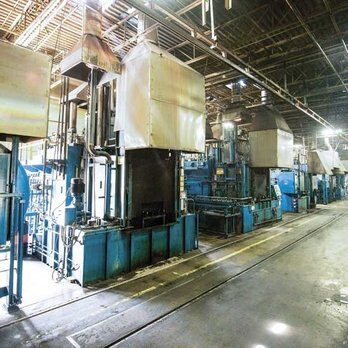
In 31st place on our list of the “52 Largest North American Commercial Heat Treaters 2025″you will find “Metex Heat Treating” of Mississauga, Ontario, Canada. This 40 year old, family owned business processes over 8o million pounds of material per year, mainly through mesh belt continuous furnace lines, batch IQ furnace and Induction hardening processes.
The firm just placed an order for a new gas fired “AFC-Holcroft” UBQ furnace with working dimensions of 36″ X 72″ X 36″ with FNC capabilities. When the furnace is installed, it will bring the number of batch IQ furnaces at this location up to 8, although this will be the third with working dimensions of 36″ X 72″ X 36″. With this addition “Metex” will have the largest installed batch IQ capacity of any commercial heat treater in Canada.
It is rather ironic that we mention “Metex” in terms of Batch IQ capacity when they are probably best known around North America for their mesh belt furnace capacity. With 7 mesh belt lines the company is able to process an astounding 26,000 pounds per hour of fastener work.
For more about “Metex” we would suggest these exclusive news items from “The Monty Heat Treat News”;
“CAN-ENG Furnaces International Ltd. (CAN-ENG) is proud to announce that it has been certified as a FANUC Authorized System Integrator (ASI), expanding its capabilities in robotic automation for industrial furnace systems and thermal processing equipment. This certification recognizes CAN-ENG’s advanced training and expertise in FANUC robot integration, supporting manufacturers worldwide with custom automation solutions for heat treatment and thermal processing applications.
As a FANUC Authorized System Integrator, CAN-ENG is part of a global network of trusted robotic system integrators specializing in industrial automation solutions. This partnership provides customers with direct access to FANUC industrial robots, advanced automation technologies, and technical support delivered through CAN-ENG as a single-source provider. CAN-ENG works closely with manufacturers to select, design, and integrate robotic automation systems that deliver high performance, reliability, and operational safety and efficiency.
CAN-ENG’s engineers have been trained and certified directly by FANUC, ensuring expert application of robotic automation in thermal processing systems, including heat treatment furnaces, material handling automation, and high-volume industrial furnace operations. With strong in-house engineering and on-site support, CAN-ENG helps manufacturers modernize production through high-performance industrial robotics.
This collaboration reinforces CAN-ENG’s role as a single-source automation partner for industrial furnace projects. By offering a unified approach from industrial furnace design and in-house manufacturing to robot programming, system integration, and long-term support CAN-ENG simplifies project execution and delivers reliable turnkey automation solutions for demanding industrial environments.
About CAN-ENG Furnaces International Ltd.; CAN-ENG is a leading global designer and manufacturer of industrial furnace systems and thermal processing equipment for ferrous and non-ferrous metals. For more than 65 years, CAN-ENG has specialized in batch and continuous heat treatment furnaces, serving automotive, steel, aluminum, forging, stamping, oil and gas, rail, and foundry industries worldwide.
CAN-ENG’s rugged furnace designs are recognized for innovation, durability, and efficiency, incorporating energy-saving furnace technology, automated material handling, and advanced industrial robotics to improve production flow, throughput, and facility performance.”
(Editors Note; February 19th“The Monty Heat Treat News” had a news item entitled “North American Furnace Builder Changing Sales Direction”. In that news item we mentioned that furnace builder “Aichelin”, through their USA division “AFC-Holcroft” had replaced a number of their independent sales representatives in favor of direct sales people. This press release from Ipsen mentions replacing one of their independent sales reps with a direct sales person.)
“Cherry Valley, ILLINOIS (March 4, 2026) – Ipsen announces that Industrial Thermal Systems, led by Dean Russell III and Dean Russell IV, is no longer representing Ipsen in the Northeast region. Ipsen appreciates the Russells’ years of dedication and service to Ipsen customers and wishes them continued success in their future endeavors.
Effective immediately, Ipsen will support customers in the region directly. Chad Mehmel, Northeast Regional Sales Engineer, will assume responsibility for all inquiries related to new furnace equipment, while continuing to support customers with replacement parts, retrofits, and hot zones.
Chad has been with Ipsen since October 2023 and has worked closely with customers on aftermarket solutions and equipment performance. His technical background and hands-on experience position him well to support customers’ equipment planning and project needs.
All service-related matters, including field service and technical assistance, will continue to be directed to Guy Kemble, Northeast Regional Service Manager.
Ipsen’s Parts, Service, Retrofits, and Equipment teams remain fully committed to ensuring a seamless transition and uninterrupted support. The company values the continued partnership of its customers and looks forward to supporting their operations.
Customers are encouraged to contact Chad Mehmel or Guy Kemble directly, or submit an inquiry through the online contact form at https://ipsenglobal.com/request-a-quote/.
“The Monty Heat Treat News” March 2026 Edition; Welcome to the March 2026 Edition of “The Monty Heat Treat News” for over 30 years the heat treatment industry’s largest source of news and industry trends. Some “trends” and industry exclusive “news” headlines in this issue include these;
In addition to our exclusive news items “The Monty” is proud to point out the most recent additions to our “Surplus Heat Treat Equipment Section”. As few examples include these;
As always “The Monty Heat Treat News” looks forward to your thoughts and comments. “The Monty Heat Treat News” is a division of William G. Montgomery Ltd., a family owned business serving the global heat treatment industry since 1968. Sincerely Gord, Jordan and Dale Montgomery.
Mödling / Göppingen / Düsseldorf. As part of the integration of NITREX, the AICHELIN Group is strengthening the organization of UPC in Germany and further intensifying the integration of its expertise in plant engineering, process control, and digital solutions. With personnel changes at United Process Controls GmbH (UPC Marathon) in Göppingen and at QMULUS in Düsseldorf, the Group is reinforcing its technological focus and responding to the growing importance of digital solutions in the heat treatment industry.
Daniel Panny Appointed Head of UPC; Effective March 1, 2026, Daniel Panny has assumed management of the UPC site in Göppingen. In this role, he holds overall responsibility for the site and has been granted power of attorney (Prokura). At the same time, he continues in his position as Head of Sales Europe at UPC.
Daniel Panny brings more than 20 years of experience in the heat treatment industry and contributes extensive market, industry, and sales expertise to his expanded role. This combination of operational site responsibility and European sales leadership is intended to further strengthen strategic market development and consistently drive the sustainable growth of UPC.
Karl-Michael Winter, who previously served as Managing Director of UPC and in a dual role as VP R&D / Engineering at NITREX Metal, will in the future support the AICHELIN Group’s R&D team as Senior Consultant R&D NITREX, contributing his many years of expertise in development.
Mike Löpke Appointed Head of QMULUS; Effective February 1, 2026, Mike Löpke has taken over the management of QMULUS. This division of the AICHELIN Group focuses on all software-related topics, primarily on the eponymous product “QMULUS,” an IIoT platform. In addition to controlling industrial plants, the platform places an expanded focus on coordination, analysis, and visualization of real-time data. The objective is to create process transparency, identify optimization potential, and enable more efficient plant control, including through the use of AI and machine learning. In March, the QMULUS development team will open a new office in Düsseldorf, further strengthening proximity to customers and partners in the German market.
Close Integration of Hardware, Process Know-how, and Digital Solutions; UPC specializes in control and automation systems for heat treatment plants and plays a central role within the AICHELIN Group in the further development of digital solutions. In combination with existing process control systems such as FOCOS 4.0 and the cloud-based analytics platform QMULUS, this creates a seamless connection between plant control, automation, and data-driven optimization.
Energy efficiency, process stability, and transparency are becoming increasingly important. At the same time, demand is growing for digital solutions that capture plant conditions in real time and enable predictive optimization.
“With the further development of our organization in Germany, we are creating the conditions to more closely integrate our technology and software expertise. Our ambition is not only to supply individual products, but to deliver holistic solutions along the entire process chain,” says Christian Grosspointner, CEO of the AICHELIN Group. “The combination of proven heat treatment technology, process know-how, and digital IIoT applications is a key element of our strategic direction.”
The structural adjustments are part of the Group-wide organizational development, ensuring clear responsibilities, faster decision-making processes, and stronger collaboration across locations and companies.
About the AICHELIN Group; The AICHELIN Group, headquartered in Mödling near Vienna and part of the Berndorf AG, is one of the world’s leading providers of heat treatment solutions. Its portfolio includes industrial furnaces, industrial heating systems, nitriding systems, control and automation systems, Industry 4.0 solutions, as well as service offerings. The company’s roots date back to 1868. In addition to the traditional AICHELIN brand, the Group includes AFC-Holcroft, SAFED, BOSIO, NOXMAT, and NITREX, making it one of the world’s top three heat treatment companies with around 1,350 employees. The AICHELIN Group operates subsidiaries in Austria, Germany, Slovenia, France, Poland, Turkey, China, India, and the USA. Its global presence is further strengthened by an international sales network. www.aichelin.com
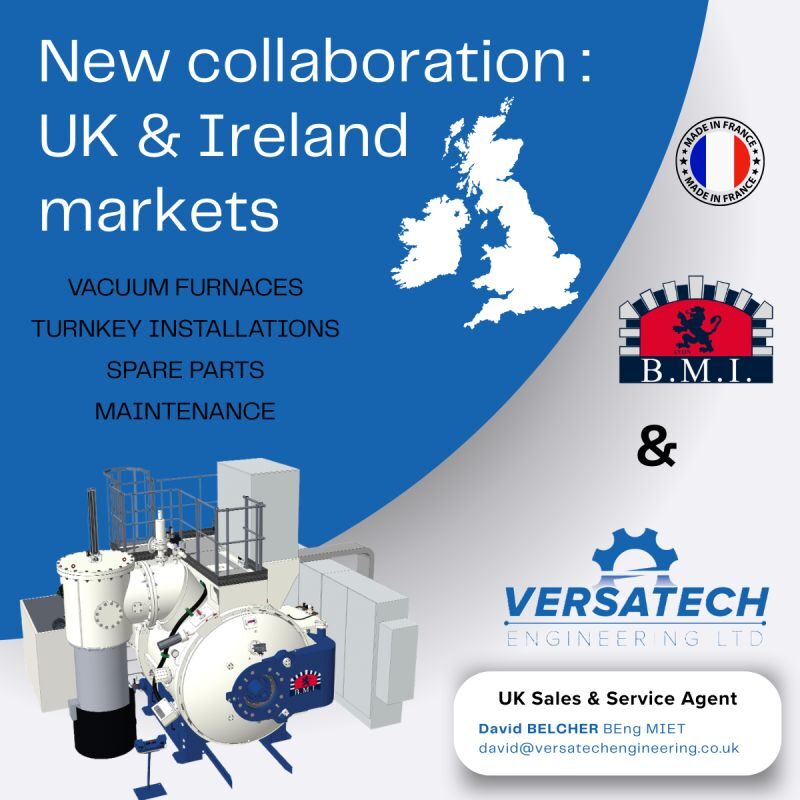
Vacuum furnace builder “BMI” is known as the largest vacuum furnace builder in France although the bulk of their systems are delivered to customers as far afield as Taiwan. Recently they have been very aggressive at moving into new markets such as North America.
This press release tells us how they have hired a new sales representative to cover the United Kingdon and Ireland;
“We are pleased to announce our partnership with Versatech Engineering, who will now represent BMI across the United Kingdom and Ireland. This collaboration marks an important step in strengthening our presence in these markets and delivering high-performance heat treatment solutions supported by local expertise and technical excellence. We look forward to supporting customers in the UK and Ireland with reliable technology and dedicated service.”
BMI Furnaces at Ramada, Portugal
(Editors Note; Bob is well remembered by many long time USA heat treaters. Bob started at Metal-Lab in Sturtevant in 1979 before it was bought by Lindbergh and then Bodycote. He started in the heat treat world back when we still did pack Carburizing and used retorts. Bob was instrumental in the success of the Bodycote Sturtevant facility developing many of the processes and procedures still in place today.)
“Robert “Bob” James Struebing, 68, passed away on February 24, 2026. Born on April 14, 1957, in Racine, Wisconsin to Roy Struebing and Hannelore (née Cziossek) Struebing.
Bob graduated from Case High School, where he was a standout athlete, playing football and excelling in track. His strong work ethic and competitive spirit carried with him throughout his life.
Following high school, Bob proudly enlisted in the United States Marine Corps. There he attained the rank of Corporal, awarded the Good Conduct Medal and the M-16 Rifle Marksman Badge while serving in Supply Administration and Operations. Bob remained deeply honored of his service, especially coming from a proud military family.
On June 24, 1981, Bob married the love of his life, Veronica (née Schilg) in Waukegan, IL. Together they built a beautiful life centered on love, happiness, and family. Their marriage of over four decades was filled with devotion, laughter, and the joy of raising their children.
Bob dedicated over 40 years of his career to Bodycote, where he worked as a heat treater and earned the title of Production Manager. After retirement, Bob couldn’t sit still for long and soon returned to work part-time at Hestia Heat Treating, motivated by staying busy and productive.
Above all else, Bob was a family man. He was a great father and an even better grandfather. He cherished time spent at the family cabin, sharing many laughs and stories. Moments that seem small but mean so much more.
Bob was an avid Wisconsin sports fan, especially a loyal supporter of the Green Bay Packers. He took great pride in his German heritage and was an active member of the Racine German Club. Whether cheering on his teams, sharing family traditions, or gathering everyone together, Bob’s presence was steady, strong, and full of love.
He is survived by his wife, Veronica Struebing; his children, Josh (Amber) Struebing, Erik (Wendy) Struebing, and Sara (David) Clark; and his grandchildren, EmaLee, Drake, Dayton, Ila, and Mack. He is further survived by his loving brothers and sisters, and many nieces and nephews.
Bob was preceded in death by his parents, Bud and Hano Struebing, and his granddaughter, Dakota Marie.
A memorial service to celebrate Bob’s life will be held Thursday, March 5th at 9:30 AM at the Draeger-Langendorf Funeral Home and Crematory, 4600 County Line Road. Prior to the service, there will be a visitation beginning at 8:30 a.m. Immediately following the service, family and friends will proceed to Southern Wisconsin Veterans Memorial Cemetery, where Bob will be laid to rest with honors.
The family would like extended their gratitude to Racine Fire Station 4 and to all the Emergency Department staff at Ascension Hospital for their life saving efforts.”
Ben we did an interview together a few years back, an interview which can be found at “Ben Gasbarre, President Gasbarre Industrial Furnace Division” so I very much appreciate the chance to see what has changed at Gasbarre since that time. Normally I would take this opportunity to ask you about your background, however since we covered this ground in the past lets jump right into the really interesting questions, what has changed at Gasbarre since we last spoke.
The most recent press release I saw from Gasbarre was about your partnership with a Swiss furnace company by the name of “Solo Swiss”, perhaps you could give us some background about how this came about.
“Hi Gord, It is good to do this again as we have a lot going on at Gasbarre and it certainly has been a busy few years.
Gasbarre and SOLO Swiss pursued the ProfiTherm partnership because it expands what we can offer the North American market in a way that’s truly differentiated, not just another variation of traditional batch atmosphere integral quench equipment.
This wasn’t an ad hoc decision, we had a series of detailed discussions with SOLO, including face-to-face meetings, to confirm strategic alignment and long-term mutual benefit.
Strategically, it does three things:
· Proven process expansion: ProfiTherm is a well-established platform that broadens our coverage across austempering, carburizing, carbonitriding, neutral hardening, and marquenching, and we’re bringing it to North America with strong application and lifecycle support behind it.
· Differentiated system: It brings a modular bell-furnace design to North America that helps customers fit floor-space realities, adapt to changing mixes and volumes, and drive better cycle costs and lifetime value.
· Confidence to invest: It’s an exclusive North American license with U.S. manufacturing and support, which strengthens responsiveness, parts availability, and provides long-term confidence for our customers.
Ultimately, ProfiTherm aligns with many of the realities and challenges in today’s market, giving customers a compelling new option to build capacity with less risk.”
I am quite familiar with “Solo” having seen a number of their installations in various locations around Europe. Undoubtedly, they have very good furnace systems, but the “modular” style of their equipment looks “odd” to a North American eye-do you think this will be a deterrent for North American heat treaters?
Visually it doesn’t look like what North American shops are used to. In fact, it looks more like a modern automation cell than a traditional furnace, and in many ways that’s where the industry is headed.
The bigger hurdle won’t be appearance as much as awareness and early education. Once we get past that, the advantages are hard to ignore. ProfiTherm is a pitless system with pick-and-place material handling, which avoids many of the operational and maintenance challenges tied to chain-based handling, especially in quench environments. The modular set-up also helps reduce downtime exposure, because issues can be isolated rather than impacting the entire line.
Another factor today is risk perception. Heat treaters are increasingly dealing with tougher insurance requirements, and this design doesn’t carry the same “fire-breathing dragon” stigma. Flames are well controlled and often barely noticeable in operation.
Finally, with labor constraints becoming more real, this technology is designed for automation and is already proven in fully automated production cells. And as salt quenching gains interest in North America, it provides a practical, scalable path to add capacity without a major infrastructure overhaul.
The “Solo” partnership is obviously a new development and quite at odds with the perception (misperception) that many of us have about Gasbarre being primarily a supplier of sintering furnaces. Is this a perception which you feel is unfair in 2026?
It’s an understandable perception, Gasbarre was built on the success of the powder metal industry, and sintering has long been a major part of our story and installed base. That market is what launched Gasbarre into furnace design and manufacturing and drove us to later expand into higher-temperature applications and vacuum capability through the acquisition of C.I. Hayes.
And to be clear, powder metal and sintering are still core to who we are. We continue to invest there, and that customer base remains extremely important.
Where the perception becomes incomplete in 2026 is that we’ve evolved and diversified. Many of the same platforms that support sintering also apply to annealing, brazing, and glass-to-metal sealing, and our vacuum technologies including multi-chamber and continuous solutions, serve demanding applications across aerospace, automotive, and industrial markets. On the batch atmosphere side, we cover everything from standard box furnaces to large car-bottom and tip-up furnaces for tempering, stress relieving, nitriding/FNC, and higher-temperature alloy processing in markets like aerospace, commercial heat treating, forging, and oil & gas.
So yes, we started with sintering furnaces and we’re still advancing it, but we’re much more than that today in both product breadth and market reach.
Lets move on to some of your other product offerings-one that has always fascinated me is your product line of “continuous vacuum” furnaces. To this day it seems like a contradiction in terms but we know you have built a lot of this style of furnace and we know that it has been successful-is this still a popular offering for you?
Yes, and in some ways, more relevant today than ever. Our customers who run continuous vacuum furnaces are some of the strongest believers in the technology because they see the value every day. We see the same dynamic with multi-chamber batch vacuum systems as well.
The main hurdle isn’t performance, it’s awareness and initial education. Most vacuum furnaces in the market are single-chamber, and many specifications are written around that style, so moving to multi-chamber or continuous can require a mindset shift.
Multi-chamber and continuous vacuum furnaces can drive real efficiency gains because you’re not constantly thermal cycling the hot zone, reducing maintenance and replacement-part costs, improving throughput, and shortening floor-to-floor time. In the right applications, we like to say you can shorten processing from “hours to minutes,” and we have installations where customers are getting a load out every 10 minutes or less.
Vacuum processing is growing for well-known reasons, but today’s production demands, along with environmental, safety, and workplace expectations are making continuous and multi-chamber solutions increasingly attractive for departments looking to do things differently and more efficiently.
How long has it been now Ben since you started offering nitriding/FNC equipment-it seems fairly recent to me but I know it is no longer a recent development. Has this technology proven to be a success for you?
We developed nitriding/FNC equipment because we saw a clear gap in the market. Many of the established equipment providers were European-based and European-built, and our goal was to bring a competitive offering to North America that was designed and manufactured in the United States, supported by a U.S.-based supply chain.
A key part of making that happen was our collaboration with Super Systems, Inc. and their controls platform, which helped us bring a well-designed, well-manufactured solution to market. Our first installation went in during 2019, and today we have several more systems in operation or currently in production.
Has it been a success? Yes. Breaking into an existing market is never easy, but I’m extremely proud of the work our team did to establish Gasbarre as a viable North American manufacturer in this category, and I strongly believe we’ll continue expanding the installed base while driving meaningful advancements in the technology.
Obviously over the years you have branched out into a number of different styles of furnaces-care to share with us which designs have the most momentum moving forward?
Market demand tends to create the momentum, and our job is to make sure our furnace designs and product offering create the opportunity to serve it.
Leading up to the last year or so, we saw strong momentum around emerging markets like alternative energy, energy storage, fuel cells, hydrogen generation, and related areas, and we were well positioned to support those needs. That momentum hasn’t gone away, but many of those segments are still working their way into broader adoption.
More recently, we’ve seen momentum shift back toward more conventional markets like automotive, aerospace, and general industry. Again, our focus has been continuing to advance and adapt our designs to match what those customers are asking for: better efficiency, more automation, stronger safety and environmental performance, and improved overall ownership experience.
One other factor that’s hard to ignore is the age of the installed base. A meaningful amount of furnace equipment was installed in the late 80s and 90s is now 30+ years old, and we’re seeing growing opportunity in both replacement and modernization as customers look for practical ways to improve reliability, capability, and long-term performance.
Lets look at changes in furnace design, in particular changes having to do with emissions and heating choices. Europe is obsessed with energy costs (for good reason) and “emissions” and how they effect “carbon footprints”-it often appears to me that North America and Europe are going in completely different directions on these topics.
First off are you getting more requests for electrically heated furnaces? Second are your customers asking you to consider emissions when designing furnaces?
What may surprise some is that well over half of the furnaces we produce each year are already electrically heated rather than gas-fired, largely driven by our product mix and end users.
What’s changing is that more traditionally gas-fired users are now asking for a true side-by-side evaluation of tradeoffs, operating cost, utilities, and carbon footprint. In some cases, they’re acting on it through electrification or efficiency-driven replacements. We’re also seeing maintenance capability factor in more; with a tighter labor market, many plants find it easier to staff and support electrically heated systems than gas-fired systems.
So no, North America hasn’t moved to widespread “electrify for environmental reasons” yet, but electric heat and emissions are increasingly part of the mainstream design discussion.
When I last visited you in PA you had just moved into a new, larger facility, as a matter of fact it was so new that the entire facility smelled of fresh paint. At the time I remember thinking that you had an enormous amount of room to grow in the future-out of curiosity have you been able to fill it yet with new furnace orders?
Yes, we’ve been fully operational in the new facility for about two years now. We expanded from roughly 50,000 sq ft to 150,000 sq ft. We had clearly outgrown the old space, and we also knew the new footprint would take time to grow into.
What the added capacity has done immediately is enable a more structured workflow and expanded pre-shipment testing, both of which directly improve equipment quality and performance once it arrives at the customer’s site. We’ve seen solid growth over the last several years and fully intend to continue that trend.
I do want to acknowledge the team at Gasbarre. A move of that scale is a major undertaking, and we executed it with minimal disruption to manufacturing or our customers. The progress we’ve made as a company is a reflection of the knowledge, experience, and dedication of our people.
People always talk about challenges as though they are bigger these days, personally I think there has always been challenges and always will be. Having said that what are there any in particular these days that you spend a lot of time thinking about?
I agree, there have always been challenges, and there always will be. I started my career during the Great Recession in 2008, and we’ve seen plenty of change since.
What feels a little different today is how many variables are moving at once. Labor and knowledge transfer remain real issues, especially maintaining consistent execution as teams grow and evolve. At the same time, customers are pushing for lower project risk and asking more of their suppliers, which raises the bar on communication, design standardization, and performance validation. Political and geopolitical shifts add another layer, but the approach doesn’t change, learn quickly, adapt, and keep moving forward while staying focused on delivering reliable equipment for our customers.
Can you share with us any new products ideas that we will be seeing from Gasbarre in the near future? I promise we won’t share this with too many people?
I can appreciate the question, Gord! The recent SOLO partnership is a good example of how we think. Gasbarre has a long history of expanding capability through acquisitions, internal development, and partnerships so we can offer the best solutions for our customers. I won’t tease a specific new product announcement, but we intend to keep that mindset, staying close to customer needs and pursuing the right opportunities when they create real value.
One final note, and one of my favorite ones-what do you expect for the rest of 2026 and even 2027? Care to share some predictions?
Nothing I want to put in writing! Predictions don’t always age well. That said, I do think a few trends will continue. We’ll likely see more industry consolidation, and businesses like ours will keep adopting AI and automation tools to become more efficient, changing how we sell, design, build, support, and communicate, even if the fundamentals stay the same.
What I enjoy is that no two opportunities are the same. And as long as we’re using metal, we’ll need thermal processing to make it functional and perform, which means there will be a strong need for the essential work our industry does through 2026, 2027, and beyond.
Ben thanks for your time, I always enjoy speaking with you and your team-each time I do I realize how you have become one of the largest new furnace builders in North America. Sincerely Gord
Thank you, Gord. I appreciate the opportunity, and I appreciate what The Monty does to share perspectives and keep the industry connected.
Cherry Valley, ILLINOIS (February 26, 2026) – Ipsen announces the sale of a TITAN H2 2-bar vacuum furnace to Grace Manufacturing, supporting the company’s continued growth in medical component manufacturing.
Grace Manufacturing, located in Russellville, Arkansas, selected the TITAN H2 following third-party testing at a Midwest Commercial Heat Treater, which confirmed the system met application requirements for thin martensitic stainless steel medical components. The furnace will mark Grace Manufacturing’s first Ipsen installation.
The TITAN H2 features a work zone measuring 18” x 18” x 24” deep, a 1,000-pound load capacity, and an operating temperature up to 2,400 ?F. Designed for precision and repeatability, the system delivers temperature uniformity of ?10 ?F, supporting the stringent quality standards required in medical manufacturing environments.
From the initial RFQ, Ipsen responded quickly, conducted an on-site visit, and worked closely with Grace to confirm metallurgical goals and align the solution with existing infrastructure. Throughout the evaluation, Ipsen remained responsive to technical questions and service needs, ensuring a smooth order process.
Established in 1966, Grace Manufacturing specializes in precision metal services primarily serving the medical industry. The new TITAN H2 will replace an aging vacuum furnace from another manufacturer that has experienced increasing downtime and service challenges in recent years. The investment reflects Grace Manufacturing’s confidence in Ipsen’s equipment reliability, application expertise, and long-term service partnership.
The insane energy policy in the UK has been having an effect on industry and certainly commercial heat treaters are also feeling the pain-this press release mentions yet another one closing their doors. From what we can tell this was a fairly “high end” shop offering press quenching, carburizing and induction hardening.
“British metal company collapses into administration after 70 years
The latest available records show that the company employed 38 people in 2024 MTE Heat Treatment has collapsed into administration after 70 years in business.
The company, based in West Yorkshire, specialises in treating industrial metals to improve strength and durability.
Administrators were appointed on February 24, the London Gazette reports.
The latest available records show that the company employed 38 people in 2024, though more recent figures are not yet available.
Lee Van Lockwood and Gareth Harris, both of RSM UK Restructuring Advisory LLP, have been appointed as joint administrators.”
 In 31st place on our list of the “52 Largest North American Commercial Heat Treaters 2025″ you will find “Metex Heat Treating” of Mississauga, Ontario, Canada. This 40 year old, family owned business processes over 8o million pounds of material per year, mainly through mesh belt continuous furnace lines, batch IQ furnace and Induction hardening processes.