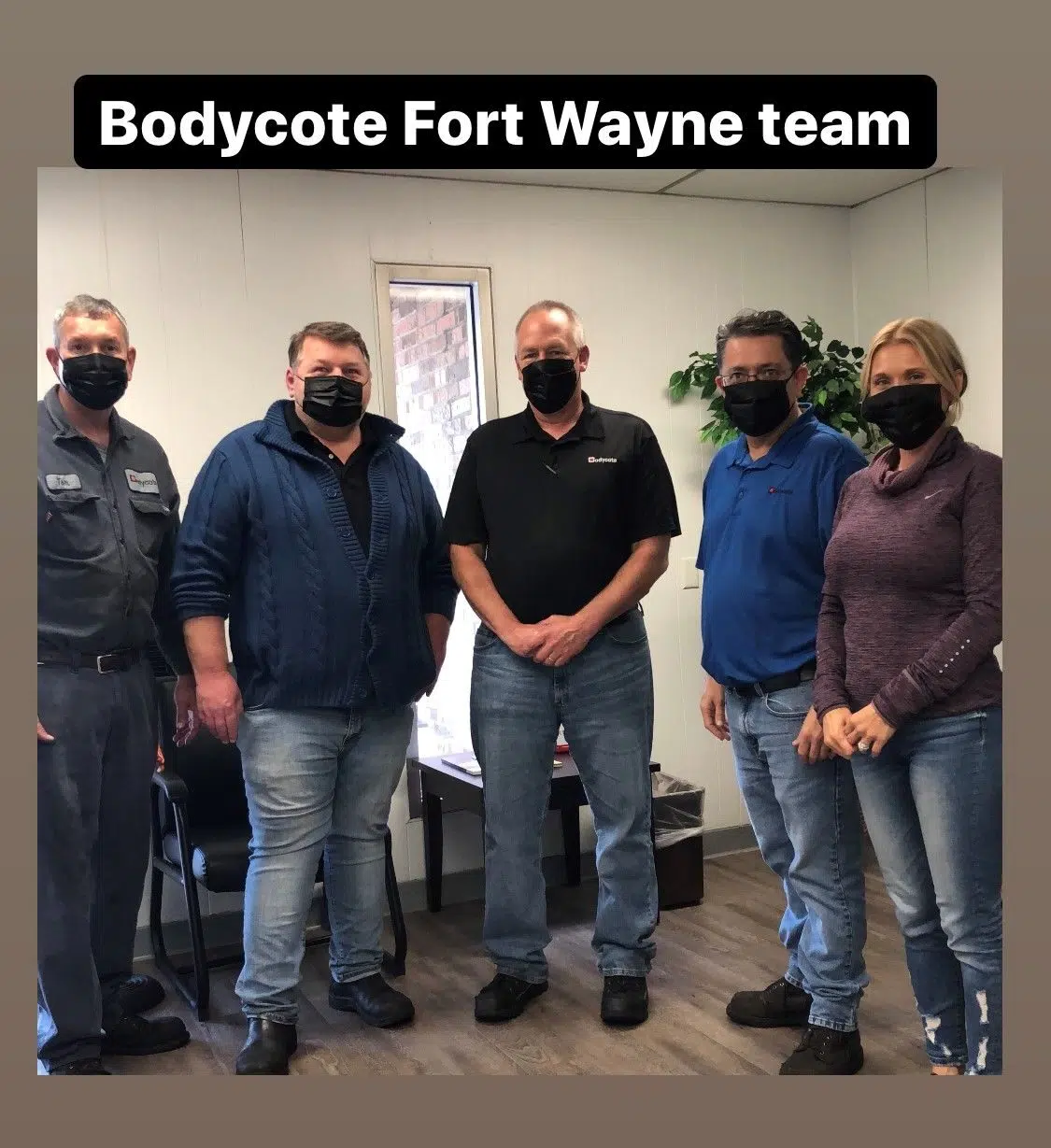
 It is our understanding that Mr. Brett Burns recently became General Manager of the Bodycote, Fort Wayne, Indiana, USA facility. Brett was previously at the Canton, Michigan, USA facility. As the world’s largest commercial heat treater Bodycote probably needs no introduction from us. The Fort Wayne location is not the standard Bodycote location in that this facility offers continuous furnace heat treat processing, not a staple of most Bodycote plants. In this photo Brett is the fellow in the mask-what a strange world we live in.
Did you like this article? Click here to subscribe to The Monty.
Vacuum furnace manufacturer Solar Manufacturing has these slightly used vacuum furnaces available.
Did you like this article? Click here to subscribe to The Monty.

As we all now the main driver of alloy pricing is nickel pricing, in other words what you pay for fabricated baskets, cast radiant tubes, base trays, muffles and every other component which goes into a furnace is largely determined by the price of nickel. At the low end of the scale HK material consists of roughly 20% nickel, at the high end of the scale you find Inconel 600 material with a nickel content of at least 72%. So how are we doing this year? Not bad at all as you can see in our 1 year graph of nickel pricing. We feel confident in saying that there will not be dramatic swings in alloy pricing either up or down in the short term.
Did you like this article? Click here to subscribe to The Monty.


It can be easy to forget that heat treating can be a dangerous industry but examples abound of tragedies that have occurred either though equipment malfunctions, carelessness, mistakes or a combination of all of these. Recently we were approached by a captive heat treater who operates a number of vacuum furnaces-he was relatively new to the industry and he was asking about safety around his department and what should be considered. This prompted a discussion about the potential dangers of inert gases and suffocation and we used an example which occurred in North America a number of years back. We have deliberately removed the location, make of furnace and the company involved-our intent is to remind heat treaters that safety always need to be considered in our industry. What you see below is the OSHA report on the accident.
“At 9:30 a.m. on May 17, 2001, an accident occurred at the employer’s facility. At the time of the accident, Employee #1, a maintenance worker, was working to repair a hydraulic leak on the inside of a XXXX Vacuum Furnace. This furnace opens to the side and has a quench oil tank, 6-feet in diameter by 9-feet deep, on the inside which is used to cool metal parts once they have been heat treated under vacuum. Once the parts have been placed in the quenching tank by the parts elevator, the furnace is backfilled with an inert gas, either argon or nitrogen, to replace the vacuum from the system. The oil from this tank was drained three days before the accident in order to service the hydraulic lines and the motor located at the bottom of the quench oil tank.
While Employee #1 was working, he collapsed into the empty quench oil tank. Employee #2, the maintenance worker’s supervisor, who was in the area called for help and climbed into the furnace to attempt to render aid to Employee #1. Employees in the area who heard the call for help came to the furnace and saw Employee #1 lying on the elevator yolk and Employee #2 slumped next to him. At the time of the accident, the electrical panel for the furnace was energized and the argon and nitrogen valves on the pipes for the inert gases to Furnace Number 9 were open. There is a solenoid valve in-line on each of these pipes which controls gas release for the treatment cycle. It is not clear why or which gas was delivered to the furnace. However, witnesses at the site stated that the selector switch on the operation panel was selected for argon. Employee #1 and Employee #2 were not wearing a harness or retrieval lines. The fire department retrieved the two employees, who were pronounced dead at the hospital. The coroner’s report lists the cause of death for both employees as suffocation.”
Did you like this article? Click here to subscribe to The Monty.

Earlier this year Martin van Rossum and Michael Aurand, two individuals who have spent most of their working lives in the European heat treat industry founded manufacturers rep firm CIBS GmbH in Kleve, Germany. Since their beginning the company has signed rep agreements with companies such as ECM, Inductotherm, Blue Power, Stange, Isserstedt, Courth and Thermocontrol.
In the past Michael was head of the Service Center at SECO/WARWICK Germany GmbH and Ipsen International GmbH while Martin has worked with companies such as Nespi International GmbH, IHU-Unna, IBW-Irretier-GmbH, SECO/WARWICK and Courth Edelstahl GmbH.
We wish them the best of luck, more details about the company can be found at https://cibs.gmbh/
Did you like this article? Click here to subscribe to The Monty.

In South Carolina, USA Kyle Favors has made a real name for himself in the heat treating industry through his rep firm “CF Thermal” and his calibration/service company “Heat Treating Services Unlimited“. Kyle recently launched another venture, “Heat Treat Depot” whose banner ad can be found on the right side of the page. Heat Treat Depot is a rather unique idea and one which we predict will be quite successful. To cut a long story short “Heat Treat Depot” has a vast stock of new and used heat treat components, the twist is that while the company offers some larger items, the real focus is on smaller items such as alloy components, valves, switches, power supplies-the myriad of small parts necessary to keep a heat treat department running. http://heattreat.store/
Did you like this article? Click here to subscribe to The Monty.

Premier Thermal is one of the largest commercial heat treaters in North America as ranked by “The Monty Heat Treat News” https://themonty.com/project/l
ugust-2020/ Phil’s career in the industry spans several commercial heat treats as you can see in the summary below;
“Phil Hilger has over 20 years of heat treating and heat treat equipment design/rebuild experience. Phil began his career in 1997 working at Guardian Industries as an engineer on the glass annealing and forming furnaces. In 2000, Phil began working for Al-Fe Systems as an engineer; designing, building and refurbishing heat treat furnaces. Phil advanced to Lead Mechanical Engineer at Al-Fe Systems. This included managing the design and project management group. In 2008 Al-Fe Systems was closed and Al-Fe Corporate decided to focus the operations on heat treating. As a result Phil was moved to Al-Fe Corporate Group with responsibility for the Engineering, Safety, and Environmental departments. In 2013 Phil began a role as Senior Project Engineer for Superior Essex. In this role, Phil was responsible for new design and installation, and upgrades to existing wire enameling ovens and ancillary equipment for the global company.
In 2016 Phil returned to Al-Fe Heat Treating as the Engineering Manager. Premier Thermal purchased Al-Fe in 2018 and Phil was retained as the Engineering and Purchasing Manager. In 2020, Phil was promoted to Director of EHS, Engineering, & Purchasing. Phil has a B.S. in Mechanical Engineering Technology from Purdue University, a Six-Sigma Green Belt from Cuyahoga Community College, a Leadership Certificate from Notre Dame and has also completed the Project Management training courses from PMI.”
Did you like this article? Click here to subscribe to The Monty.

So what do you think a refurbished 1964 Ipsen Batch IQ furnace is worth-well we can tell you exactly what it is worth in the current market. What you see is a batch IQ furnace manufactured by Ipsen in 1964, Model T7-1000-DGM with working dimensions of 30″ wide X 48″ deep X 20″ high. The furnace is gas fired and capable of Carburizing, Neutral Hardening and Carbonitriding comes with a loader, spare parts and ammonia tank.
The story behind this furnace is that it was refurbished by Unitherm (a furnace builder in Missouri) in 2015 down to bare metal, converted to Eclipse Recuperative Burners, new wiring and SSI controls, basically everything but the shell is new. Unit was even rebricked just two years ago. Cost for all of this? We don’t know but $150K is probably on the low side. Asking price was dropped several times and at the time of sale just a couple of weeks ago it was at $49,000. Bottom line is it sold for $20,000 USD, we are not surprised.
Generally we at “The Monty Heat Treat News” consider a furnace built in the 1960’s to be worthless, however in this case it was basically almost new because of the rebuild project. However many buyers can’t see beyond the original build date and combined with the relatively small size of the furnace it ended up selling for a fraction of what the original owners invested in it which is a shame. By the way we reference the small size of the furnace as being a deterrent to the sale, except for some captive heat treaters and commercials in areas with small volumes such as parts of the US west cost and the US Northeast most heat treaters would consider this too small for their needs.
The moral of the story is that sometimes it doesn’t make sense to invest in upgrading a very old furnace.
Did you like this article? Click here to subscribe to The Monty.


French furnace builder BMI recently delivered and commissioned two vacuum furnaces for a Spanish customer, Egile Group. “Egile is a promising new actor on the market of aero transmissions. We have just validated the final acceptance of the furnaces which are both AMS2750F compliant and NADCAP certified.
The customer manufactures critical components that will be part of engines and aircrafts made by the industry leaders such as Safran, Airbus, Rolls Royce, Pratt & Whitney, GE Aviation, Guimbal. To heat treat these parts, the customer is equipped with a tempering and low pressure nitriding furnace, type B55RN, as well as a dual-chamber vacuum furnace type B64THC, allowing to do oil quenching, gas quenching and low pressure carburizing.
Today, more than 60 BMI furnaces are in operation in Spain. The Spanish market has grown remarkably in the last five years, making Spain a major player in the development of European manufacturing.”
Did you like this article? Click here to subscribe to The Monty.

To go with this interesting press release from US furnace builder Gasbarre we have this photo of part of the team which “The Monty Heat Treat News” took at the ASM heat treat exhibition in Mexico in March of 2020.
“Gasbarre Thermal Processing Systems is pleased to announce the recent commissioning of a Vacuum Oil Quench Furnace, which included 2 BAR gas quench capabilities to an international manufacturer. The batch system, with isolated graphite heating chamber, is capable of processing 12” wide by 12” high by 36” long loads weighing up to 500 pounds, and is rated to 3000°F. The modular furnace design gives the customer the capability of utilizing the 2 BAR gas quench in the heating chamber, or transferring through internal doors to the oil quench module. The Gasbarre designed Allen-Bradley control system ensures precise control to the customer’s strict requirements. Gasbarre was chosen as the equipment supplier based on the unique modular design that achieves both process flexibly and maintenance ease.
With locations in Plymouth, MI, Cranston, RI and St. Marys, PA Gasbarre Thermal Processing Systems has been designing, manufacturing, and servicing a full line of industrial thermal processing equipment for nearly 50 years. Gasbarre’s product offering includes batch and continuous thermal processing equipment for both atmosphere and vacuum applications as well as a full line of alloy fabrications, replacement parts and auxiliary equipment which consists of atmosphere generators, quench tanks, washers and charge cars. Gasbarre’s equipment is designed for your process by experienced engineers and metallurgists that understand your requirements.”
Did you like this article? Click here to subscribe to The Monty.

Left to Right; Bill Gasbarre, Mark Saline, Ban Gasbarre, Humberto Bastides