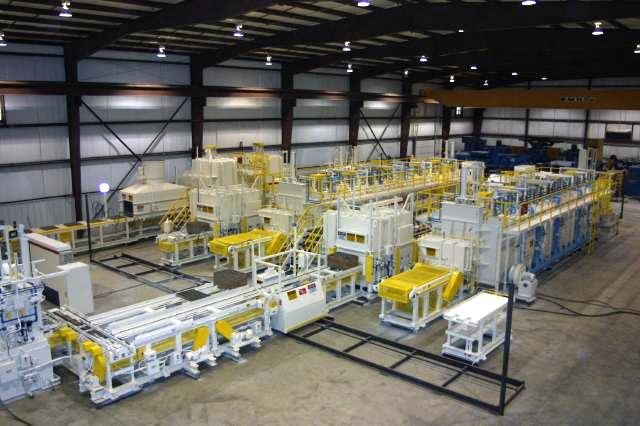
St. Marys, PA – Gasbarre is pleased to announce Keith Fleming has joined the organization as Business Development Manager for Gasbarre Thermal Processing Systems. Keith’s experience and knowledge will allow him to support our existing customers and advance Gasbarre’s growing footprint in the continuous annealing, brazing, and sintering markets.
Keith brings over 25 years of industry experience to Gasbarre; having previously worked with powder materials, powder metal parts producers, and investment castings. Keith is also dedicated to advancing the industries he is in by serving on Penn State DuBois’ Industry Advisory Board, MPIF’s Industry Development Board, and the Marketing and Membership Committee of the Investment Casting Institute. Keith’s experience continues to show Gasbarre’s commitment to having personnel that understand our customer’s challenges and provide proven solutions.
Says Mark Saline, President of Sinterite & C. I. Hayes divisions, “With the addition of Keith, we have added yet another team member to our organization that brings many years of experience. Keith’s work in the powder metal industry and beyond has given him the tools necessary to support our growing customer base as well as advancing our products into new markets. We are excited to have him on board!”
About Gasbarre Thermal Processing Systems. With locations in Plymouth, MI, Cranston, RI and St. Marys, PA Gasbarre Thermal Processing Systems has been designing, manufacturing, and servicing a full line of industrial thermal processing equipment for nearly 50 years. Gasbarre’s product offering includes batch and continuous thermal processing equipment for both atmosphere and vacuum applications as well as a full line of alloy fabrications, replacement parts and auxiliary equipment which consists of atmosphere generators, quench tanks, washers and charge cars. Gasbarre’s equipment is designed for your process by experienced engineers and metallurgists that understand your requirements.
Did you like this article? Click here to subscribe to The Monty.

The world’s largest heat treat industry news source “The Monty” has just made available their November 2020 issue https://fliphtml5.com/gvbzt/sj
Did you like this article? Click here to subscribe to The Monty.

It is with genuine regret that we mention the passing of James “Jimmy” Stewart, Vice President of Akron Steel Treating in Akron, Ohio, USA. We met Jimmy a number of times and always had a high respect for the man. Akron Steel Treating is one of the oldest commercial heat treaters in the USA and has a very interesting history. We include this photo of the owner of the company Mr. Joe Powell in the plant, circa 2018 to provide some background to James’s professional life.
“James W. Stewart, “Jimmy”, age 60 of Akron, Ohio, died on November 2, 2020 at Akron City Hospital. He was born on February 16, 1960 in Akron, the son of the late Gilbert and Ann (nee Williams) Stewart. Jimmy was a 1978 graduate of Central Hower High School. He was Vice President of Akron Steel Treating in Akron for 41 years. He enjoyed fishing and taking drives, however, his greatest joy was spending time with his family, especially his grandchildren.
Survivors include his loving wife, the former Judith A. “Judy” Angerstien, whom he married on June 26, 1978; his two children, Craig Stewart and Marie Stewart; his three grandchildren, DJ Smith and John and Victoria Sowa. His siblings also survive, Margaret Oney, Thomas Stewart and Beverly Stewart and many nieces and nephews. Family and friends may visit on Sunday, November 8, 2020 from 4:00 – 7:00 PM at Newcomer Funeral Home, 131 North Canton Road, Akron. For those of you attending we do ask that you ADHERE TO SOCIAL DISTANCING GUIDELINES AND WEAR A MASK.”
Did you like this article? Click here to subscribe to The Monty.

Vacu Braze, a specialty commercial heat-treating facility, meets the evolving needs of its customers with an Ipsen Turbo2Treater® vacuum furnace specially designed for carburizing and solution nitriding. With high-speed, high-pressure internal gas quenching, the Turbo2Treater® provides best-in-industry cycle times while minimizing part distortion and enhancing part quality. It can also adapt to a wide range of materials, geometries and load types.
Vacu Braze uses the Turbo2Treater® to harden steels with Ipsen’s patented SolNit® (solution nitriding) process. The SolNit® process increases surface hardness and improves resistance against wear, erosion and cavitation. Parts treated in Ipsen’s Turbo2Treater® range from surgical instruments to household appliances. Vacu Braze also uses Ipsen’s aftermarket resources including installation, spare parts, controls upgrades, replacements and retrofits.
“Vacu Braze is extremely proud of the relationship we have developed with Ipsen over the years,” said Kirk Palermo, Vice President of Vacu Braze. Vacu Braze reports an increase in new market opportunity since installing the Turbo2Treater®. Learn more at ipsenusa.com/products/vacuum-furnaces/turbo2treater.
Did you like this article? Click here to subscribe to The Monty.

 Scott, I have been looking forward to talking to you and learning more about Cleveland Electric but first I want to ask how you are doing these days? How has COVID affected you and your family?
“It has certainly been an interesting year for us all. Each of us has handled things differently; I tend to immerse myself in work as a general distraction for outside noise in my life. That is not always easy. My wife and I are learning to work with potential home schooling for our youngest, and our two college kids that may or may not make it through a full semester. We have older parents that are concerned. In general, we are missing life as it was. But with change comes opportunity. For me, that means coming out of this better and stronger. I have enjoyed time with family so much more, from walks and talks to just re-connecting with each other. At work I have also been reminded of the daily value in each of our employees — their presence and input and passion.”
“Cleveland Electric Laboratories was established in Cleveland, Ohio in 1920. At that time, the primary focus was to service and repair electric meters for railroads and local Cleveland industries. Over time, field service became a more prevalent part of our business. At the request of customers, as well as our own requirements for higher quality thermocouples in our service work, CEL began to design and build thermocouples. Eventually the business model shifted exclusively to thermocouples as we began selling to a wide range of industries. What started as a small service and repair business has grown to be the global leader in industrial thermocouples and home to over 100 employees.”
I understand you have two locations, the one in Twinsburg, Ohio and a second, Advanced Technologies Group, in Tempe, Arizona-what is the story behind the Arizona location?
“CEL was looking to expand our physical footprint, create duplicity in manufacturing capability, and complement our existing product offering to our primary customer base, so in 2004 we opened our Advanced Technologies Group in Tempe, Arizona. Realizing that turbine engine manufacturers for both aerospace and power generation perform extensive testing for new designs and are constantly in search of greater efficiencies for existing models, CEL wanted to position itself to support these testing initiatives. Cleveland Electric Labs began fabricating specialty temperature and pressure probes, in addition to performing modification machining of customer components and offering engineering and installation of temperature, pressure and strain gauges on engine components.”
Our focus at “The Monty” as you know is the heat treatment industry, so this question is specifically dedicated to the heat treatment industry. What products do you offer to captive and commercial heat treaters and industry suppliers such as furnace builders?
“Cleveland Electric Labs is proud of its history and relationship in the heat treatment industry. Since our company is rooted in the service industry, we continually focus on how the customer uses our product, and how we can partner with them to meet or exceed expectations that are critical to them. We consider raw materials, accuracy, drift, response time, longevity, lead times and pricing. We work with significant industrial furnace manufacturers to understand form, fit, and function. In short, if it is an industrial thermocouple, then we make it, but our expertise has moved towards high temperature (control or high limit sensors) and critical–to–quality builds.”
How do you sell your products? Direct salespeople? Manufacturers reps? Distributors?
“Our sales strategy is clean and simple – CEL sells direct. All the staff operates as a team and is salary based. The group all has the same goal: to diligently serve our customers, having their best interests in mind. If we can move a customer from a type ‘S’ to type ‘K’ for their application, I do not want our staff to ever think about how a decrease is sales dollars may affect their overall compensation. For that reason, any potential commission structure is removed from consideration. Our group is measured based on the longevity of our relationships, and the ability to retain, foster and grow them.”
At this point I want to mention that the company is celebrating a very impressive anniversary this year, one which only a handful of companies in this industry can match-please tell us about it.
“A century of business is certainly a milestone that we do not take lightly. Under the leadership of Fred Lieske, who became President in 1954, followed by his son Jack Lieske in 1981, then the appointment of Alan Seymour in 2019, the business was built on a foundation of faith, family, and service. Our customers are truly considered partners, and our employees are CEL family. We have extremely high employee retention, which offers us a continuity in knowledge and customer familiarity that is invaluable in today’s uncertain conditions.”
Scott I am going to play Devil’s advocate for a moment and make a rather provocative statement, isn’t a thermocouple a thermocouple? Now before you get annoyed at me let me rephrase this a bit, how much difference can there be between a thermocouple made by Company X as opposed to one made by Company Z-what sets yours apart from others?
“It is fair to question if a difference exists between manufacturers, especially if a thermocouple is classified as MRO and is not considered critical–to–quality. It is important to realize that the ramifications of a “bad” thermocouple can be catastrophic. A customer selects a supplier based on price, quality, and delivery. These buying criteria are unique to everyone, and as a manufacturer of custom products we must balance the significance of each. For CEL, quality takes precedent over all else, as much of our business requires elevated standards. We also have a constant eye toward reduction in “Per Heat Cost”—how we extend the service life of our thermocouple while maximizing performance. This is generally achieved through thoughtful collaboration and by carefully listening to our customers’ needs.”
What is a typical order for you Scott? For instance, are your customers buying a few small items from you at a time or is it more typical that a customer will place an order for their thermocouple requirements for the next year? This question leads to another one, are you mainly dealing with end users, captives and commercials or is more of your business with furnace builders and industry suppliers?
“Cleveland Electric Labs sells thousands of line items to a wide range of industries. We support long-term agreements, blanket orders, and spot buys for customers. Our relationships are not overly selective or targeted, as diversification across industries is something we value, especially in today’s market. CEL targets end users, captive and commercial heat treat, and furnace builders. Our business model supports a direct relationship as much as possible, reducing the risk of misinformation and increasing our ability to give the customer exactly what they want—from performance and certification to packaging, product identification, serialization and more.”
Has the technology behind thermocouples changed much over the years? This of course leads to the next question which is; do you see any changes on the horizon when it comes to measuring temperatures in furnaces? Anything exciting which you can share with us?
“The technology behind thermocouples is nearly 200 years old, with CEL existing for over half of that timespan. The general purpose of simply achieving a temperature reading has elevated to the adherence to strict quality standards, both internally and industry/customer mandated. There is a constant effort to raise temperatures, increase longevity, reduce diameter, and improve accuracy. The industry is trending, as it should, towards value-added relationships. We believe that there are many suppliers that can give a customer what they ask for. We make it our business to give them what they need. We make the effort to understand our customers business as if it is our own.”
I owe you a bit of an apology here Scott, I didn’t ask the most important question of all; what is your background and how did you end up as VP of Sales for Cleveland Electric Laboratories?
“The short answer: family. I grew up with Cleveland Electric Labs. My father, Ron Puhalsky, was with CEL for over forty years. I spent time as a teenager at CEL, learning the product before going to college. I worked as a financial analyst for a short time before I realized that I did not want a desk job, and I was fortunate to have General Electric in Cleveland offer me a position in sales, managing a distribution channel with Grainger. Both companies taught me a lot, but I eventually moved into medical sales. Opportunities for advancement in that field required relocation, and that was not attractive to my young family. I joined the sales team at CEL again in 2007. CEL was good for my father and has been great for my family as well.”
Our final question has to do with the state of the industry. This have been a very upsetting and disappointing year for just about everyone and we all have been forced to change the way we do business. What changes have you made to sell, market, and produce your products?
“This year has been a challenge for both employers and employees alike. All of us have been tasked with navigating constant uncertainty and the toll that takes has been significant. For CEL, 2019 was a record year, and the first quarter of 2020 was even better. The economy was strong and our customers were challenged to keep up with demand. Investments were made in new employees, furnaces, buildings, and the like. No industry was fully prepared for this, but we are doing our best to overcome each challenge as it comes. We are finding new business and working to create diversification without moving too far from our core. We have reduced lead times, increased inventory, and stayed strong. We are optimistic about our business and our industry, as well as our next century of service.”
Scott I very much appreciate the time and I look forward to the time when we can get together in person again, shake hands and do things the way we use to.
Did you like this article? Click here to subscribe to The Monty.

“Solar Atmospheres of Western PA successfully vacuum hardened one of the largest aluminum extrusion liners ever produced by Lake Park Tool and Machine located in Youngstown Ohio. The massive H13 liner measured over 100” OAL and weighed a total of 16,000 pounds. The liner was turned on Lake Park’s new large capacity lathe with 34” max diameter and 200” max length.
This H13 liner arrived at Solar Atmospheres of Western PA only one month after the fastest cooling large vacuum furnace in the industry was completed and ready to run. This recently built Solar Manufacturing 10 bar vacuum furnace is equipped with a newly designed hot zone measuring 48” wide X 108” OAL. Additionally, the furnace has a 600 HP blower motor for increased cooling power. The critical cooling rate, to obtain optimum properties for H13 hot worked tool steel, was achieved as evidenced in the as-quenched hardness of HRC 54-55. The part was then double tempered to the customer’s specification of HRC 46 to 48.
Bob Hill, President of Solar Atmospheres in Western PA stated,” this large rapid cooling vacuum furnace provides us continued diversification to our vacuum heat treating repertoire and capabilities. We’re proud of this partnership with Lake Park Tool and Machine and to assist our customers in vacuum heat treating one of the largest air hardening dies that I have personally heat treated over my 40 year career.”
Did you like this article? Click here to subscribe to The Monty.

Last Thursday, October 28th we had a news item about heat treatment safety in general, with a specific example in which case ignoring safety guidelines lead directly to the death of two individuals. The article prompted a number of responses, two of which we are including today below the original note. These two deaths occurred because Lock Out Tag Out (LOTO) and Confined Space Entry Policies were not followed.
“Original Story October 28th, 2020; It can be easy to forget that heat treating can be a dangerous industry but examples abound of tragedies that have occurred either though equipment malfunctions, carelessness, mistakes or a combination of all of these. Recently we were approached by a captive heat treater who operates a number of vacuum furnaces-he was relatively new to the industry and he was asking about safety around his department and what should be considered. This prompted a discussion about the potential dangers of inert gases and suffocation and we used an example which occurred in North America a number of years back. We have deliberately removed the location, make of furnace and the company involved-our intent is to remind heat treaters that safety always need to be considered in our industry. What you see below is the OSHA report on the accident.
“At 9:30 a.m. on May 17, 2001, an accident occurred at the employer’s facility. At the time of the accident, Employee #1, a maintenance worker, was working to repair a hydraulic leak on the inside of a XXXX Vacuum Furnace. This furnace opens to the side and has a quench oil tank, 6-feet in diameter by 9-feet deep, on the inside which is used to cool metal parts once they have been heat treated under vacuum. Once the parts have been placed in the quenching tank by the parts elevator, the furnace is backfilled with an inert gas, either argon or nitrogen, to replace the vacuum from the system. The oil from this tank was drained three days before the accident in order to service the hydraulic lines and the motor located at the bottom of the quench oil tank.
While Employee #1 was working, he collapsed into the empty quench oil tank. Employee #2, the maintenance worker’s supervisor, who was in the area called for help and climbed into the furnace to attempt to render aid to Employee #1. Employees in the area who heard the call for help came to the furnace and saw Employee #1 lying on the elevator yolk and Employee #2 slumped next to him. At the time of the accident, the electrical panel for the furnace was energized and the argon and nitrogen valves on the pipes for the inert gases to Furnace Number 9 were open. There is a solenoid valve in-line on each of these pipes which controls gas release for the treatment cycle. It is not clear why or which gas was delivered to the furnace. However, witnesses at the site stated that the selector switch on the operation panel was selected for argon. Employee #1 and Employee #2 were not wearing a harness or retrieval lines. The fire department retrieved the two employees, who were pronounced dead at the hospital. The coroner’s report lists the cause of death for both employees as suffocation.”
“Ulrich Schwahn, Plant Manager bei Bodycote Wärmebehandlung GmbH; It is painful to read and yet, I am grateful when Information regarding accidents is being shared so that everyone interested can learn from it. I am member of a German specialist group (FA08 at the AWT) for safety in heat treat environments. We publish safety guide lines not only of a technical nature but also by pointing out what employees carrying out specific tasks need to know. Our next publication will detail areas to cover when no employees are present at the heat treat shop, like on weekends.
Earlier this year the DGUV (comparable to OSHA and Workers Compensation) published a book for safety in the heat treat sector, written by us in German and based on European laws. We are convinced that this is a comprehensive and easy to read information made for a practical application rather then having to study abstract laws governing multiple industries. We were able to convince the DGUV to produce an English translation of this safety guide line which should be available soon. This will be a free resource for everyone interested in this subject. These accidents are specifically what we want to prevent from happening.”
“John Hubbard, Chairman at Thermal Process Holdings; Thanks for sharing Gord. Stories like this NEED to be shared so as to potentially prevent other fatalities. Use Lock Out Tag Out (LOTO) and Confined Space Entry policies – 100% of the time. BTW: this was in Tarzana, California.”
Did you like this article? Click here to subscribe to The Monty.

We see that Angela Fleming recently became President of Hudapack Metal Treating of Illinois, Inc., in Glendale Heights, IL, USA. Hudapack was originally a three location commercial heat treater in Wisconsin and Illinois, USA owned and run by Earl Pack and Gary Huss, before Thermal Process Holdings purchased the two Wisconsin facilities back in 2018. Hudapack Metal Treating of Illinois, Inc. is owned and run by Earl Pack and concentrates on mesh belt austempering.
Did you like this article? Click here to subscribe to The Monty.

In Poland we see that Mr. Jędrzej Malinowski of furnace builder SECO/WARWICK was recently named Sales Manager, Vacuum Furnaces Team. Jędrzej has been with the company for a number of years in several different positions.
Did you like this article? Click here to subscribe to The Monty.

“Hubbard-Hall Inc. welcomes Fernando Carminholi as Business Development Manager. Carminholi will focus on developing new business opportunities for Hubbard-Hall’s Aquaease® Infinity line of sustainable cleaners, which is designed to work with Arbortech Membrane Technology. The system reduces total cleaning costs by 35% while reclaiming 95% of production cleaners to allow customers to clean with less cost, complexity, and chemical consumption. Carminholi brings with him over 20 years of experience managing sales territories, supporting local distributors, and overseeing global accounts. This includes his work in metal finishing, electroplating, functional and decorative, metal pre-treatment, and industrial parts cleaning.”
Did you like this article? Click here to subscribe to The Monty.

Andrew Yazotchanka worked with furnace manufacturing giant Ipsen for quite a number of years in Sales Positions both in the USA as well as in Germany and Russia. He parted ways with the company earlier this year and is now looking for another sales position within the industry. He can be reached at [email protected]
Did you like this article? Click here to subscribe to The Monty.


Back in 2008 what at the time was Chrysler LLC joined forces with German auto parts supplier ZF Friedrichshafen AG to produce a new axle manufacturing alliance. The partnership utilized Chrysler’s new Marysville (Mich.) Axle Plant to build three families of state-of-the-art axles for improved fuel efficiency. Production started in early 2010 in what was at the time a 7000,000 square foot plant with the goal of producing approximately 500,000 axles per year. Fast forward to 2020 and we see that FCA plans on spinning off the plant to ZF Corp., in what is an amicable separation. What does this have to do with heat treating? Well it just so happens that this facility has a very substantial in house heat treating department. When production started back in 2010 the facility included several single row pusher furnaces supplied by Williams Industrial Service, Inc., of Bowling Green, Ohio. Since that time the heat treating department has expanded several times and now includes numerous Williams pusher furnaces combined with HEESS press quenching systems, making it a very modern, impressive captive heat treat.
Did you like this article? Click here to subscribe to The Monty.