 As we continue our ambitious project of putting together a list of the 50 “Largest Commercial Heat Treaters in North America” in terms of annual sales we look at a newcomer on our list “Metal Finishing Company” based in Wichita, Kansas, USD who bill themselves as the largest family-owned aerospace processing company in North America. This third generation company, formed in 1940 has a total of 9 locations in the US and Mexico, two of which are dedicated to heat treating, one for aluminum parts and the second for “hard metals”. Processes offered include Hot Forming, Straightening, Tempering, Normalizing, Annealing, Carburizing, and Carbo-Nitriding as well as Aluminum Solution Furnaces and aging ovens. This is in addition to the company’s plating, coating and NDT offerings. While we can’t say for sure in what position the company will land on our final list we will say that the firm will make our list for the first time ever.
Did you like this article? Click here to subscribe to The Monty.
View our recent magazines and podcasts by clicking the following link. https://themonty.com/magazine/

What does a project engineer at furnace builders Surface Combustion or AFC-Holcroft get paid? How about a field service engineer at a controls company such as Nitrex or Eurotherm?
Josh Hale of International Search Partners [email protected], the leader in recruiting for the heat treatment industry tells us in his “Salary Guide for Heat Treat Equipment OEMs”. This article follows hard on the heals of his Salary Guide for the commercial heat treating industry. Stay tuned for a third article next week.
Salary Guide for Heat Treat Equipment OEMs
As with commercial heat treats, job descriptions and requisite salaries for furnace and oven OEMs can vary quite a bit depending on geography, job specs, size of company, etc. Caveats aside, the following offers a glimpse into the current market-value for most job functions within a heat treat equipment manufacturer.
An important note: the below information focuses primarily on salary data and does not account for non-cash incentives such as vacation, flexible work schedules, incentive bonuses, profit sharing, etc. Overall compensation has increased rapidly across the board since the last iteration of this guide and many companies have gotten creative in looking outside base wages to entice and retain employees.
Mechanical, Electrical and Project Engineers: Engineering is a key function for any OEM and these are typically degreed individuals who handle project management and will often act as the project lead regarding equipment design. Electrical Engineers will generally not be the lead on a single project but will spread themselves out over several projects, whereas Mechanical Engineers are more likely to see a specific project cradle-to-grave. Project Engineers are lumped into this category, but often occupy a unique space in the Venn diagram between engineering, applications, management, service, and sales.
Typical salary ranges for engineers can vary quite a bit depending on total number years of experience, but usually falls anywhere from $90k up to around $120k and can go up from there for someone with several years’ experience of niche expertise.
Designers, Draftsman, Detailers (mechanical or electrical): These are typically non-degreed individuals who are the backbone of every engineering or design department and handles drawings, schematics, and software design.
They are usually paid hourly, although some may be exempt, and earn anywhere from $25-40+/hr.
Application Engineers: Also called Proposal Engineers, Estimators, or Inside Sales Associates, Applications Engineers are responsible for the quotes and pricing that gets sent to prospective customers and act as a liaison between sales, engineering, production, and customer.
Entry-level salaries for Apps Engineers start at around $65k but can easily reach up to the low six figures for those who have niche technical expertise and may also be incentivized with bonuses or commission if they work closely with outside sales to close deals.
Field Service Engineers: FSEs are a unique breed of technical “road warriors,” who love to travel and spend days, weeks, or sometimes even months away from home. These hands-on technicians work on installations, commissioning, and start-ups of equipment all over the world. They are almost always non-exempt employees who earn a significant percentage of their income from OT.
Good ones are often making over $100K in any given year with a base pay rate in the $30-40/hr range. That said, this is undoubtedly the most competitive job functions in the industry and pay is rising rapidly as companies try to lure new hires away from their existing employers.
Sales Engineers: Two types of compensation plans are prevalent for sales. One type of plan is salary only, commensurate with experience. The other is salary plus commission or bonus. Generally, OEMs who have a very technical, custom designed product and a long sales cycle will incentivize their sales engineers mainly with base salary and perhaps a small incentive bonus that could be based on measured activity, sales, or gross profits. This works well for both parties since it can be hard to determine a commission percentage for a sale that might be years in the making, but at the same time any good salesman is driven by the hunt and wants to “eat his kill.”
Whatever mix of base and commission, most sales engineers are earning somewhere in the low to mid $100k’s + incentives and car allowance.
VP/GM/Production/Other: This is not a completely exhaustive list of positions within an OEM but covers most of the major roles that require experience and/or technical knowledge. VPs and GMs were intentionally left out because compensation varies so wildly at the top of the pyramid and usually involves other factors such as stock options, equity, or bonuses.
While there is high demand for hourly production workers, fabricators, assemblers, and the like, most companies don’t require much experience for these types of roles and will offer market rates and training to attract entry-level talent or recent technical school graduate to fulfill these needs.
This salary information has been culled together based on data International Search Partners has collected from over 20 years of providing recruiting solutions exclusively to the heat treat industry. There are many variables to consider, and it is becoming quite common for companies to have hybrid roles that are not specifically addressed here. That said, this guide provides a solid, accurate baseline of information and is meant to be used a reference for employers and employees alike. For specific salary questions, or to inquire about more about recruiting and placement solutions, please contact Josh Hale at [email protected] or call 619-828-1040.”
Did you like this article? Click here to subscribe to The Monty.
View our recent magazines and podcasts by clicking the following link. https://themonty.com/magazine/


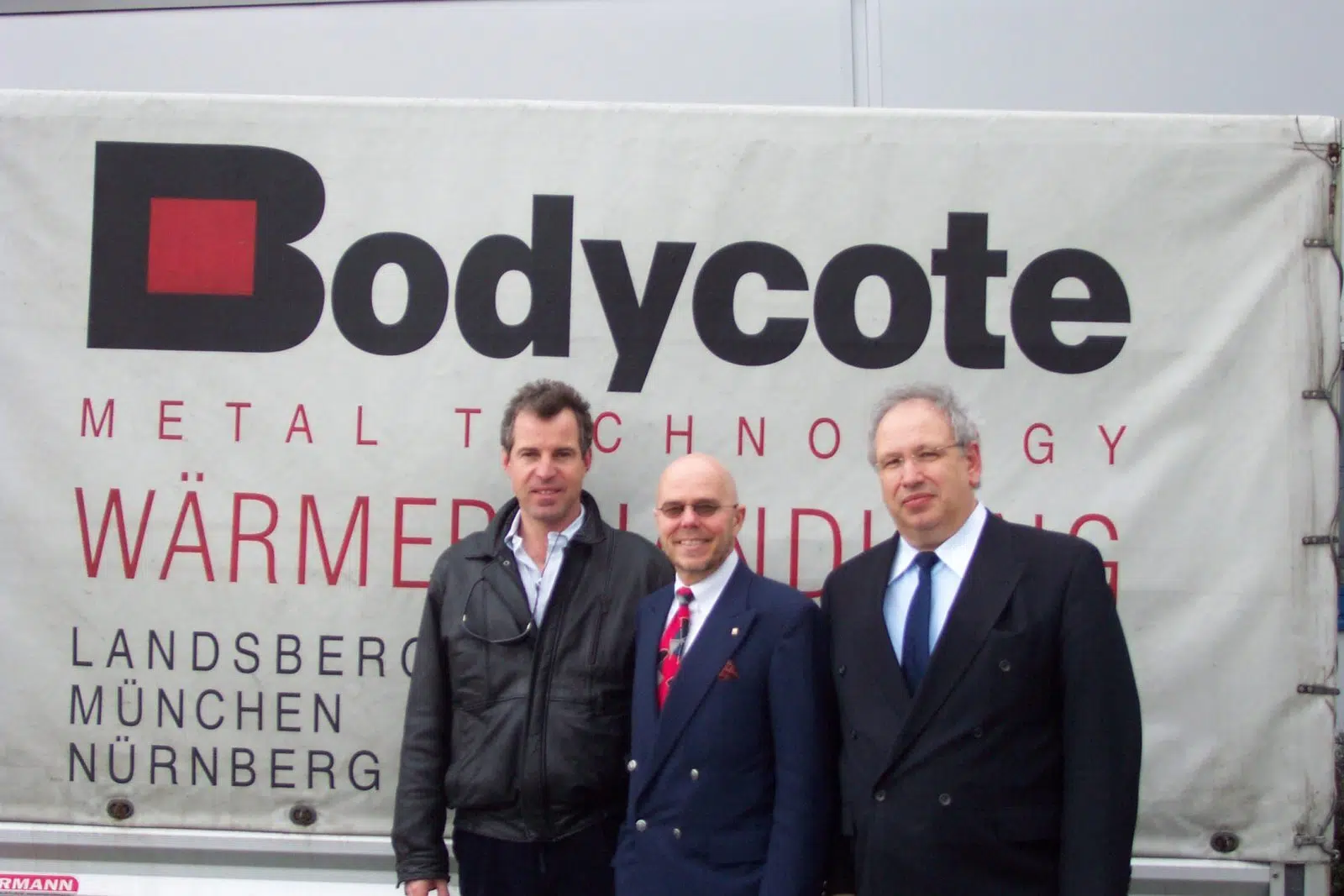
We met Jan for the first time in the late 1990s, when Bodycote was acquiring an Ion Nitriding shop in Munich, Germany by the name of “Nitrion”. The photo below was taken during the acquisition and in it you can see from the left; Gord Montgomery, John Hubbard and Jan Elwart of Bodycote.
Jan leaves behind a powerful legacy, his son, Florian, who has also spent his life in the industry and currently works for furnace supplier ELTROPULS. Jan’s presence and experience will be missed. Our condolences to Jan’s family.
Bodycote, the world’s largest commercial heat treater released their interim financial results for the first 6 month of 2021, a brief summary of which can be found below. The full report can be found at 2021 Interim Results (bodycote.com)

Highlights:
• Revenues up 5.9%4 to £312.9m (2.0% at actual rates)
• Headline Operating Profit up 35%4 to £48.7m
• Headline Operating Margin increased to 15.6% (2020: 12.3%); with AGI margins above 20% for the first time
• Free cash flow of £60m (124% free cash conversion)
• £78m net cash from operating activities
• Profits benefit strongly from restructuring and efficiency improvements, with gearing5 over 70%
• On track to deliver £20m net restructuring cost savings in 2021
• Specialist Technologies and Emerging Market strategies delivering strong outperformance against background markets
• Full year guidance raised
Commenting, Stephen Harris, Group Chief Executive said: “Bodycote’s headline operating margin, at 15.6%, has recovered strongly, boosted by good operational performance and net savings from the 2020 restructuring programme. AGI margins are above 20% for the first time, while ADE margins have also improved over the previous half year. Revenues in the Automotive and General Industrial market sectors have shown good recovery, even if end market performance has been held back by the global chip shortage and supply chain constraints more generally.
Did you like this article? Click here to subscribe to The Monty.
View our recent magazines and podcasts by clicking the following link. https://themonty.com/magazine/
In this weeks edition of “The Heat Treat Podcast”, Mr. Carlos Torres speaks with Ms. Karen Stanton of Heat Treatment Australia about the heat treatment industry in Australia. We would venture to say that nobody knows more about the Australian market in general and Aerospace heat treating in particular than Ms. Stanton. Heat Treating Australia | Karen Stanton | THE HEAT TREAT PODCAST #023 – YouTube
Did you like this article? Click here to subscribe to The Monty.
View our recent magazines and podcasts by clicking the following link. https://themonty.com/magazine/
Solar Atmospheres of Western PA successfully vacuum heat treated the largest and longest load of nickel alloy tubing ever in a commercial vacuum furnace. The mission was to preserve the crucial elements of brightness and cleanliness of the 45 foot long seamless tubing while meeting extremely stringent mechanical properties.
“We spent countless hours reviewing critical systems such as triplicate pumping systems and redundant hot zone controls for any unforeseeable event that might arise during the 100+ hour run. We are also fortunate that we can rely on our furnace manufacturing division, Solar Manufacturing, for guidance should any issue arise. This successful run will ignite a production campaign for the next 5 years, once again boosting confidence that this 48 foot vacuum furnace will surpass our customers’ expectations,” stated Michael Johnson, Sales Director.
Did you like this article? Click here to subscribe to The Monty.
View our recent magazines and podcasts by clicking the following link. https://themonty.com/magazine/

We are pleased to announce that Bob Cole has recently joined Unitherm Furnace, LLC as Senior Mechanical Engineer. Bob comes to Unitherm with a history in the engineering field and is an accomplished engineer with experience in research, new product design and development, product testing and project management. Bob earned his Mechanical Engineering degree from Southern Illinois University Edwardsville.
As Unitherm’s Senior Mechanical Engineer, Bob will lead the direction of new furnace equipment and retrofits, while developing and refining its existing standard line of heat-treating equipment. With Bob’s experience, he will also assist with applications engineering and sales to better understand the customer’s ever-changing needs. Please join in welcoming Bob to our team at Unitherm Furnace.
For additional information, please contact Unitherm at 636.327.5777. Bob Cole Senior Mechanical Engineer Unitherm Furnace, LLC 55 May Road Wentzville, MO 63385 Phone: 636.327.5777 ext. 2008”
Did you like this article? Click here to subscribe to The Monty.
View our recent magazines and podcasts by clicking the following link. https://themonty.com/magazine/

IQ Technologies Inc., of Cleveland, Ohio, USA has for a number of years been marketing a process called “IntensiQuench”, a very interesting and promising process using water as the quenching medium. While the process offers some advantages over oil or polymer quenching it has never quite achieved “mainstream” acceptance. According to this press release Induction heat treat supplier Ajax TOCCO Magnethermic has acquired the assets of the company. The attached photo shows a batch IQ furnace set up for the “IntensiQuench”-this furnace was located at Euclid Heat Treating in Euclid, Ohio.
“Ajax TOCCO Magnethermic acquired assets of IQ Technologies Inc. Cleveland, Ohio-based IQ Technologies has been commercializing an intensive quenching (IQ) process for steel parts in the U.S. and overseas for the past 20 years. The IQ process is an effective and alternative way of quenching steel parts. Developed by Dr. Kobasko of Ukraine in 1964, it presents a very rapid and uniform cooling of steel products in water with cooling rates several times greater than that of conventional quenching in agitated oil or polymer. The IQ process is interrupted at an optimal time when the surface compressive stresses reach their maximum value and the part hardened layer reaches its optimal depth. A proprietary computer program is used for determining an optimal dwell time for steel parts of different shapes and dimensions.
Combining Ajax TOCCO’s induction technology with the IQ process not only creates ideal part processing results, it uses less energy, creates cleaner parts and could possibly lower overall parts and material costs. Ajax TOCCO set up an IQ facility at its Detroit Development & Support Center that includes a single-part processing IQ unit and an induction heating station. The IQ unit is capable of processing gear products and shafts up to 8 inches in diameter and 15 inches long. The induction heating fixture consists of a pneumatic horizontal indexing heat station used for power supply load matching and inductor positioning. The load-matching station can be fed by numerous power supplies capable of operating frequencies and power levels up to 600 kW.
The Detroit Development & Support Center also houses a large area for the manufacture and repair of induction tooling and a metallurgical lab with the equipment and staff necessary to support IQ process development. The metallurgical lab contains macro- and micro-hardness testers, cut-off wheels, polishing equipment and a metallograph for analyzing microstructures.”
Did you like this article? Click here to subscribe to The Monty.
View our recent magazines and podcasts by clicking the following link. https://themonty.com/magazine/


The new furnace system “uses transfer shuttles to maximize the use of the two quench options (oil quench and high-pressure 20-bar gas quench). We have the ability to add many more heating chambers to more than double our capacity easily. This means we can continue to grow quickly with minimal future investment,” Mr. Hemsath explains.
As Nitrex’s biggest carburizing, hardening and carbonitriding facility, the Aurora plant needed to expand its carburizing capacity, according to Mark Hemsath. “We also have good vacuum processing capability in Aurora, and this new installation allows us to perform a wide variety of tool steel projects. Combined with some of the country’s largest nitriding/ferritic nitro-carburizing (FNC) capabilities, Aurora is definitely the showcase of our facilities in North America as a full-service heat treater.” Some advantages of the LPC system include the fact that there is no intergranular oxidation and no surface decarburization. Also, the system’s higher temperatures will lead to shorter cycle times, making the carburizing process faster, more exacting and cost competitive, especially for longer term program production parts.
Did you like this article? Click here to subscribe to The Monty.
View our recent magazines and podcasts by clicking the following link. https://themonty.com/magazine/

From Mr. Josh Hale of International Search Partners we have this fascinating summary about what commercial heat treaters in the USA get paid “Salary Guide for Commercial Heat Treating”. This is part of a three part series with the next one covering typical salaries for heat treatment industry suppliers. Josh can be reached at [email protected], International Search Partners | (ispards.com)
Salary Guide for Commercial Heat-Treating
Although job descriptions can vary quite a bit between companies and salaries are subject to regional cost of living adjustments, what follows is a snapshot representation of the current market-value for most job functions in a commercial heat treat.
An important note: the below information focuses primarily on salary data and does not account for non-cash incentives such as vacation, flexible work schedules, incentive bonuses, profit sharing, etc. Overall compensation has increased rapidly across the board since the last iteration of this guide and many companies have gotten creative in looking outside base wages to entice and retain employees.
General Manager: GM, Plant Manager, Director of Operations… there are some nebulous titles at the top of the typical heat treat hierarchy, but for these purposes, consider at GM as the plant “owner.” He acts as the face of the company and rather than getting overly concerned with day-to-day tactical operations, he focused on dealing with key customers, high-level strategy/planning and ultimately has full P&L responsibility to turn a profit.
Salaries for an experienced GM are in the $125-175k range but can sometimes exceed $200k+ per year for larger, multi-site operations. Almost all GMs are incentivized with performance bonuses, and some are offered a path to ownership or equity.
Plant Manager: PMs usually report to a GM, and like their superior, they can go by many names such as Operations Manager, Production Manager, etc. Here a Plant Manager is considered the person responsible for day-to-day operations of a plant and overseeing all hourly employees and production.
PM salaries are hard to pinpoint because they can vary widely based on size of company, organizational structure and how much hands-on work is necessary for the role. Confounding things further, some companies will also have a plant “supervisor” level just a step below the manager. Those caveats aside, a base salary in the $90-120k range is a fair estimate, with supervisors at about a 10-20% discount from there and both most often with a bonus or additional incentive program.
Plant Metallurgist: Metallurgists will sometimes also act as the Quality Manager and/or Lab Manager, but here assume that the Plant Metallurgist’s main responsibility is over the various processes within the plant. As with most of the positions discussed here, there is a wide variance based on the employee’s qualifications, skills, and experience. A recently degreed process engineer acting as a plant metallurgist will obviously earn less than a seasoned metallurgist who oversees his company’s lab and testing.
Overall, good metallurgy skills are in high demand and wages have increased significantly over the past 2-3 years. An experienced, non-manager, plant metallurgist will earn a salary in the realm of $80-110k.
Quality: As mentioned, sometimes a Metallurgist will fill this role, but often it is a non-degreed person with hands-on experience who has risen through the ranks. It is common for there to be manager of the quality department who will supervise a staff of quality technicians or engineers. Together, they will ensure quality over all heat treat processes, oversee audits, and usually have responsibility over the lab and testing.
Salaries for experienced Quality Managers are between $75–$100k but can easily creep into the low-mid $100ks for someone with niche expertise such as NADCAP or ISO. Quality technicians or quality engineers will have a wide range based on experience and education and can be anywhere from $25ish/hr up to $60-75k per year or more.
Maintenance: Maintenance is one of the most important functions for any heat treat facility. Without a good preventative maintenance plan and good repair capability when furnaces do go down, a commercial heat treater is out of business. Most of the time, Maintenance Supervisors are non-degreed professionals who have worked their way up from an hourly position on the floor. Maintenance Mechanics might be former field service engineers or operators who have transitioned. Over the past few years, there has been a huge uptick in demand for qualified maintenance professionals and salaries have risen as a result – so much so that they are sometimes the highest comped employees in a company earning even more than their bosses.
Hands-on maintenance mechanics are earning high $20s to mid-high $30s/hr plus overtime and can earn more with strong electrical or controls experience. Supervisors and managers are at a $100k minimum and can be up to the mid-$100ks with bonuses.
Sales Engineer: Two types of compensation plans are prevalent for sales. One type of plan is salary only, commensurate with experience. The other is salary plus commission or bonus. Most heat treats implement the latter as it aligns incentives for the company and employee and allows for the motivated sales professional to earn his worth and be rewarded for results.
Commission structures come in all shapes and sizes and be set-up in an infinite number of ways but suffice to say that base salaries for heat treat sales start in the $80-100k range.
Furnace Operators: Hourly Furnace Operators are always in demand, and while they sometimes don’t require much experience and are trained in-house, there are situations where these workers are not only running equipment, but also providing quality control checks and resolving minor maintenance issues.
Wages for furnace operators have increased quite a bit in the past few years and are now around $17-20/hour + OT to start and can get up above $25/hr for someone with extensive experience and additional skills around maintenance, quality or shipping/receiving.
This salary information has been culled together based on data International Search Partners has collected from over 20 years of providing recruiting solutions exclusively to the heat treat industry. There are many variables to consider, and it is becoming quite common for companies to have hybrid roles that are not specifically addressed here. That said, this guide provides a solid, accurate baseline of information and is meant to be used a reference for employers and employees alike. For specific salary questions, or to inquire about more about recruiting and placement solutions, please contact Josh Hale at [email protected] or call 619-828-1040.
Did you like this article? Click here to subscribe to The Monty.
View our recent magazines and podcasts by clicking the following link. https://themonty.com/magazine/
