“Can-Eng Furnaces International Limited was recently contracted to engineer and commission a Continuous Quench and Temper Furnace System for a North American producer of mining, construction, and materials handling products. The purchase of this equipment is part of a larger plant expansion and initiative to bring foreign outsourced manufacturing in house. This move is not only to improve part quality but also to help eliminate overall shipping costs and reduce supply chain issues which have been plaguing many industries over the past couple of years.
This equipment will be part of an automated manufacturing cell and fed automatically from upstream handling equipment. Special considerations have been made to precisely control the quench temperature to reduce hardness variations and improve overall part quality. The multizone belt style temper furnace employs high efficiency natural gas fired heating and recirculation systems which have been proven to provide the ultimate in temperature uniformity in even the most demanding of applications. All pieces of equipment are accessible for control and monitoring through the equipment’s Can-Eng engineered control system which utilizes an Allen Bradly PLC and HMI.
Can-Eng Furnaces International, Ltd. is a global provider and leader in the design of state-of-the-art thermal processing systems. Headquartered in Niagara Falls, ON, Canada, Can-Eng is an ISO 9001:2015 certified company. For further information please contact Can-Eng at [email protected] or [email protected].”
The attached photo shows a recent visit to Can Eng by “The Monty Heat Treat News”
Did you like this article? Click here to subscribe to The Monty.
View our recent magazines and podcasts by clicking the following link. https://themonty.com/magazine/

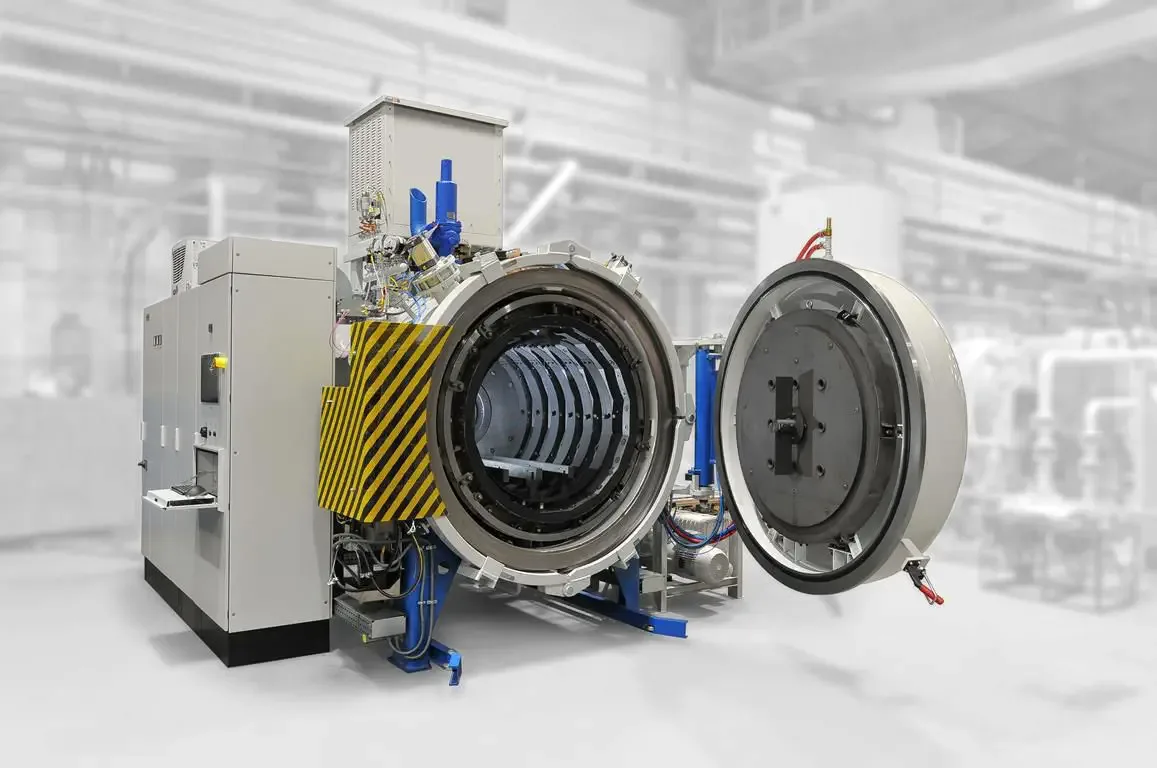
“Two Vector® vacuum furnaces are scheduled to be delivered to a national Mint in Europe. This is the eighth mint to choose SECO/WARWICK solutions. The Vector furnaces will be used to harden the dies necessary for the production of coins for both circulation and collector series. Vector vacuum furnaces with 15 Bar high-pressure gas quenching perfectly match the mint’s operating characteristics. Vector enables fast heat treatment while the working space is optimal for the production of dies, coins, medals and orders. The Vector line of vacuum furnaces with a round graphite heating chamber can be used for most standard hardening, tempering, annealing, solution heat treatment and brazing processes. They provide intense and uniform gas cooling, which guarantees high hardness and durability of mint tools. The perfect surface quality of the stamped coin and other products is ensured by a very high purity of the vacuum atmosphere.”
Did you like this article? Click here to subscribe to The Monty.
View our recent magazines and podcasts by clicking the following link. https://themonty.com/magazine/

Today we have the privilege of speaking with Mr. Simon Powell, Business Unit Manager at Fluke Process Instruments (FPI). Simon, I understand that what you would most like to speak about today is a very interesting new product called the SV600. Before we get into it though I would like to pose a few questions to you about yourself, Fluke and Datapaq. Let’s start with yourself- how did you end up where you are today?
Sure, I joined Fluke Process Instruments 10 years ago as Marketing Director and have since enjoyed a few commercial roles including Customer Experience Director and more recently, Business Unit Leader for the Datapaq profiling business. (Your readers may be familiar with the Datapaq temperature measurement dataloggers). I am based in our UK office in Cambridge, where the core Datapaq engineering and product management teams are based.
Two years ago, I was asked to lead a small team focused on growth initiatives, launching our first product, the SV600, into the exciting new world of acoustic imaging technology!
When I think about FPI, I think about Datapaq, one of the best-known brands in the world when it comes to thermal profiling. However, I know that the Datapaq brand is just one part of what FPI has to offer. Can you tell us a bit about Fluke Process Instruments in general and the products you offer in particular?
Yes, Fluke Process Instruments is a worldwide leader in industrial temperature measurement solutions. FPI was originally made up of the three renowned brands of Raytek, Ircon and of course, Datapaq. Together, FPI became the temperature technology leader.
Our products offer top performing, rugged and dependable noncontact temperature measurement and profiling equipment – the portfolio includes a complete line of infrared sensors, line scanners, thermal imagers and profiling systems for use in today’s most demanding environments. FPI has been a pioneer of many industry firsts, market innovations and new technologies, and the brand of choice for the harshest, high-temperature industrial environments in manufacturing.
Now, we are proud to add acoustic imaging to that product stable!
The product you would like to introduce today is the SV600 Acoustic Imager. I tried to be well prepared for this discussion and did some research on Acoustic Imaging earlier this week, however I am still not entirely clear on the technology. Could you please explain in “layman’s” terms what acoustic imaging is?
Yes, I’ll try. As a non-engineer, explaining in layman’s terms is easier for me! Acoustic imaging is the use of ultrasound to produce real-time images of almost undetectable noise…to humans anyway. In other words, acoustic imaging allows us to see sounds. The units of frequency are called hertz (Hz). Humans with normal hearing can hear sounds between 20 Hz and 20,000 Hz (our ability to hear at this higher level unfortunately goes down as we get older). Frequencies above 20,000 Hz are known as ultrasound. When your dog tilts its head to listen to seemingly imaginary sounds, he or she is probably tuning in to ultrasonic frequencies, as high as 45,000 Hz. Many compressed air leaks in a factory cannot typically be heard by humans and are indeed ultrasonic, meaning above 20,000 Hz, and many can be up to 40,000 Hz.
Think of an acoustic imager as an array of sophisticated microphones which convert sound into an image. It relies on waves to produce pictures instead of vibrating sounds (the way your ear does) to show where seemingly undetectable sounds (and possibly air or gas leaks) might be. Once a technician can see an image of a sound/leak, he or she can go and repair it. We put together a great article on the history of acoustic imaging if you’d like to learn more.
Are you saying that from this “imaging” you are producing a picture showing where leaks are? Do you have an example?

And what is the technology behind this? In other words, how do you produce an image?
The SV600 is a Fixed Acoustic Imager that uses an array of sophisticated sound sensors like microphones and powerful SoundMap™ technology to translate the sounds that it hears into a visual representation so that customers can quickly locate problem areas.
While the technology sounds very impressive the question on my lips and most of our readers would be: Where did this product come from and can you give us some examples of how this benefits heat treaters? For instance, can you track air leaks or is this for gases only?
Yes, Fluke is the pioneer of this technology for industrial applications and in 2019 the Fluke ii900 handheld industrial imager was launched. As with the ‘fixed’ SV600, the ii900 is similarly equipped with an array of microphones for an expanded field-of-view and enables users to quickly and accurately locate air, gas and vacuum leaks in compressed air systems. Fluke also developed SoundSight™ technology that powered the Fluke ii900, making it easy to learn and operate. The 7″ LCD touchscreen overlays a visual image for quick leak location identification. The ii900 has been a huge success with customer maintenance teams using the ii900 for detecting previously unseen air leaks and enabling quick fixes and savings in energy costs.
The SV600 can benefit heat treaters in several ways. The use case I would like to highlight first is based on a recent application need for the SV600, by the one of largest global heat treaters. This was at a site using Hot Isostatic Pressing (HIP) where the customer wanted to monitor dangerous argon/nitrogen gas leaks on the vessel, high pressure pipe work and infrastructure which, if inhaled, can be catastrophic.
Monitoring for gas leaks in the pit area under the furnace is usually done with static oxygen monitors and a manual measurement taken by an operator wearing PPE. However, installing the SV600 enabled a continuous 24/7 remote monitoring solution, which can detect leaks in real time and raise an early alarm before any risk in low oxygen levels occur. If the SV600 detects a gas leak and sets off an alarm the exact location and image of the leak can be recorded or sent to a control room, ensuring maintenance and repair is more timely and safer, thus limiting any possible furnace downtime.
In addition to HIP facilities, the SV600 enables critical equipment and associated compressors, pumps, valves, and pipes to be monitored for air or gas leaks in other heat treatment facilities. Not only can the SV600 detect air, gas or vacuum leaks, but it can detect unwanted electrical partial discharge, which may be relevant for facilities who need to monitor switchgear, transformers or electrical machinery.
Simon I would imagine that you are way ahead of me on this one-do you see this product as being used extensively because of safety issues? Specifically in cases where nitrogen or argon might be present?
Yes, as for the HIP example given in question 6, safety is a key driver for deploying the SV600. What we have seen across many of the industries we serve, that Maintenance Managers, Production Managers, and HSE Managers want SV600 to detect, locate and visualize air or gas leaks, or sound signature changes remotely without human intervention to create a safer work environment. We have seen many portable ii900 customers considering a fixed SV600 imager where they are concerned about sending people into unsafe areas where they need to continuously monitor for leaks or where they need to monitor an area or equipment at a distance or remotely.
Finally, and again from an HSE perspective, the SV600 includes user-programmable alarms for sound level (dB) and frequency (kHz) to help facilities better meet national and international standards and ensure workers are not exposed to dangerous noise and sound levels.
It’s a tired old cliché to say that the world is a more difficult place these days and that challenges abound on all sides, however that is the way many people feel currently. Having said that what challenges are you facing these days and how are you reacting to them?
As a manufacturer of electronic instruments, the biggest challenge is probably ensuring a reliable supply of the components we use. As part of one of the largest electronic test and measure companies, FPI has been able to keep supply chain disruption to a minimum by leveraging the Group’s extensive supplier base to secure the necessary parts.
Lets talk about trends. You see a lot of different companies in a lot of different geographic areas. Are you noticing any significant changes? Let me throw out an example; with the shortage of skilled people at least some companies are looking at taking some control away from operators and putting that control into the hands of controllers and automation-is this something you have seen? Any other interesting changes?
I think the example you mention is spot on. We are seeing one of the biggest challenges for our customers is a shortage of skilled labor which is increasing the need for more automation and digitization—whether that be for maintenance, production or quality teams. Through an Ethernet network communications interface (with installed 8-wire M12 fieldbus or RJ45 connector), the SV600 can integrate into the factory network / PLC. This really helps where customers have a need to improve automation.
The SV600 can have a big impact for manufacturers of products such as tanks, heat exchangers, radiators, etc. using traditional soapy water or water baths for their leak test process. The process can be automated with acoustic leak detection on the production line and immediately notify teams of quality issues or product rejects, thereby improving productivity.

And how are we doing overall these days? Would you consider the heat treatment industry to be healthy and vibrant these days?
Generally, business is good. FPI has a broad range of products and while some markets and regions struggle, other regions and segments are growing. Europe, of course, remains challenging with energy costs rising and conflict in the region. This is offset by growth in demand for solutions in semiconductor manufacturing, in particular.
Recent FPI product launches have included some novel solutions for quench applications on the Datapaq heat treatment profiling side, and with vehicleweight reductions being a key driver for development (with electric vehicles in mind) this represents an opportunity for growth in the coming months.
Heat treatment in general has had a tough few years with COVID affecting the aerospace industry and the semiconductor supply chain hampering automotive production. That said, there are some signs of recovery with air travel increasing and new applications emerging as the electric vehicle market further develops. I think the future will be interesting, if a little hard to predict.
I very much appreciate your time and insights today Simon, thank you. Gord
Thank you, Gord, for giving me the chance to talk about this exciting new technology. We hope your readers find this of interest too. If they need more information on the SV600 visit https://www.flukeprocessinstruments.com/en-us/products/sv600-fixed-acoustic-imager or www.flukeprocessinsuruments.com, or email me at [email protected]
Did you like this article? Click here to subscribe to The Monty.
View our recent magazines and podcasts by clicking the following link. https://themonty.com/magazine/
“Ipsen Japan is pleased to announce the addition of Mr. Masakazu Kanaka in the role of Customer Service Director.
In this newly created role, Kanaka san is responsible for the growth of all Ipsen Japan customer service business, which includes retrofits, parts and service. As a member of Ipsen Japan’s Executive Leadership, he will oversee the aftermarket sales team and field service engineers.
Kanaka san comes to Ipsen from Key Technologies, where he served as Director of Service Operations. He previously worked for VAT Japan where he held a leadership role in aftermarket services. He holds a Mechanical Engineering Degree from the National Institute of Technology.
Kanaka san was raised in the Okayama Prefecture, just west of Osaka. Outside of work, he enjoys endurance cycling as well as horseback riding with his daughter.
Ipsen has a strong foothold in the Japanese market with 900 furnace installations across the country. Ipsen Japan focuses on customer service, providing sales and support for some of the world’s most advanced and cutting-edge manufacturers. To Learn more about Ipsen Japan, visit IpsenGlobal.com/about/Japan.”
Did you like this article? Click here to subscribe to The Monty.
View our recent magazines and podcasts by clicking the following link. https://themonty.com/magazine/

In Milwaukee, Wisconsin, USA we find a reasonably large Captive/Commercial heat treater by the name of Treat All Metals, a division of Regal Rexnord Corp., a manufacturer of electric motors and power transmission components headquartered in Beloit, Wisconsin.
For many years Treat All offered a variety of heat treating processes including press quenching on a commercial basis and also as a service for their parent company Regal Rexnord. For reasons unknown to “The Monty Heat Treat News” the company recently decided that it made more sense to outsource the work and the end result is that the company closed down with the equipment being sold off. Part of the equipment, in particular the press quenching systems will go to a local heat treater who will take over the heat treating requirements of Regal Rexnord.
These photos show a small portion of the equipment at Treat All.
Did you like this article? Click here to subscribe to The Monty.
View our recent magazines and podcasts by clicking the following link. https://themonty.com/magazine/


Back in early 2020 it was announced by the Timken Company that their recently acquired Diamond Chain Company division in Indianapolis, Indiana, USA would be permanently closed by 2023 with operations moving to other Timken facilities; “FEBRUARY 4, 2020. The 102-year-old Diamond Chain Company facility in downtown Indianapolis and its 240 employees will leave the city for good in two to three years as company officials look to consolidate operations in Illinois. Officials from The Timken Company, which acquired Diamond Chain from Amsted Industries in April 2019, notified associates at the Indianapolis plant of the closure and relocation on Tuesday. Timken Spokesperson Scott Schroeder said the facility in Fulton, Illinois, will be established as the global chain business headquarters over the next 24 to 36 months. “Since acquiring Diamond Chain last year, we’ve been carefully evaluating how to best integrate the business,” Schroeder told IndyStar via email. “Our lease is expiring in Indianapolis; relocating to Fulton, where we own the facility, allows us to leverage our existing manufacturing footprint to best serve our customers.”
The closure did indeed happen and the end result is that all of the equipment is going to auction early in 2023. As always the interest of “The Monty Heat Treat News” begins and ends with the heat treatment aspect. Diamond Chain had a respectable in house heat treatment department with the center piece being 4 Surface Combustion mesh belt furnace lines. Recently we had an article about how large capacity mesh belt lines are very hard to find and generally never make it to the used market-unfortunately in the case of Diamond Chain, these are not large capacity furnaces, they are older and they were built by Surface Combustion who is one of the smaller players in the mesh belt furnace industry. Still we would expect these furnaces will find a home and we will try and tell you where that home is.
We leave you with this article published August 30/2022 by “The Monty Heat Treat News” in which Tim Donofrio, VP of Sales for Can Eng Furnaces talks about the history of mesh belt furnaces in North America and how over the years the capacity has become larger and larger.
“What’s Hot on the Used Heat Treat Furnace Market-Mesh Belt Furnace Lines” By Tim Donofrio of Can Eng Furnaces
“Your recent posting regarding Mesh Belt Furnaces and CAN-ENG Furnaces contributions to these technologies was presented well and I can confirm that decent larger capacity used Mesh Belt Furnaces are as common as unicorn sightings.


As the equipment designs matured so did the advancements in designs and capacities. CAN-ENG has always been a company with engineers at its core. Customers’ needs drove designs forward. Feedback from customers, enhanced servicing in the field with improved access and combustion designs. CAN-ENG’s Continuous Mesh Belt Atmosphere Furnace became more robust, more energy efficient and easier to maintain. The struggle for industry dominance was being won and CAN-ENG became the North American leader for this industrial furnace. The following thirty years has provided CAN-ENG the opportunity to continue to modify the CAN-ENG Mesh Belt (CEMB) design, building larger equipment for commercial fastener manufacturers, automotive and stamping industries and Austemper and Martempering processors. I included an advertisement that dates to the early 1990s that I thought you would find interesting.” Tim Donofrio, Vice President Sales at Can-Eng Furnaces International, Ltd
Did you like this article? Click here to subscribe to The Monty.
View our recent magazines and podcasts by clicking the following link. https://themonty.com/magazine/

typical new Surface Combustion Mesh Belt Furnace Line
 The obvious answer to this question is that yes commercial heat treating can be quite profitable, however it can also be a very difficult way to make a living. Lets look at a real life example. The listing below is for a North American commercial heat treater currently on the market which “The Monty Heat Treat News” knows quite well (although we will make it clear that we have nothing to do with selling this company). This firm like many in the industry is family owned, has been in business for quite a number of years and is what we would consider a little smaller than the average heat treat, at least in North America. It is clean, well run in our opinion and has quite respectable equipment, like many commercial shops the equipment is a mix of new and used with more than half the equipment purchased new.
The sales figures for the past few years give you a pretty good idea about what a commercial operation can make at the end of the day.
“The company is a North American-based heat treating facility providing a broad range of treatment services including stress relieving, annealing, normalizing, vacuum heat treatment, carburizing and other services primarily used as a value-add service in the manufacturing supply chain. The company primarily serves the foundry, tool & die, fabrication, mining, commercial transport, defense, gearing and automation sectors. The business does not supply any customers in the automotive or aerospace sectors.
The shareholders have recently invested in adding new equipment and refurbishing existing furnaces to ensure that the business has one of the most diverse range of well-maintained equipment solutions in the industry. The company operates from an owned 25,000+ SF facility with sufficient capacity to double existing revenue volumes with added production labor resources. Historical revenues have been resilient and are reliant on local manufacturing activity which has been steady throughout COVID due to ongoing onshoring activities and buy-local mandates seen in the North American manufacturing sector.
The company has no outside sales presence and invests little in marketing as the shareholders have not pursued additional revenues beyond current production levels. The company employs 11 staff with the shareholders playing active roles in the business. The shareholders are approaching retirement age and are looking for a strategic investor to acquire the business. The owners are available to work with the new buyer to transition the company for up to two years in a full time capacity to provide the necessary training for incoming management personnel.
Investment highlights
• Strong financial track record with 30%+ EBITDA margins and stable historical revenue performance over the last decade and throughout the COVID pandemic.
• Available equipment and facility capacity to double current revenue levels with additional labor and management support.
• The company’s competitive positioning is its well-maintained equipment fleet and diverse range of services positioning them as a one-stop shop for OEMs and manufacturing customers.”
Did you like this article? Click here to subscribe to The Monty.
View our recent magazines and podcasts by clicking the following link. https://themonty.com/magazine/

“Effective immediately, C3 Data’s real-time pyrometry compliance software enables digital uploading of certificate data of all TT Electronics thermocouples. TT Electronics is a leading UK provider of thermocouples and design-led advanced electronic technologies for performance critical applications in specialty markets in the heat treat industry and other specialty markets.
This collaboration enables heat treat customers for both C3 Data’s pyrometry compliance software and TT Electronics thermocouple customers to seamlessly load certificate data into C3 Data’s modules avoiding human error and streamlining processes.
Both C3 Data and TT Electronics build their solutions with customers at the forefront of development ideas, improving precision, speed, and reliability of applications. C3 Data’s software platform is built specifically for the thermal processing industry to help ensure furnace compliance to any number of industry or custom specifications (Nadcap, AM2750G, CQI-9, and more). Integrating with leading thermocouple manufacturers simplifies the process for customers and is integral to C3 Data’s mission of effectively eliminating human-error-prone processes associated with compliance.
“C3 Data is proud to collaborate with TT Electronics, a leading UK thermocouple manufacturer. Our collaboration with TT Electronics in the UK expands our value to our UK & EU software users and continues our efforts to meet customer preferences for flexible open-source solutions.” – Nathan Wright, CEO, C3 Data
“I would like to thank Nathan and the team for their assistance during the integration period and look forward to working closely with them to provide our customers with complete pyrometry solutions and specification compliance.” – Tom Aylward, Head of Sales and Business Development, TT Electronics.
ABOUT C3 DATA, LLC. C3 Data provides a dynamic software platform built specifically for the thermal processing industry to help ensure furnace compliance to any number of industry or custom pyrometry requirements, in addition to providing solutions for managing sensors, standards, technicians, scheduling, data collection, label printing, report generation, quality approval, audit preparation, and consulting. To learn more about C3 Data visit: C3data.com. Follow us on LinkedIn: C3 Data
ABOUT TT ELECTRONICS, PLC. TT Electronics (Roxspur Measurement & Control), supply a comprehensive range of temperature, pressure, flow, level & electrical instrumentation. Our based in Sheffield, UK, is an ISO 9001:2015 approved facility offering UKAS & traceable calibration under ISO 17025. Our expertise is widely proven in diverse and challenging markets such as aerospace & defense, automotive, energy, glass, and steel: TT Electronics PLC.”
Did you like this article? Click here to subscribe to The Monty.
View our recent magazines and podcasts by clicking the following link. https://themonty.com/magazine/

Auburn, Indiana, USA is home to Auburn Gear LLC a very progressive manufacturer and captive heat treater who recently invited “The Monty Heat Treat News” to inspect their manufacturing facility and in house heat treat department. “Auburn Gear, LLC is a leading designer and manufacturer of custom engineered wheel drives, axle drive components, and specialty drives and solutions for diverse mobile equipment applications. Through its expansive product portfolio of planetary gearboxes, electric drive systems, driveline systems, and differentials, Auburn Gear offers more than 120 base product models covering over 3,200 application solutions that transfer power and torque to wheels, axles, booms, augers, winches, and platforms. https://auburngear.com/
Gord Montgomery of “The Monty Heat Treat News” in conjunction with Ben Tackett and Ryan McLaughlin of “McLaughlin Furnace Group” were given the complete tour of the Auburn Gear facility this week by long time heat treater Don Bartelt, Process Metallurgist for Auburn Gear and it could not have been a more interesting and complete tour mainly because of Don’s enthusiasm for the company and it’s abilities.
What we viewed was a company which offers a complete “made in America” solution to high end drive systems. While the entire facility was fascinating, as usual our focus was on the “in house” heat treating department. In years past the heat treat department was fairly typical of many if not most heat treat departments-older, dark and smoky. However the decision was made earlier this year that this was no longer acceptable and early in 2022 most of the floors were replaced, solutions to smoke from the furnaces were addressed and the entire heat treat department was updated. The end result is that what you now see is quite a clear, well organized department with large batch IQ furnaces, ancillary equipment and a brand new induction system being added.
These photos show the Surface Batch IQ furnaces, part fixturing and in one of our favorite pictures the finished product ready for shipping. The underlying theme of the entire company is their desire to offer a top notch, entirely made in America product which has complete control over every part of the manufacturing process and this includes heat treating.
It was a joy to see this facility and we thank the entire “Auburn Gear” team for their incredible hospitality.
Did you like this article? Click here to subscribe to The Monty.
View our recent magazines and podcasts by clicking the following link. https://themonty.com/magazine/


Back in early 2021 “The Monty Heat Treat News” posted a rumor about a North American manufacturer placing an order with several furnace builders for what amounted to a multi million dollar investment. Subsequently we posted the news that the company in question is the Castool division of Exco Technologies a leading tooling and equipment supplier to light metal extruders and die casters. We can now say that most of the furnaces are now in production and have been for a short period of time. The details below come from the company itself and while it mentions Ipsen and Nitrex as suppliers our understanding is that SECO/WARWICK also provided equipment although perhaps at another location.
“Castool has dedicated heat treatment and nitride facilities in Canada, Thailand and Morocco. Each has 12-bar vacuum heat treatment furnaces capable of heat treating 15,000 lbs and vertical tubes up to 65” in length. We can nitride virtually any heat treated tool also in vacuum. The adjacent vacuum oven is located beside our Kenitra facility. In Canada, Castool currently heat treats more than 2 million lbs. of H-13 a year. The volume, sizes and specifications reguired by the market are constantly increasing. With the recent use of Gigapresses to make aluminum automotive structural members, the maximum length of a shot sleeve has increased from 50” to 65”, and is expected to increase again to more than 80”. Castool is working with Ipsen and Nitrex to equip a state-of -the-art heat treat facility in Newmarket, Ontario. The facility will start operation in spring of 2022, and will be fully operational by fall. We will offer vacuum heat treatment and nitriding services commensurate with the market demands.

“2021 POSTING; Exco Technologies to Make Large Investment in Captive Heat Treat Dept.-Find Out Why; Last Friday we posted a rumor about a Canadian company placing orders for what would appear to be a brand new, state of the art heat treatment department. The rumor is indeed true and we can now share some public details.
Exco Technologies is an international company headquartered in Canada-all the details of the firm can be found at Exco Technologies Limited – innovation, efficiency and quality (excocorp.com). Friday the company had a conference call to discuss earnings, a transcript of which can be found at Exco Technologies Limited (EXCOF) CEO Darren Kirk on Q2 2021 Results – Earnings Call Transcript | Seeking Alpha. The transcript made for fascinating reading and showed what is obviously a forward looking, very successful company. Included in the transcript were some details about the heat treating investment and why the decision was made to move ahead with this project-basically a faster turn around time for heat treating which is almost always the #1 reason to bring heat treating in house (further down is a short extract from the conversation).

“Darren Kirk, CEO; Yes. Well, the tool steel that we use for both extrusion and die-cast needs to be heat-treated to enhance the hardness properties of the steel through the manufacturing process. And so all of our steel goes through heat treat at some part of the process. And for our extrusion business, we have in-house heat treat capabilities, and we’ve long had that. And we have needed that in order to keep the lead times short. The lead time in that part of the business is seven to nine days. And if you outsource it and you lose control over that aspect, you won’t meet the objective of the lead time turnaround.
In Castool’s part of the business, they’ve grown significantly over the years, and they have relied on third-party heat treat providers. And as the complexity and these products increases and the scale of their business increases, we have determined that it is advantageous to bring that heat treat in-house. And so we’re doing that and we’re making significant investments to do so. And so, I guess with respect to extrusion, again, we are adding new heat treat equipment that is much more energy efficient, and that will have positive impacts for our operating costs as well. So there’s a few heat treat programs going on, but they’re all to upgrade our internal capabilities and reduce our costs.”
Did you like this article? Click here to subscribe to The Monty.
View our recent magazines and podcasts by clicking the following link. https://themonty.com/magazine/
