The link below will take you to the April 2023 Edition of “The Monty Heat Treat News”, for almost 30 years offering the most up to date information about the global heat treatment industry. In this 92 page edition you will find these stories and more; https://fliphtml5.com/gvbzt/xrop
- Busch Vacuum Acquires VESCO McLaughlin
- Extrusion Die Manufacturer Castool completes state of the art in house heat treatment department
- SKF Germany upgrades heat treat department
- Mr. Bill Disler, CEO of AFC-Holcroft leaves company
- “The Monty Heat Treat News” Visits Solar Atmospheres of Michigan
- Aalberts adds more austempering capacity
As always the entire “Monty Heat Treat News” team looks forward to your thoughts and comments.
Sincerely, Gord, Dale, Jordan, Ann
https://fliphtml5.com/gvbzt/xrop
Did you like this article? Click here to subscribe to The Monty.
View our recent magazines and podcasts by clicking the following link. https://themonty.com/magazine/

Thermal Process Holdings is ranked by “The Monty Heat Treat News” as one of the largest commercial heat treaters in North America-find out their ranking at The Monty Heat Treat News – 50 Largest North American Commercial Heat Treats 2022 | The Monty
Effective March 30, 2023 the President and CEO of the company since 2019, Mr. Todd McDonald has been replaced with David Storey. Mr. Storey will be acting as interim CEO until a permanent CEO is appointed. All the details about Thermal Process Holdings can be found at Thermal Process Holdings | A Unique Partnership for the Future You Want
Did you like this article? Click here to subscribe to The Monty.
View our recent magazines and podcasts by clicking the following link. https://themonty.com/magazine/

“In Chatworth, California, USA we find a small commercial by the name of Thermal Technologies who summarize their company thusly; “Thermal Tech, Inc. (TTI) provides thermal processing of materials for a variety of industries including aerospace, automotive and medical. We strive to meet customer requirements by combining heat treating knowledge and experience with accurate processing, to produce materials and services of the highest quality, on time, at lower cost while remaining in full compliance with ISO 9001:2015 and AS9100D quality standards. Our highly trained and fully qualified personnel remain actively involved in our continual improvement program. https://www.thermaltechnologie
Unfortunately the company very recently closed their doors and have already sold some of their equipment. We do not know the reasons behind this closure but it is always upsetting to see small, privately owned companies such as this close down. TTI had a mixture of vacuum and I equipment.”
Did you like this article? Click here to subscribe to The Monty.
View our recent magazines and podcasts by clicking the following link. https://themonty.com/magazine/

Arslan Aluminyum recently added three new extrusion presses to its production, increasing the demand for nitriding dies and necessitating a large-capacity nitriding system for the biggest press. Because the plant was upgraded and a new nitriding system furnace was required to help double the production capacity, the long-standing relationship with Nitrex made the choice easy.
Arslan selected an NX-1015 pit furnace designed to treat workloads up to 2000 kg that are 1000 mm (39″) in diameter and 1500 mm (59″) high (4400 lb.).
The collaboration with Arslan started in 2011 when the family-run business purchased an NX-812 turnkey nitriding system. Arslan was the first extruder in the Turkish market that Nitrex worked with. Since then, Nitrex has added several other aluminum extrusion companies to its customer portfolio in Turkey.
“The people of Arslan appreciate our good contact and customer service, and their high regard for our products and company has helped us tremendously in getting new contracts in Turkey. We have sent Turkish customers to the Arslan plant, where they can see our installation,” explains Marcin Stokłosa, Project Manager at Nitrex.
The heavy-duty furnace incorporates multiple controlled heating zones for optimal temperature uniformity inside the retort, typically +/-5 °C (9 °F) or better. It is made to quickly heat up and maintain consistent temperatures throughout the load. Arslan uses the Nitrex system to nitride H11 and H13 dies that extrude aluminum profiles for the construction, renewables, joinery, furniture, and equipment sectors.
Did you like this article? Click here to subscribe to The Monty.
View our recent magazines and podcasts by clicking the following link. https://themonty.com/magazine/

Longtime Metlab employee Robert J. (Bob) Swanlund of Philadelphia passed away suddenly at his residence last week. Bob was the beloved husband of Sharon, married for over 30 wonderful years. He was the loving father of Anthony and Brianna. He will be sadly missed by his grandchildren, Alexander, Autumn and Aiden, and his brother Arthur, and all his coworkers at Metlab where he was a foreman.
Bob came to came to Metlab when the company acquired the John V. Potero company in 2002. All told, he worked in heat treating over 35 years. He was skilled in all phases of the small parts heat treating particularly operating Metlab’s Sunbeam Case Master’s and Surface Combustion Integral Oil Quench furnaces, as well as responsible for flame and induction hardening, and straightening. Bob was more than a manager at Metlab – he was a metallurgist and understood the interaction of heat treating and material properties, often modifying recipes and heat treatment cycles to ensure customer parts met or exceeded specifications while making sure shipments were always on time. He also was expert in our black oxide processes.
Bob was a family man, enjoying time with his wife, daughter, and his grandchildren. He enjoyed riding his motorcycle, and unfortunately was banged up badly several years ago, swerving to avoid hitting a cat and hitting a parked car instead. When he wasn’t spending time with his family, he loved to play pool and watch western movies. No question – Bob was a “manly man”, and he will be missed by his friends, family, and coworkers.
Did you like this article? Click here to subscribe to The Monty.
View our recent magazines and podcasts by clicking the following link. https://themonty.com/magazine/

The Monty Heat Treat News has worked closely with International Search Partners, a US search firm which is known for being the only recruiting agency in the world working exclusively in the heat treatment industry, for many years now. In 2023, The Monty is pleased to announce that this relationship will continue with ISP offering a regular exclusive feature where they will answer questions about salaries, interviewing, negotiations, and a host of other topics related to recruiting and job searching for companies and/or individual professionals in the heat treat industry.
Managing Recruiter, Josh Hale, recently tackled a question that comes up often from smaller, “mom and pop” shops that lack a dedicated HR department and aren’t used to a lot of hiring:
What are the Best Practices associated with proper onboarding of a new employee?
Josh: This is a great question and one that more hiring managers should be asking. However, the unfortunate reality is that many smaller companies aren’t prepared to bring on new employees and up with a “sink or swim” strategy resulting in higher turnover and unnecessary stress among their workers. Even larger companies with a full-time personnel department can benefit from revisiting their procedures time-to-time in order to ensure best practices are always up-to-date and in place.
Some aspects of the onboarding process will be unique to the individual company and culture, but there are a few evergreen tips that can and should be implemented by everyone to ensure that new hires are transitioned from candidate to employee as smoothly as possible – improving morale and retention!
Share the news! Make an office announcement, post it on LinkedIN, update the website… shout it from the rooftops! People love attention and want to be seen – this is a simple, low-cost, and effective way to show the new hire that they’re welcomed to the new team and ensures things get started off on an enthusiastically positive foot.
Get ready. More workers than one might think show up to day one and don’t have a desk or computer ready and have to wait around for logins, email, etc. This is a waste of time and money for everyone – it is infinitely better to have the work station set and take care of any admin/IT/printing (business cards!), etc. BEFORE day one so that they can hit the ground running and start earning their salary!
It’s not just a paycheck. During the recruiting, it was a courtship with talk about all the ancillary benefits that come in addition to base pay – health insurance, vacation, retirement, company car, free lattes in the breakroom, whatever else… it all sounds great, but if on day one, there isn’t someone there to walk the new employee through access to all these great benefits, then do they really exist? Make sure this doesn’t happen by having a checklist and walking them through all the key points. This should be completed by the end of their first week.
The final tip is the most important and really should be the first one… it’s simply, remember to START EARLY! Once a candidate formally accepts, show some excitement with them on the phone. Tell them how great they’re going to do. It’s a huge, life-changing ordeal for someone to take a new job and joining a new company and leaving an existing team can be daunting (especially if a relocation is involved!). Ask them how it went giving notice. Maybe take them to lunch before they start or stay in touch by emailing an interesting article or texting a few words of encouragement. It’s often the basic things that make all the difference.
Josh Hale collaborates with companies to identify, engage, and hire top performers as a professional “headhunter” where he’s focused exclusively on the thermal processing industry as part of International Search Partners since acquiring the firm in 2015. He works closely with Jessica Maier to support the practice, and, together, they’ve helped dozens of companies make hundreds of hires in a variety of roles within the industry, including engineering, sales, quality, metallurgy, and management. For more information email [email protected] or call 619-465-9621.
Did you like this article? Click here to subscribe to The Monty.
View our recent magazines and podcasts by clicking the following link. https://themonty.com/magazine/

We last mentioned commercial heat treater Metalex in Berthoud, Colorado, in June of 2022 when the company added a deep cryogenic system (the original posting is below). Since that time the firm has moved into a new 10,000 ft facility and added another cryogenic system, again from the same manufacturer DCT. The two systems are used mainly for DCT 440C, D-2 dies, knife blade blanks and other tooling.
“JUNE 2022; Heat Treater Metalex Expands into The Aerospace Industry; “Metalex Thermal Specialties in Berthoud, Colorado, USA just completed accreditation to provide its heat treating services for the aerospace industry complementing the long list of other industries it serves. “There’s a large aerospace industry here in Colorado, and there was no heat treater before us that’s certified to do that, so they’re shipped out of state,” said Chris James, co-owner and general manager of Metalex Thermal Specialties, 205 Turner Ave. “To grow our business, we wanted to get accredited to start processing that type of work and keep it in the state of Colorado.”
Metalex received the certification, AS9100, in May to be able to process parts used in the aerospace industry, including those for the engine and the fuel system and for the landing and other gears. “It shows we follow the strict quality system (controls) accepted in the aerospace industry,” James said. James and his parents, Bruce and Debra James, purchased Metalex in September 2020, in business under that name since 2005, when the former owner purchased it. Before then it was called Thermal Specialties. “My mom and I worked for a heat treating company in California,” James said. “We were wanting to get our own business, and we wanted to move to Colorado.”
The James family didn’t make any major changes right away, but did immediately put a focus on customer service and improving the turnaround time to five days for parts. They heat treat knife blades, plungers and other parts for the oil and gas industry, parts for food processing equipment, and axle shafts and bearings and gears for automobiles. They also heat treat metal molds used to make plastic parts. They heat treat an average of 90,000 to 100,000 parts a month.
Heat treating is a process that hardens metal to improve its toughness, wear-resistance and corrosion resistance. The metal is heated in a furnace to a specified temperature, then quenched, or rapidly cooled down to harden it. “Then we temper the material to the hardness range the customer is wanting,” James said. “It’s really important because otherwise, metal wouldn’t hold up to the processes it’s used for. It would be too soft.”
Two months ago, the James family added a deep cryogenics process that in addition to the regular heat-treating process cools metal to -300 degrees Fahrenheit. Cryogenics improves the metallurgical properties of the metal and results in greater wear and corrosion resistance that can’t be achieved with heat alone. “We use hardness to improve hardness resistance,” James said. “It’s one of the newer things to use in heat treating because of the improved benefits you get. That process gives you the best properties of the steel that you can achieve.”
Did you like this article? Click here to subscribe to The Monty.
View our recent magazines and podcasts by clicking the following link. https://themonty.com/magazine/


Gord Montgomery; I am going to go out on a limb and say unequivocally that the foremost topic in the heat treatment industry these days is that of energy and everything which that term encompasses. The cost of energy, the energy source, CO2 emissions and how to save on energy costs. To get answers to these questions we are speaking with Mr. Joe Wuenning, President of WS Thermal Processing Technology Inc., a true expert on gas burner technology.
Joe with that prelude I have to say I have been looking forward to speaking with you about this extremely interesting topic. Before I get ahead of myself perhaps you could give us some personal background; how you arrived in this field, what your background is and what your current position is.
Originally, I wanted to become a naval engineer and received my education in mechanical engineering at the Technical University of Aachen in Germany. In 1989, a little before I received my diploma, my father invented flameless oxidation – FLOX®. This interesting new combustion technology made me change course and I started my PhD with the topic of flameless oxidation. Once completed, I relocated to the US in order to start WS Inc. in 1997. Since I moved back to Germany around the year 2000, I am responsible for our German headquarters WS GmbH as well. Since then, I work closely together with my father, who founded WS GmbH. Even today, my father, who was born in 1930, is still active in R&D in the company and is present every day.
Lets move from you personally to WS Thermal Processing Technology-how about the history of the company, size of the company and what you have to offer. The German company WS GmbH was founded in 1982 and the US subsidiary WS Inc. was founded in 1997. WS Inc. was a one-man show during the first year. I rented a building in Elyria, Ohio. Soon after, Steve and Rich became part of the team, followed by Helen and Dave and they are all still on board with us today. Currently we are about 8 people at WS Inc. but we would hire more if we could find them. WS Inc. moved into its own building in 2011. We offer efficient low NOx burners, spare parts as well as repair services. Our service engineers ensure proper maintenance on site for our customers. My estimate is that today, there are between 10,000 and 20,000 WS burners installed in the U.S. Innovative North American furnace builders installed many of them and just as many arrived here in furnaces from European manufacturers as well.

Where do we stand in the development of gas burners? Perhaps another way to phrase this would be; has the basic design of gas burners changed much in the past 20 years or so?
A common denominator for WS burners is the combination of the burner and the heat exchanger for waste heat recovery into one compact unit. That is unchanged but over the years, new and more efficient heat exchangers were introduced. While FLOX® burners were still an exception 25 years ago, these burners, providing extremely low NOx emissions, became a standard nowadays.
I am really curious about how efficiency has changed over the years. Could you compare a1980’s burner to a 2022 burner in terms of efficiency?
In the 1980´s it was still pretty common to heat industrial furnaces with cold air burners, meaning without any sort of combustion air preheat. At a typical furnace temperature of around 1,800 F, this relates to an efficiency of only 50% or less. So more than half of the energy is lost with the hot exhaust stream. Using heat recovery, these losses can be reduced significantly. Modern recuperative or regenerative burners provide efficiencies of more than 80% (exhaust gas losses < 20%) and still meet very strict NO x -emission regulations.
What is the focus of development for modern gas burners? Is it to reduce emissions? Save on energy costs? Reduce maintenance? Or (I suspect) a combination of all of these?
Of course, efficiency, low NOx and maintenance are still in our focus. However, there is also a new request for fuel flexible burners, which are capable to burn hydrogen or other synthetic fuel, which might be available in the not so far future. The life of an industrial furnace is often 30 years and more, so it is necessary to think about future fuel and energy options already today. Properly designed, a burner (and a furnace) can be prepared for these scenarios at little extra cost as compared to the cost of complicated retrofits or even replacements in the future.
Now this is the question I have been itching to ask; will the stampede toward clean, renewable electricity spell the death knell of heating with natural gas? Do you think in 25 or 50 years natural gas will still be the energy of choice for heat treaters?
I think in the long-term future the vast majority of “primary energy” will be generated in the form of renewable electricity. Heat treaters, however, will preferably use chemically stored electricity in the form of hydrogen or another chemical energy carrier. Fuel flexible burners will ensure a smooth transition, because today nobody is able to exactly predict when and where these future fuels will be available. In the meantime, properly designed burners can be operated using natural gas but will be able to make the switch when necessary.
This question goes hand in hand with the one above, are you personally seeing more interest in heating with electricity?
There is some interest in the industry because there are no local emissions using electricity. However, in Germany and in many parts of the United States, today’s CO2-emissions will actually increase with electric heating because of the CO2 emissions from the coal or gas fired power plants. Since most processes are not flexible enough to perfectly follow the generation pattern of renewable electricity like solar and wind, this is unlikely to change in the near future. It will therefore be necessary to chemically store fluctuating renewable electricity. And once you have a chemical energy carrier it will be most efficient to use it directly as opposed to generating electricity again with considerable losses.
Clean, green and reduced emissions appear to be a selling point in Europe but my own opinion is that these are not selling points for the vast bulk of North American heat treaters. Would you agree or disagree?
I would partly agree today but that could change soon. In a few years, it might not be accepted by the society anymore to buy a luxury car, which is produced using “grey” steel just as it is not accepted to buy a bench for your garden made with timber from a tropical rain-forest. Even today, we are already seeing a significant increase of interest into energy saving technology in the US. The last trade shows in North America were interesting in that respect because we witnessed how many companies already suffer from increased energy prices. The situation in Europe shows that external shocks can quickly make energy a decisive factor. Saving energy is therefore also contributing to increased resilience of any country.
A North American controls company offers a very interesting and relatively inexpensive system which automatically tells users if their burners are tuned correctly (I will add that it tells the operators when a burner needs to be tuned but does not automatically change the air/gas mixture). Do you have any experience with this technology? Do you think it is something worth looking at?
I know too little about that system to give a proper assessment, but I would be interested to learn more about it. Generally speaking, proper tuning of a burner is very important for both its life and its efficiency. As burner efficiency increases, a majority of losses through excess air are avoided, which is why a high-efficiency burner can and should be tuned to a safe fuel/air ratio. Knowing when a burner is out of tune will be helpful to extend the life of a burner.
I hear a lot of talk about hydrogen combustion being the future of gas heating-what are your personal thoughts?
I think it is the future. Already in 1989, I tested a WS recuperative burner using hydrogen as a fuel. It was done as a term paper for the University and it worked just fine. Hydrogen is a very good and versatile energy carrier and the thermal processing industry has already been used to handling it for decades. Many of our customers have a full-sized hydrogen infrastructure already in place, e.g. for atmosphere furnaces.
I hear a lot of talk these days about how burner deliveries have increased dramatically in the past couple of years. Is this correct or does it just apply to certain brands?
In our industry, it is always an up and down especially since sales are strictly dependent on furnace projects being realized. While I have not seen a dramatic increase of overall quantities in the last years, we do see a significant shift towards the ultra-high efficiency options. Energy did not only become more expensive but in many cases also sparse, which makes more and more customers aim for the best available technology rather than the cheapest.
Joe the world has challenges these days-lots of them. As a manufacturer what are your main challenges?
In general, we like challenges. They make us stronger and lead to innovation. Something that worries me, however, is the difficulty to find good people who are willing to work with their hands. This is a challenge in almost all highly developed countries.
What are your personal goals both for yourself and WS? As an example do you aim to have the company the largest in the industry? Are you driven to come up with the most advanced burner in the world? Are you aiming to have the lowest emission system in the world? Perhaps some combination of all of these?
Becoming the largest company in the industry is certainly not a goal for us. We like to focus on quality rather than size. As an owner operated company, we concentrate on long-term success, not short-term optimization of financial figures. Our ambition is to create value for our customers by providing not only well-designed products, but also by supporting them along the whole life-cycle. Technologically, in our sector, I think we already provide the most advanced burners with the lowest emissions in the industry and it is our goal to do that also in the future, using green fuels. To achieve this goal, we are continuing to massively invest in R&D, covering all aspects of an even more efficient and sustainable future in thermal processing.
Joe I really appreciate the time and feel like I will be able to answer questions about burner technology with more knowledge than I previously had. I thank you for your time.
Did you like this article? Click here to subscribe to The Monty.
View our recent magazines and podcasts by clicking the following link. https://themonty.com/magazine/
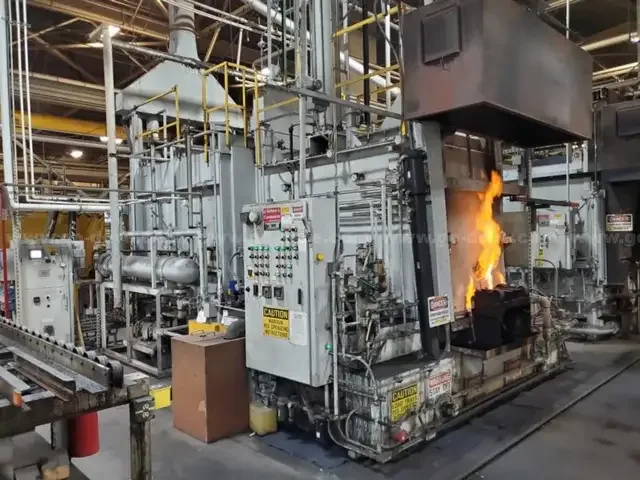
Heavy equipment supplier and captive heat treater Komatsu Mining is auctioning off a number of heat treating furnaces which are surplus to their ongoing operations as we speak. Komatsu Mining, West Milwaukee Manufacturing Facility is having an ongoing “on line” auction which features a wide variety of heat treat furnaces, some very interesting others not so much so. Included in the auction are a number of batch IQ furnaces along with salt processing items and some other odds and ends. As a footnote to this story we include the press release below published by “The Monty Heat Treat News” back in 2020. In it we talk about a very substantial investment Komatsu made in a brand new, state of the art heat treating facility in Milwaukee, Wisconsin, USA.
“NOVEMBER 15th 2020. Komatsu Mining Corp., Heat Treat Project Update; As part of our Monday Morning Briefing we had the note below about mining equipment giant Komatsu adding a state of the art heat treating department to their new facility in Milwaukee, Wisconsin. To update this story we can say that the entire heat treatment department will be housed in its own building and the furnaces will be the most versatile in the world-Batch Integral Quench furnaces (IQ for short in North America, Sealed Quench in the rest of the world)-the furnaces were provided by AFC-Holcroft of Wixom, Michigan. While you could argue that the cost per pound of heat treating components in a continuous style furnace such as a pusher are lower, the benefit of a batch IQ is that they are versatile. Different part sizes, different weights not a problem and plus it is far easier to shut down a 3500 pound capacity batch IQ than a large pusher line.
“For our Monday Morning Briefing for October 19/2020 we start off in Milwaukee, Wisconsin, USA. To begin we will use this press release which appeared just a couple of weeks ago; “Building on its 135-year-legacy in Milwaukee, Komatsu Mining Corp. officially broke ground earlier this month for its new state-of-the-art headquarters and manufacturing campus in Milwaukee’s Harbor District on east Greenfield Avenue. The company recently finalized the acquisition of two parcels of land totaling nearly 57 acres for the project. Partnering with the State of Wisconsin and City of Milwaukee, Komatsu is investing approximately $285 million in its South Harbor Campus, which will include purpose-built, modern manufacturing facilities; advanced technology, robotics, engineering and R&D labs; a large office complex, training facilities, a data solutions center and an experience center.” When this project was announced back in 2018 one of the details emphasized by Komatsu was that this new project would include a state of the art heat treating facility. We can confirm that this is the case and while we can’t provide details at this point we can say that the heat treat portion of the project is certainly moving ahead.”
Did you like this article? Click here to subscribe to The Monty.
View our recent magazines and podcasts by clicking the following link. https://themonty.com/magazine/

Castool Tooling Systems, based in Uxbridge, Canada, designs and manufactures production tooling systems for the extrusion and die casting industries. For the extrusion sector, the company pioneered the fixed dummy block, thermally stable container, single cell die heater, and other innovations.
Recently, Castoool completed the construction of a new facility, in which the company has installed of heat treat and nitriding furnaces — providing the plant with some of the largest capacity equipment in North America.
“We perceived there was a shortage of quality heat treat and nitriding sources in North America to support the Tooling Revolution we are experiencing,” said Paul Robbins, president of Castool. “Both die cast presses and extrusion presses have increased in size and pressures. We are being required to manufacture shot sleeves, stems, and liners in larger diameters and longer lengths than ever before. It is best to heat treat these items vertically and to guarantee best structure with a vacuum quench up to 12 bar.”
The new facility includes several heat treating and tempering furances from Ipsen, which is capable of vertically heat treating dies up to 90 inches tall or 20,000 lbs. This includes:
- An Ipsen 6 bar heat treating furnace capable of processing pieces up to 36 x 36 x 48 inches in size, or a 3,000 lb load
- An Ipsen 12 bar heat treating furnace capable of processing pieces up to 48 x 48 x 72 inches in size, or a 6,000 lb load
- An Ipsen 12 bar heat treating furnace capable of processing pieces up to 60 inches in diameter x 90 inches tall, or a 20,000 lb load
- An Ipsen tempering furnace capable of processing pieces up to 36 x 36 x 48 inches in size, or a 3,000 lb load
- An Ipsen tempering furnace capable of processing pieces up to 48 x 48 x 72 inches in size, or a 6,000 lb load
The nitriding equipment was supplied by Nitrex. The new vacuum nitriding furnace includes with nitrocarburizing capabilities and can nitride pieces up to 61 inches in diameter and 98.5 inches high, with a load capacity of 14,000 lbs.
Castool’s ISO 9001 certified heat treating and nitriding facility operates according to most automotive standards. The company’s in-house laboratory capable of microstructure and chemical analysis, strength and reliability testing, and nitride layer evaluation.”
Did you like this article? Click here to subscribe to The Monty.
View our recent magazines and podcasts by clicking the following link. https://themonty.com/magazine/

