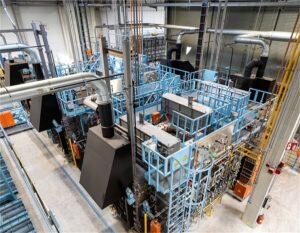
Over the course of the past couple of years we have reported on the progress of commecial heat treater “Hestia” in Racine, Wisconsin, USA. Their most recent developments included adding several used batch IQ furnaces, the photo attached shows that installation of the furnaces is almost complete.
“JANUARY 2023; In Racine, Wisconsin we find commercial heat treater Hestia Heat Treat (formerly called Racine Heat Treating), this is how the company describes themselves; “Racine Heat Treating had been offering heat treat services to the Southeast Wisconsin/Northern Illinois area for over 50 years, under a few different owners. The company was purchased by Darius Szczekocki in 2017, and rebranding the company began, along with improvements in company culture, equipment, and facilities. Hestia, Greek goddess of the hearth, seems a fitting name for a heat treating company providing manufacturers with quality product meeting their precise specifications. https://hestiaheattreat.com/#o
Under owner Darius Szczekocki the company has grown substantially since he acquired it in 2017. Our understanding is that in 2023 the firm will be bringing on line 3 batch IQ furnaces each with working dimensions of 36″ X 48″ X 36″ and a weight capacity of 3500 pounds. The AFC-Holcroft built furnaces were originally bought by oil field company Haliburton in Texas, but became redundant a year ago when Haliburton made some changes.”
Did you like this article? Click here to subscribe to The Monty.
View our recent magazines and podcasts by clicking the following link. https://themonty.com/magazine/

We move to Italy for this news item. Meapforni is a manufacturer of a variety of different styles of heat treatment furnaces, covering everything from sealed quench to mesh belt furnaces with a number of different styles in between. They are very pleased to announce that they are just completing two projects.
The first is a 750 kg, mesh belt furnace line destined for a customer in Switzerland. The second is also a mesh belt furnace line, this one 1,000 kg and going to Italy. Both are in final assembly and will be shipped shortly.
Did you like this article? Click here to subscribe to The Monty.
View our recent magazines and podcasts by clicking the following link. https://themonty.com/magazine/

Nitriding is the thermochemical process for producing surface layers in ferrous alloys, such as steels and cast irons used for making various mechanical components and tools [1]. Ferritic nitrocarburizing (FNC) is a process of nitriding doped with a small amount of carbon [1]. Producing the best nitrided layers for the given application requires a good cooperation between designers of the product and the manufacturing companies making it. Nitriding is a type of heat treating, which has a significant effect on the final properties of the product in improving its tribological properties. It reduces friction and enhances wear resistance of the surface as well as produces very good bending fatigue and corrosion resistance properties. All the above is decided by formation of the proper structure, thickness and hardness of the nitrided layer. Metallography of the parts, or samples which run together with them, is extremely important for verifying results of this thermochemical treatment and assessing the properties of the layer formed during, the data are also used for maintaining a good predictability of the process. It should be noted; however, that surface condition of machined parts may significantly affect the nitriding outcome and should always be taken under consideration [2-4].
Metallographic Characteristics of the Nitrided Layer
Low-Alloy Steels
The typical nitrided layer formed in these steels has two sub-layers: the compound zone and diffusion zone, see Fig. 1 a & b. The compound zone increases wear and corrosion resistance and the diffusion zone enhances the bending fatigue strength of the component.


It should be noted that the effective case for this specific, Nit135M steel was >50% of total case depth, Fig. 5.
However, it should be remembered that the relationship between the effective case depth’s percentage of the total case varies depending on steel and its tempering temperature. Therefore, it is important to note that the thickness of the effective case depth depends on the core hardness of the sample used for certifying the load and it may be different than in the actual parts. As mentioned before, this depends on the tempering temperature of the steel, see Fig. 6.

Plain Carbon Steels
Nitriding of the plain carbon steels such as 10xx, 11xx, 12xx and similar is oriented on formation of the compound zones of sufficient, larger than in the low-alloy steels, thicknesses. This is caused by the fact that these steels do not form sufficiently hard diffusion zones and also that their typical applications do not require a high bending fatigue strength but rather wear and corrosion resistance. There is a variety of the compound zones structures formed in these steels. Some of the examples are shown below.

It should also be noted that the total thickness of the nitrided layers in these steels can be assessed by microscopic evaluations without a need for the microhardness testing. Diffusion layer in the carbon steels has typically precipitates of the gamma prime, ɣ’ (Fe4N) or Fe16N2 nitrides visible in the structure, see Fig. 9 and 10.

Identification Surface Defects Affecting Nitriding
Surface condition of steel parts have tremendous effect on their ability to accept thermochemical treatment such as nitriding or nitrocarburizing (Ref. 1 and 2-3). Too aggressive machining leading to distortion of the steel structure, its cold work, burnishing or inducing tensile stress at the surface may completely stop or inhibit nucleation of nitrides at the surface (Ref. 1-4). The same, negative effect on nitriding can be expected from surface contaminations, if the metalworking fluids and coolants are not completely removed from prior nitriding or FNC (Ref. 2-4). On the other hand, compressive stress induced by machining or shot peening into the surface may have a very positive effect on formation of the nitrided layer (Ref. 4).
The risk of producing unwanted stress condition by machining is very high and therefore general industrial/heat treating practice is to perform the stress relieving or recrystallize-anneal operation after rough, aggressive machining. After that, final machining should be applied to remove any remaining surface defects or conditions before nitriding or nitrocarburizing can be applied.
Machining operation affects surface structure of 12xx steel components resulting in distorted grains and a possible smeared surface. Insufficient stress relief/recrystallization after that may result in a condition, which affects nitriding or FNC processes resulting in waviness as well as insufficient thickness of the compound zone. Also, effects of sulfides presence in the steel cannot be overcome easily. Sulfides are a physical barrier to diffusion of nitrogen into the steel and if they are present near the surface (and they are!), they reduce effectiveness of nitriding, see Fig. 11. Such voids are very likely to occur since the sulfides are present everywhere and they may locally stop or limit diffusion of nitrogen. These phenomena cannot be controlled by any action of the machinists or heat treaters. Potential defects and surface imperfections of the steels affecting formation of the nitrided layers can be metallographically discovered and analyzed, see an example in Fig. 11 and 12.

It should be observed that there is a clear negative effect of sulfides on formation of the compound layer and potential for a local imperfection in properties of it. Nevertheless, those inclusions have no practical effect on wear resistance of the steel but may have negative effects on their corrosion resistance. [email protected]
Did you like this article? Click here to subscribe to The Monty.
View our recent magazines and podcasts by clicking the following link. https://themonty.com/magazine/

One of Ipsen’s main initiatives under David’s leadership is expanding the service team to provide more localized support to customers, resulting in quicker response times. “Ipsen service is world class,” said Choate. “I am thrilled to be a part of this team as we continue our drive for service excellence.”
David comes to Ipsen from Cupertino Electric, Inc. in Edgerton, Wisconsin where he served as a product line manager. Prior to that, he held various service-focused roles including Market Director for Bear Communications, and Senior Manager of Field Service for NetApp.
David holds an Associates of Arts in Telecommunications Technology from the Community College of the Air Force, and a Bachelor of Science and Master of Business Administration from the University of Phoenix. In addition to his work experience and education, he is a veteran of the U.S. Air Force.
“David brings a solid, diversified background to Ipsen and we are excited to have him join our team,” said Ipsen’s Chief Service Officer, John Dykstra.”
Did you like this article? Click here to subscribe to The Monty.
View our recent magazines and podcasts by clicking the following link. https://themonty.com/magazine/
 Since 1995 “The Monty Heat Treat News” has maintained one of the largest lists of surplus heat treat equipment available in the world. Currently we have almost 200 listings ranging from Batch IQ Furnaces, to Lab Items, Vacuum Furnaces, Table Blast Machines and a host of other listings all related to the heat treat industry Used Equipment | The Monty. If you don’t see what you want-ask [email protected] Have surplus equipment? We are happy to help with suggestions and a free market appraisal.
Did you like this article? Click here to subscribe to The Monty.
View our recent magazines and podcasts by clicking the following link. https://themonty.com/magazine/

McLaughlin Furnace Group Press Release, AVILLA, IN, USA, May 11, 2023; McLaughlin Furnace Group of Avilla, Indiana, USA is very pleased to announce that they were recently award a contract for a Tru-Mix™ Endothermic Gas Generator by the U.S. Army Watervliet Arsenal, in Watervliet, NY, USA. The gas fired unit has a capacity of 2,000 CFH, high turn down ratio and features Allen Bradley and SSi controls. Ben Tackett, COO of McLaughlin Furnace Group has this to say: “We are delighted with the opportunity to work with the US Army. We at McLaughlin are incredibly proud of all the products we offer but we are especially proud of our Tru-Mix™ Endothermic Gas Generator product line. This is a tried and proven system offering many advantages over competitors units, especially when it comes to energy use”. The system will be delivered and installed later this year. McLaughlin Furnaces | American Made | Global Reach (mclaughlinsvc.com)
Did you like this article? Click here to subscribe to The Monty.
View our recent magazines and podcasts by clicking the following link. https://themonty.com/magazine/

Ben Tackett, and Ryan McLaughlin, McLaughlin Furnace Group
As already mentioned in many articles, the reduction of emissions as well as the energy efficiency of the entire process line are currently one of the top issues in industrial heat treatment processes, especially in Europe. As a result, the perennial questions on the minds of management and chairholders are: Is electric heating a viable option for my heat-treatment facility? Where are the limits of economic viability? What needs to be considered for chamber furnaces and what limitations in the overall process must be accepted? Beside the visually appealing alternatives such as the use of electric igniters instead of gas burners for flaring escaping process gas, some key aspects of reducing the carbon footprint are highlighted below.


Retrofits and new purchases in existing production lines – While various technical concepts are possible or can be easily adapted for new plants, the situation is more complicated for existing heat- treatment systems. Assuming that the necessary power supply is available at the factory, that the wire size is sufficient and that there is enough space to expand the switch cabinets, the number of existing gas burners and their heating capacity is a challenge in most projects.
- For standard electric heating elements, the sum of all heaters must be divisible by 3 to avoid creating unbalanced loads in the power grid.
- The use of 2- or 3-phase heaters is just being implemented for the first customers – long-term experience is not yet available.
- The heating power to be installed must be adapted to the diameters and materials (steel, ceramic, powder metallurgical based) of the radiant tubes installed. Despite the higher efficiency, a reduced power input is possible.
Active Radiant Tube Cooling – In gas-fired systems with indirect radiant tube heating, the combustion air can also be used to cool the system. This cooling is used for faster temperature reduction from carburizing temperature (920-950°C / 1690-1740°F) to hardening temperature (850- 880°C / 1570-1610°F). Without this active cooling, the process time will be extended on a case-by- case basis. Currently, there is no easy way to solve this cooling function for electrically heated heat- treatment equipment without additional technical and thus financial effort.
Heat Recovery System Proposals – Implementing advanced heat recovery systems in existing and new plants continues to be a challenge for plant engineers and operators. The pressing need to increase the energy efficiency of a thermal processing plant and minimize the carbon footprint is leading to several innovative approaches. The temperature level and its time dependence have a significant impact on the feasibility and efficiency of a heat recovery system. In addition to the classical methods of direct heat recovery via heat exchangers, also in combination with heat storage, indirect heat recovery can lower or raise the temperature level of the waste heat by using additional energy (chillers or heat pumps) or convert the waste heat into electricity. There are three main sources of wasted heat:
The main difference between a conventional gas-fired and an electrically heated heat-treatment system is the elimination of burner exhaust gases and the associated additional thermal losses. Due to the exhaust gas temperatures, this results in a reasonably usable energy potential that should be exploited. The same is true for flared process gas. However, the cost-benefit ratio must be carefully considered. Direct use of the unburned process gas is not common due to safety considerations and possible negative effects on the heat treatment process. Therefore, the greatest savings potential lies in process optimization. This refers to optimized process control and reduction/adjustment of process gas consumption. The waste heat from oil bath or salt bath quenching must be investigated with a view to reducing energy requirements. Utilization of the thermal energy released during product cooling has a high recovery potential due to the continuity of the heat input. The high energy density of the liquid medium can be used economically despite the lower temperature level compared to the hot exhaust gases.
Preparing for the future – Numerous highly volatile influences affect the decision on the energy supply of your plant which must be carefully evaluated for each factory in different locations. It is therefore reasonable to analyze all possible scenarios separately for each site, while preparing for future changes in local environmental conditions.
- Consideration of space requirements for possible retrofit of heat recovery systems and installation of a NOx reduction system.
- Consider alternative heating media and funding opportunities (e.g. biogas, hydrogen).

Did you like this article? Click here to subscribe to The Monty.
View our recent magazines and podcasts by clicking the following link. https://themonty.com/magazine/
 In Edmonton, Alberta, Canada we find commercial heat treater “Thermex Metal Treating, a long established firm owned and run by Mr. Norm Hanson. Thermex is a “full service” commercial heat treater offering Induction Hardening, Nitriding, Carburizing and a number of other processes. The company is just taking delivery of a new “Surface Combustion” gas fired, batch IQ furnace with working dimensions of 36″ X 48″ X 36″ which means the firm will now have 5 batch IQ units.
Alberta is the heart of the oil and gas industry in Canada and the economy fluctuates according to oil prices-currently the economy is booming. Western Canada has virtually no captive or commercial heat treating, Thermex is the largest (for either commercial or captive heat treating) with only a handful of smaller heat treaters in the region. It is expected that this furnace will be up and running by early June of this year.
Did you like this article? Click here to subscribe to The Monty.
View our recent magazines and podcasts by clicking the following link. https://themonty.com/magazine/


“CFC fixtures for high-temperature processes offer you numerous advantages for your applications. They are not only durable and ideally suited for automated charging, but also extremely light: with the same load-bearing capacity, CFC fixtures only take up about one fifth of the weight of steel fixtures. This allows you to significantly increase the number of components for each oven run.
Thanks to the higher packing density as well as the energy saving properties, you can also reduce your costs.
In addition, our support structure allows stacking of charging beams. With the increased process efficiency, you can raise your applications to carbon level – we would be happy to advise you.
As tough as it comes: CFC
CFC fixtures show high resistance to distortion even at extreme temperatures. This means they remain dimensionally stable even after thousands of oven runs. Even at high temperatures, they retain their functionality, whereas steel fixtures experience stronger distortions.
Our CFC fixtures are suitable for parts for which lower shape and position tolerances have to be maintained after heat treatment. In addition, they are particularly applicable for distortion-critical parts, for automated charging as well as for small and light parts – e.g. bulk material.
CFC – Advantages for your application:
- lightweight: 5 times lighter than steel
- durable: durability of 10 and more years
- easy: ideal for automated charging
- cost-saving: higher packing density and energy-saving
- plannable: reliable processes due to reproducible minimum warpage
DuComGrid

DuComGrid® at a glance:
- Combination of CFC and ceramic or refractory metal
- Component specific images by means of 3D – FDM printing
- Protection against carbon diffusion at high temeratures (>1,050°C)”
Did you like this article? Click here to subscribe to The Monty.
View our recent magazines and podcasts by clicking the following link. https://themonty.com/magazine/

Did you like this article? Click here to subscribe to The Monty.
View our recent magazines and podcasts by clicking the following link. https://themonty.com/magazine/