Gord Montgomery (GM). March 5, 2024 Gord Montgomery of “The Monty Heat Treat News” interviewed “Mr. Steven Christopher” of controls company SSi an interview which can be found at “Steven Christopher of Super Systems Inc.-The Interview”. Steven, in our last interview we spoke about a number of topics including flowmeters, automation and your personal background to name just a view. Today let’s talk about what is new in the heat treat industry in general and specifically what is new at SSi.
(GM). AI (Artificial Intelligence) fascinates me, both from what it can provide today but more importantly where it will take us in the future. I understand that you and your team are also exploring the possibilities it offers so my first question is-how seriously is SSi taking this new tool for lack of a better word?
(SC). Hi Gord, thanks for the opportunity to return. “Seriously” is a great descriptor and we are taking this seriously. AI is a huge opportunity and we are building, actually weaving, DataCenter AI (DCAI) into the fabric of our software. For years we have helped customers collect tremendous amounts of process data, now we are focused on helping them put that information to work, identifying opportunities to improve quality, reduce operating costs and overall make better decisions. We have regular meetings, bringing in views from different departments, to help navigate the effort. I think the beauty of AI is it makes it easier for non-software people to be part of the discussion. Our meetings avoid software-centric approach, seeking input from all the business units. Our sales and engineering teams are our front lines and active in these conversations. But in reality the best ideas start with our customers, what do they want that doesn’t exist? What challenges them day to day? In that light, software is just an opportunity to deliver what heat treaters are asking for, and AI the vehicle to speed that up.
(GM). In the near term how can we see AI applied in SSi products and applications?
(SC). Before you used the word serious to describe our approach, now let me use the word “curiosity”. We approached AI with a certain curiosity because it inevitably feeds itself. We started off using AI as a tool within our software team to speed up development, debug code, and so on. That led to the realization that we sat on mounds of data that never left a spreadsheet and was filed away on the network—not too different than heat treaters process data in many ways. So we started using AI to make this data easier to access, from dashboards to reports to whatever. Our curiosity naturally shifted our inward thinking to outward. We realized the power in reviewing massive amounts of data and developed that in our latest product, Goal Posts (GP). GP in simple terms is an automated chart review, confirming jobs meet all the temperature, soak and any other requirements along the way. A lot of people saw this at FNA and the feedback was nothing short of amazing. Going back to what I said before, customers are our inspiration and they have been asking for this for a long time; though we had to lean on AI to deliver the final product.
(GM). Looking out to a distant horizon how do you see AI affecting SSi and the heat treatment industry in general?
(SC).This is why I love the topic, because I honestly can’t come up with an answer! This is sort of like repeating the dot-com boom, we all knew this was the future, but beyond creating our own website didn’t understand how prevalent it would become in daily life. Everyone I supposed besides Jeff Bezos who had a clear vision and went all in; now we can’t imagine life without. AI is today where the internet was in the late 90s, only the signs point to this moving even faster. So the distant horizon is not a decade from now, but a year from now. But I want to give a concrete answer and not skirt the question.
I see DCAI in particular making life easier on that distant horizon. On the front end users will be able to scan a spec or talk to a prompt, and it will construct an appropriate recipe. In cases where there is enough data it will be intelligent enough to tailor recipes based on unique furnace characteristics–consider two seemingly identical furnaces but one has a slightly faster quench rate, resulting in higher hardness. When I was cutting my teeth at a commercial heat treater, I remember punching parts’ as-quenched hardness, then asking opinions and consulting tables to find the perfect tempering temperature to achieve 40HRC.
AI eliminates all of this, these in the moment discussions will go the way of the card catalog. A new operator will interact with controllers in such a way that they’re guided to the optimal temperature to draw back hardness. On the shop floor it will remove ambiguity around furnace alarms and errors, pointing users to the exact problem, explain their options, along with how to do what. We want to shift from intelligent controllers to “self-aware” controllers; capable of making evaluations (and ultimately recommendations/adjustments) as to quench problems, production bottlenecks, and more. Of course this is just what I can predict, AI is going to take it even further.
(GM). Before we move away from this subject do you share some of the concerns which we see voiced about AI? Namely, is it going to cause mass unemployment?
(SC). Restructuring, of course. But unemployment, no way. We have had these Luddite concerns before and naturally there will be winners and losers, but mass unemployment is unlikely. There are a lot of jobs today built around market and data research, creating summaries for someone else to make informed decisions. AI is going to reduce jobs on the research side, after all it can consume thousands of pages of content very quickly. But in doing so it is going to produce even more information and entire teams of people will be required to act on it. AI agents are excellent at tasks that may be challenging, or less efficient, for humans. Leaning on AI as a tool doesn’t replace operators, rather allows them to shift their time and efforts to other priorities. But that’s the beauty of technology, it does not eliminate one job without creating new ones. To relate this to heat treat, imagine AI evaluating so much data that it cannot only predict maintenance, but recommend the optimal time to perform such a task to limit the impact on production—you may need a larger maintenance team to act, so it may create jobs in some ways.
(GM). Let’s move on from AI and look at a new product which SSi very recently introduced to the market, a software called “Goalposts”. The system is promoted as being designed to manage, monitor, and optimize thermal processing and heat-treating facility operations but what does that mean exactly?
(SC). We are really excited for Goal Posts. Monitoring has always been part of our SuperDATA suite, specifically with SDRecorder. The “manage and optimize” components existed before as part of our Load Entry software, GP is just one more tool in that toolbox. I would describe GP more as a quality tool and time saver. Ten years ago, we asked customers to describe their biggest challenges and they said operators running the wrong recipes; so we built a Parts database into Load Entry; problem solved.
Recently when we asked the same question, they all struggled with chart review. We repeatedly heard how difficult it was to find a talented quality person and often that talented person had options and moved on, they were difficult to pin down. At the end of the day even with the right people in place it was a hard job and human error inevitable. Then the problem was exacerbated with the labor crunch, so the time required to review charts became equally important. So we went back to the drawing board, came up with a plan, releasing what we now call Goal Posts.
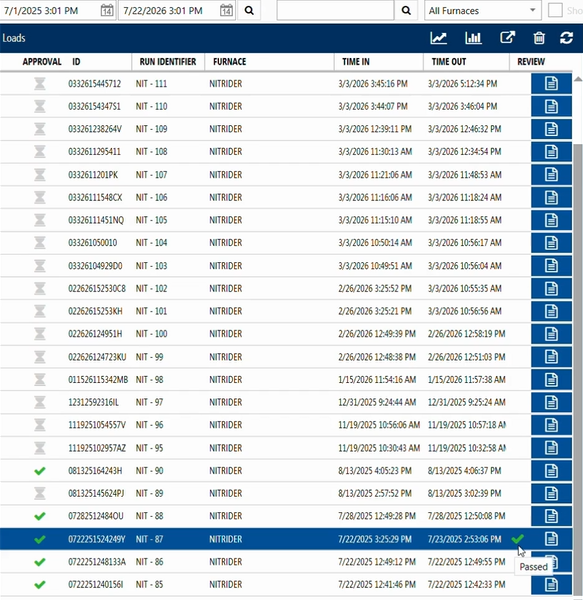
GP allows Load Entry users to build specifications, defining time at heat, overshoot, starting and ending quench temperatures, dew point limits, really whatever is required by the process. To me we can call them widgets, because the user can literally enter any parameter they want, then audit the charts accordingly. Without even a single click, our jobs are evaluated as pass/fail and visually indicates as such on the history dashboard. For those jobs that failed, with a single click the user sees in red text the exact reason for non-compliance. Can you imagine the time saved? The paperwork avoided due to errors? I can’t remember the last product that I was this excited about—2027 is going to be a heck of a year as this rolls out!
(GM). How does this system fit in with your tried and proven “SuperData” system? Will it be an integral part of “SuperData” or an add-on option?
(SC). I almost finished the last response with “and the best part is it folds up nicely into the existing Load Entry system”, so glad that I didn’t say that! But that’s the answer here, it’s just an extension of Load Entry. Users have already built their Parts and Recipes, now they just build a Specification and it works without altering their daily routine. If you don’t mind me rambling a bit, Goal Posts is just one piece of the Load Entry puzzle. Users can lock out equipment due to maintenance issues or overdue pyrometry using our Maintenance module.
It kills a piece of me every time I hear a job being run beyond the qualified TUS dates, why? Why not build this into the system and prevent it from ever happening again? Another often overlooked component of Load Entry is Scheduling. Users can finally eliminate those production office white boards, and here again AI enters the picture. Today we predict door-to-door time by evaluating past runs, and in the future, we look to optimize scheduling by suggesting users combine this or wait for that. I really am proud how we have added all these features but managed to keep the product simple and intuitive. That is not always easy, but our team has done just that with Load Entry.
(SC). I don’t think we’re groundbreaking in 2026 terms, but we certainly are on the leading edge. Quite frankly the bar for what controls can and should) do is rising quickly. I was inspired at FNA this year seeing what companies are offering. I think GP is part of that rising tide, users just expect more and more from their suppliers and this is part of the ship.
What is unique about SSi is our ability to bring everything under one roof; and we do that in two ways. First, at our core we are system integrators, meaning we can’t specialize in just vacuum or nitriding, but both of them along with carburizing and everything else. Everything we do recognizes that every piece of equipment needs to fit nicely within our ecosystem—and that’s a real challenge. But it is also a real opportunity because it allows us to do all the cool things discussed up until now, no matter the model or type of equipment.
The second pillar to the under one roof philosophy is to be open. We’d love to be Apple and sell the phones and software and chargers and headphones, but we realize the importance of playing nice with others. Revisiting the maintenance example from before, we’d love for every SSi user to build their maintenance activities into our system. It’s certainly capable of it, why not? But we also appreciate that many users have maintenance systems in place which they are quite happy with. Who are we to tell them otherwise? We must be open to sharing information with secure 3rd party systems, which is quite easy via our API. So, if you’re happy with your ERP or pyrometry software, but want to lock out a furnace in your SSi system, why not! Just make the hooks. To wrap it up, we may not be groundbreaking with any single feature, but we sure are one of the few to do it so well and without limits.
(GM). As mentioned our last interview was two years ago and since then the industry has seen some changes, a major one being that one of your larger competitors was acquired by a furnace builder. This changes a lot of the dynamics between furnace builders and furnace controls companies-is this a subject which you could comment on either in specific or general terms?
(SC). Yeah a lot has changed in two years, including my role within SSi. I have taken on the challenge of business development and clearly this type of acquisition is on my radar. That being said this is not the first acquisition to create some, either real or perceived, conflicts of interest and I am thankful that we do not have to navigate such things at SSi.
Their challenge will be keeping an open mind and playing nice with an ever integrating world; perhaps easier said than done when you have hands in different ventures. But to be honest I am entirely focused on what we are going to do next, everything else is just noise.
We’ve talked a lot about software, now add to that our generator control platform [SuperGEN] and new mass flow controller, there is no time to worry about others. We just want to focus on doing what we do better than anyone else. One of SSI’s greatest advantages is that we are not focused solely on a single process. We work across vacuum, atmosphere, nitriding, carburizing and all thermal processes. That gives us a unique perspective on how different equipment operates—creating solutions for heat treat as a whole, not just one type. On the AI front related to that, as we develop AI capabilities, we are combining that experience with years of process information to create something much more valuable than a generic AI tool, it will be intelligence specifically designed for the heat treating industry.
(GM). On a final note, I understand that SSi is setting records these days for sales growth-why? What I mean by that question is that the heat treatment industry globally has seen a lot of ups and downs over the past year. Segments such as automotive and heavy industry are seeing lackluster growth while industries such as aerospace, defense and power generation are struggling to keep up with demand. So how is it that SSi has seen such tremendous growth during this turbulent time?
(SC). You said it, one sector is down but another is up—diversification is key. We host these monthly project meetings where we review everything on the books. Who is going where? What road blocks exist? Pretty typical project management. I remember a few years back these meetings were 75% endothermic work, nitriding and vacuum split what was left. Two years ago that shifted to 90% vacuum—a clear nod to the recent boom in the aerospace and defense sectors. And I don’t see that changing anytime soon, I anticipate that industry will remain strong well into 2028. But diversification highlights why we have seen such tremendous growth and expect to even as the industry makes its next shift.
But backing up a bit, we’re busy today because of choices we made long ago. Ten years ago we were known as an excellent controls company, but we weren’t viewed as the leaders in certain technologies. We invested heavily in expanding our field- and software teams and assembled a really talented team along the way. Heat treaters now look to us as the leaders in vacuum and nitriding even if we don’t make the equipment. We appreciate the recognition but also realize it neither happened by chance nor overnight. We have a lot of experience and clearly the industry sees it and is rewarding SSi with a lot of excellent opportunities. We are very thankful for the growth and excited to partner with so many great heat treaters.
(GM). Thank you for your time, Steven and I hope to be posing new questions to you two years from now.
(SC). Of course Gord, thank you for the opportunity. And thanks for everything that your team does for the industry. The Monty creates this amazing space for everyone to come together as one, and I applaud you for what you’ve created.

The recipe says the load goes to temperature, soaks, and quenches. The parts don’t all agree. In a dense load, the parts on the outside of the rack heat first and cool first. The parts buried in the middle of a basket, or on the bottom tier, lag behind on the way up and hang on to their heat on the way down. Every part in the load runs its own version of the cycle, and the hardness, case depth and distortion you measure afterward are the record of which version it got.
Experience covers most of that. Good operators know which positions run cold, which parts need extra soak, and which fixtures cause trouble, and that knowledge is hard won. What experience can’t easily do is show you the inside of a load you have never run before. That is why a new part can take a few tries to clear first article, and why soak times tend to carry a little extra margin.
What the thermocouples don’t see
Temperature gets measured in a handful of places. Load thermocouples are attached to a few parts, or test pieces, in a production load. A temperature uniformity survey (TUS) under AMS2750 pyrometry places thermocouples at fixed points across the work zone, often with the furnace empty, and checks that the zone holds tolerance at temperature. Both are essential, and neither tells you how every part in a dense, real load heats, soaks and quenches. That is where the variation lives.
A thermal and flow simulation of the furnace fills in the rest. It models the chamber, the heating elements, the quench gas, the racks, boats and fixtures, and the parts together, and follows the whole cycle over time.

Surface temperature across a four-shelf gear load through a gas quench cycle. The lower tiers hold heat after the upper ones have let go.
In this gear load, the top shelves cool quickly while the bottom tiers stay hot well into the quench. On paper, every gear went through the same cycle. In the furnace, they went through very different ones, and that is the kind of difference that shows up later as scatter in hardness and distortion. The flow field shows why.

Quench gas velocity on a cut plane through the loaded chamber. Red is gas moving at 20 m/s or more; dark blue is nearly still.
Quench gas comes in fast through the nozzles, but vertical rack posts block some of the jets, and parts of the load sit in nearly still gas. Those dead zones are where the slow-cooling parts are.
What a simple fix is worth
Seeing the problem points to the fix. In this case it was a modest change to the rack: the same load, the same temperatures and the same quench flows, with the obstructions moved out of the way of the gas.

Temperature spread across the load through the quench, original rack against the modified rack.
The peak temperature spread across the load fell from about 378 °F to about 310 °F (210 °C to 172 °C), and the load settled out sooner: more consistent parts from the same furnace, with no new equipment. The furnace and load here are representative, because client studies stay confidential, but the pattern is one I see often: the biggest gains come from the fixturing and load arrangement, not from the furnace itself.
Why most shops don’t simulate
If this is so useful, why isn’t every heat treater doing it? Because the economics don’t work for a job shop. Doing it in-house means a commercial simulation license, which typically runs tens of thousands of dollars a year, plus a simulation engineer who knows how to drive it and keep the models honest. That is a full-time salary aimed at questions that come up a few times a year. Against job-shop margins, and lots that change every week, it doesn’t pay back. The tools were built for equipment makers and large manufacturers, and they are priced that way.
The industry reflects that. I keep a running survey of heat treaters across the US and abroad, based on what each shop shows publicly. Of 217 reviewed, 154 (71%) show no sign of in-house simulation, and only 13 clearly have it.
Most are small: of the companies with a known headcount, 106 of 137 have 50 people or fewer. The median founding year is 1976. That says nothing about skill. It is a matter of what makes sense to own. A question that comes up a few times a year is better answered by buying a study when you need one than by staffing for it.
What’s coming from aerospace and defense
The question may start coming from customers, too. In 2025 the Navy put out a small business research topic, N251-D02, asking for modeling and simulation tools that predict the microstructure and properties of aerospace gear and bearing steels from their melt and heat treatment processing. The topic is candid about where things stand: modeling tools exist, but “there has not been a dedicated effort to apply these to the subject steel alloys,” and qualifying by empirical testing “consumes large amounts of resources and time.”
Metallurgical models like these are complex, and every one of them starts from the same input: the time-temperature history of each part. A microstructure prediction built on the furnace setpoint, instead of on what each part actually saw, inherits every cold corner and slow quench in the load as error. Getting that history right is the first step toward controlling variation in microstructure, and for most shops it is the biggest return: much of the scatter in hardness and case depth traces back to it before any metallurgy is modeled. If prediction like this moves into how critical parts get qualified, the shops that already know what their loads actually see will be well placed to support it.
See inside your furnace, ship more consistent parts
Your customers judge you on consistency: every part in every load hitting the same hardness, case depth and dimensions, lot after lot. That is what a study helps you deliver, by showing which parts see a different cycle and what change to the load, rack or fixturing brings them back in line.
You don’t need CAD drawings or a simulation department to get there. Send us photos of the load and fixturing, a few key measurements, the make and model of the furnace, your cycle data and the problem in your own words. We build the CAD and the simulation from that, drawing on decades of designing, building and running high-temperature furnaces and the materials that go inside them, so the model behaves like your equipment and comes together quickly. You get a fixed scope, a fixed price, and a written report in about two weeks. You know your furnace; a study just lets you see inside it. Here is how one works.
Mathew J. Leis, P.E., founded Reactech Engineering Group. He has spent fifteen years designing, building and operating furnaces above 2,000 °C, and developing the CFD and FEA models that predict how they behave. He works alongside a principal engineer with over thirty years in high-temperature equipment: furnace design at an OEM, prototype furnace development, and hot-zone materials engineering for vacuum heat treating.
Recently “Gord Montgomery” of “The Monty Heat Treat News” was honored to have an in-depth conversation with “Mr. Eric Hutton”, Senior Vice President Operations, Aerospace, Defense & Energy HIP & PHT, North America, Bodycote.
In this wide-ranging discussion, we covered topics such as our mutual love of the heat treatment industry, recent very substantial investments in two Bodycote facilities in Ohio, USA and why these investments took place.
From there, the conversation moved on to topics such as “Hot Isostatic Pressing”, green energy and what prompts manufacturers to send their heat-treating requirements to commercial heat treaters.
“Gord Montgomery” had this to say about the discussion; “It is truly a joy to speak with an individual like Eric who not only really enjoys his job but has years of experience to back up this passion. His comments gave me new insight into Bodycote and what has made the company so successful.”
-
“The McCurdy Take” By “Daniel W McCurdy” PE (retired)
-
Alcon Industries, Cleveland, Ohio, USA Asset Sale
-
“Hertwig Heat Treat”-On the Road to Cologne
-
North American Heat Treat to Add Large Capacity Pit Nitriding Furnace
-
Firm Invest Millions in Heat Treat-Merges Under One Banner
-
Furnace Builders Expand Co-Operation to Include Nitriding Technology
-
Defense Spending Continues to “Boost” Vacuum Furnace Sales
-
Heat Treatment of Firearms-“Blaser” Part II
-
Item#M526 Wire Mesh Belt Company 54”id X 100.21’ long Mesh Belt (Brand New, 2 Available)
-
Item# B494 Pit Nitriding Furnace 22” Diameter x 32” High-Completely Rebuilt
-
Item#IQ530 Batch IQ Furnace 30″ x 48″ x 24″and Endothermic Generator-Like New Condition
-
Item# T446 Batch Tempers (5) 1400F, Gas 30″ X 48″ X 30″
-
Item#L240 Buehler Simplimet-1000 Hot Mounting Press
-
Item# T448 Electric Oven 48″ X 48″ X 72″ Long 2200F

“An Ohio couple has filed a product liability lawsuit alleging a defective NordicTrack treadmill caused the woman to fall and fracture her hip, requiring surgery to implant a metal plate, bolt and locking screws.
The complaint (PDF) was brought by Janet Bockey and Randall Baumgarte in the Ohio Court of Common Pleas for Hamilton County on October 16, naming iFIT Inc., Nordictrack Inc., Western & Southern Financial Group and other unknown entities as defendants.
Bockey and Baumgarte allege that NordicTrack improperly manufactured the treadmill and knew about defects involving its bolts. They claim those defects caused Bockey’s injuries, leaving her with permanent impairments.
NordicTrack and other major treadmill manufacturers have faced lawsuits in recent years involving allegations that defective designs and malfunctioning components caused serious injuries. The claims have raised concerns about unexpected changes in treadmill speed, mechanical failures and moving belts that can pose dangers to users and nearby children.
Last year, a New York woman filed a lawsuit against NordicTrack alleging a defective treadmill suddenly accelerated to its maximum speed without warning, causing her to lose her balance and fall face-first onto the moving belt. The woman claims the unexpected acceleration left her with serious injuries that could have been prevented through safer design features.
Similar safety concerns have also been raised about treadmills manufactured by Peloton. In September, a lawsuit alleged that the defective design of a Peloton treadmill created an entrapment hazard, causing a child’s hand to become trapped beneath the moving belt and resulting in serious injuries.
The allegations follow a series of safety problems involving Peloton treadmills, which led the company to recall more than 125,000 treadmills in 2021. The recall was announced after a child died and dozens of other incidents were reported involving children, pets and objects becoming trapped beneath the machines.
According to the complaint, Bockey and Baumgarte purchased a NordicTrack treadmill, model NTL14119, on May 2, 2020. Bockey regularly used the machine for walking and running several times a week and was training for a marathon when the accident occurred.
On February 18, 2022, Bockey was running on the treadmill when one of its two rear tension bolts allegedly fractured, causing the rear roller to shift and the moving belt to slip off track. As a result, her foot landed on the treadmill deck instead of the belt, causing her to lose her balance and fall from the machine onto her hip.
The fall left Bockey with fractures to her femur and hip, requiring emergency surgery to repair the damage. During the procedure, surgeons implanted permanent titanium hardware, including a plate, bolt and locking screws, to stabilize the fractured bone near her hip joint.
Following surgery, Bockey reportedly experienced severe pain and mental anguish and underwent extensive physical therapy. She relied on a walker for several months before transitioning to a cane, and the lawsuit indicates she continues to experience difficulty walking and cannot run without pain.
An investigation into the treadmill failure allegedly revealed fatigue striations on the fractured bolt, indicating damage from repeated stress. Further testing determined that the bolt had not undergone proper heat treatment during manufacturing, leaving it brittle and unable to withstand the repeated impact of normal treadmill use.
Bockey and Baumgarte maintain that the manufacturing defect caused the bolt to fracture and the treadmill belt to shift unexpectedly, resulting in her injuries. They also allege that safer alternative designs were available, but the manufacturers prioritized profits over consumer safety.
The couple further claims the manufacturers knew or should have known about the risks associated with the treadmill’s bolts, yet failed to warn consumers about the potential for sudden failures or provide instructions to inspect the components for signs of damage.
“The design of this bolt did not conform to SAE J429, an applicable private product standard in effect when the Treadmill left iFIT’s control. The bolt was also more dangerous than a reasonably prudent consumer would expect of the fastener holding the rear roller of a treadmill in ordinary use.” — Janet Bockey et al. v. iFIT Inc. et al.
The lawsuit raises allegations of design defect and failure to warn. It seeks compensation for medical expenses, out of pocket expenses, lost wages, physical pain and suffering and mental anguish.”
“Toptech Polska”, a manufacturer of precision metal components, is investing in its own metal heat treatment capabilities. The company has ordered a Vector vacuum furnace from SECO/WARWICK with high pressure gas quenching at up to 15 bar absolute. The investment will allow Toptech to take control of a key production stage, shorten lead times, and build expertise in the hardening, tempering and annealing of tool steel components.
The Vector on order is a compact vacuum furnace with a 400 x 400 x 600 mm (approximately 16 x 16 x 24 in) work zone. It is equipped with a high-pressure gas cooling system operating with nitrogen at up to 15 bar absolute. The furnace will be used primarily for hardening, tempering and annealing marking tools, type characters, punches, dies and working components for stamping dies.

For this partner, bringing the process in-house means greater independence from the availability of external service providers, easier production planning, and less transportation of parts between facilities. The company will also be able to adjust heat treatment parameters directly according to the material type, part geometry and required final properties. At the same time, an in-house heat treatment department opens up a new line of business. Toptech will be able to use the furnace not only for its own production, but also to provide vacuum heat treatment services to other companies in the region.
One of the key features of the unit on order is high pressure gas quenching (HPGQ). In vacuum technology, a component is heated without exposure to air and then cooled with a stream of high-pressure gas. Compared with conventional methods, the process limits surface oxidation and decarburization, enables precise cycle control, and may reduce the need for subsequent processing. This is especially important for tools, punches, dies, and tool steel components, where product quality depends not only on hardness, but also on surface cleanliness, dimensional stability, and distortion control.


 January 14th, 2025 it was announced that “Aalberts Surface Technologies” was opening a new heat treat/”HIP” Facility in Windsor Locks, CT, USA; “Commercial Heat Treater Moving Into New Facility”. According to a local news source “Patch” the facility is now in production with a grand opening being held Wednesday, November 11th.
“WINDSOR LOCKS, CT — A new industrial processing facility on Hamilton Road is already operating with 22 employees and more than $9 million invested, with room for further growth, a company spokeswoman told Patch.

In an email response to Patch on Friday, Cynthia Crowley, the company’s marketing communication manager, confirmed the facility has begun operating. Asked about employment, she said it has “22 now and potentially around 50.”
Crowley said the investment currently exceeds $9 million, with future investment potentially exceeding $82 million. She did not provide a timeline for that investment or for reaching the potential staffing level.
The facility covers more than 100,000 square feet. According to the company’s announcement, it is the first operation in the northeastern United States to combine hot isostatic pressing and advanced vacuum heat treatment under one roof. Hot isostatic pressing uses high temperatures and pressure to improve materials and reduce internal pores in components, according to a company fact sheet Crowley provided.

Wyatt said bringing the two processes together would simplify customers’ supply chains and reinforce Connecticut’s role in aerospace and advanced manufacturing.
The Nov. 11 grand opening is scheduled for 9 to 11 a.m., with a ribbon-cutting at 9:30 a.m. The event will include a facility tour and remarks from company leaders, according to Crowley’s invitation.
Aalberts Surface Technologies provides heat treatment, surface treatment, hot isostatic pressing and related services for industrial manufacturers.”

Following an announcement in August, the company moved ahead in October with plans to eliminate 170 jobs and close the plant on Mill Street near Ainsworth Pet Nutrition. As recently as the first quarter of 2026, the company ranked as Crawford County’s 24th-largest employer and 10th-largest industrial employer, according to the state Department of Labor & Industry. From outside the company, there was little to suggest a problem at the plant, which was founded in 1983. “We had zero advance warning. This came out of the blue,” said Jim Becker, executive director of the Economic Progress Alliance of Crawford County, the county’s industrial development agency. Becker said his organization visits many of the county’s employers to help identify problems and determine how it can help.
“This was a company we never got into,” he said. “I don’t know if we could have done anything. Second closing in two years for owner of plant According to the company’s website, the Meadville plant had unique capabilities. Grede described Advanced Cast Products as a ductile iron foundry with a programmed heat-treating line “that allows us to boast the only salt-to-salt austempering line in the (North American foundry market).” The Meadville closure follows another plant shutdown by Grede. In 2025, the company discontinued operations at its 50-year-old foundry in Brewton, Alabama, eliminating more than 160 jobs Paul C. Lynch, an associate professor of engineering at Penn State Behrend and an authority in metal casting, was familiar with the Meadville plant, but not the reason for the closure.
“A lot of places don’t have enough capacity as work starts to onshore. I’m not sure what transpired,” he said. While many manufacturers are looking for employees, Lynch called the closure unfortunate. “I hate to hear the words job losses,” he said. Becker agreed, saying there is nothing he can say to minimize the disruption the 170 layoffs will cause 170 employees and their families. The good news, he said, is that most companies in Crawford County’s manufacturing sector are hiring. The most recent numbers from the state Department of Labor & Industry shows Crawford County with about 7,000 manufacturing employees. “This is unfortunate and troubling for these people,” Becker said. “But there are a lot of job opportunities available in Crawford County with manufacturing and related career fields.”

Earlier this year we had a news item about fineblanking firm “Precsion Rescource” investing in new thermal treating capacity-this story can be found at; “Heat Treat Expansion Planned for Precision Metal Forming Company”.
Now comes word the firm is investing in more heat treating capacity at new locations in California and Connecticut;

In Huntington Beach, California, Precision Resource is breaking ground on its second additive manufacturing location. This expansion will double the site’s current industrial additive manufacturing capacity.
In Shelton, Connecticut, the company is breaking ground on its first additive manufacturing location that can further expand as demand grows.

“This expansion is much more than adding machines. We are building something significant by connecting our Huntington Beach and Shelton operations into an integrated additive manufacturing network,” said Chris Gratton, Director of Additive and Machine Operations at Precision Resource. “Together, these operations give our customers greater capacity, flexibility, and a faster path from print to finished component. They also allow us to reduce supply-chain complexity, provide greater manufacturing and geographic redundancy, and take on increasingly demanding production programs with the speed, quality and reliability our customers require.”
“Precision Resource has established itself as a leader in delivering high-quality, production-ready metal components to demanding markets,” said Reji Puthenveetil, EVP, Additive Solutions and Chief Commercial Officer, 3D Systems. “This expansion demonstrates how additive manufacturing is increasingly becoming an integrated production solution for critical commercial and defense applications. By combining Precision Resource’s manufacturing expertise with 3D Systems’ advanced DMP technology and application expertise, these new facilities will help accelerate the adoption of high-volume, production-grade metal additive manufacturing for critical commercial and defense applications while providing customers with the scale, consistency, and reliability required for mission-critical programs.”

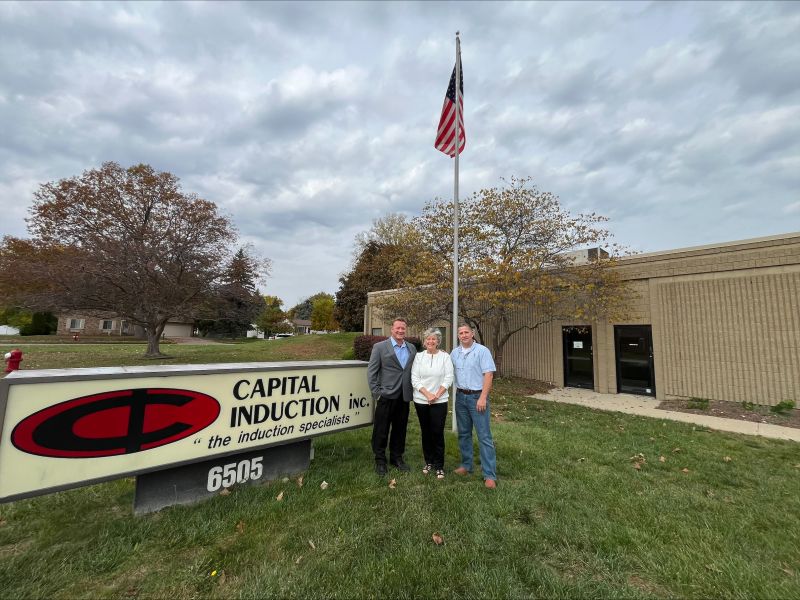
“Big news for our team: Cyprium Induction has acquired Capital Induction; This one hits close to home. In the mid‑to‑late 90s and early 2000s, I was a young engineer buying coils from Capital, visiting their shop, and learning from the people who shaped this industry. Larry Misner wasn’t just the founder he was a friend. Debbie Misner carried the company with resilience after Larry’s passing, and it’s been an honor working with her to make this next chapter possible.
Today, Capital Induction joins Cyprium under our umbrella, continuing its name and legacy while gaining the expanded engineering depth, machining capability, and equipment support Cyprium has built. Through our partnership with Megatherm Cyprium, Capital can now also offer complete induction equipment solutions, expanding what customers can access through the Capital brand by offering Scanners, Melters and Billet Heating systems.
It’s also important to highlight that James Link, my partner and co‑owner, is the founder of Cyprium Induction. His vision and leadership built the foundation that allows us to take on a legacy company like Capital and strengthen it for the future. For both of us, carrying Larry’s legacy forward is a responsibility we take seriously.
Customers will see faster lead times, stronger technical support, improved quality, and new capabilities without losing the reliability Capital has always delivered. For James and myself, this is about stewardship. We’re committed to honoring the past and building something even stronger for the industry.”